
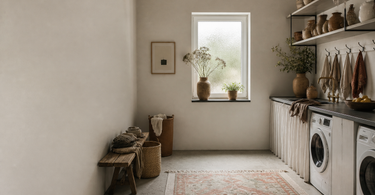
The utility room is the most overlooked room in the home — and one of the easiest to transform. Three concrete changes make the biggest difference: hooks that keep jackets, bags and clothes in order, a doormat that stops dirt at the source, and new knobs that upgrade existing cupboards in under five minutes. You don't need to tear anything down or buy new furniture. Smart placement and the right details are enough.
Most homes have a utility room that acts as a buffer between the outside world and the rest of the home. This is where the boots land, where the jacket ends up, and where bags, bike helmets and dog leads end up in a pile. The potential is there — the square metres are already set aside. It's just about using them more deliberately. Three elements solve most of the problems: the right hooks for the hallway and utility room, a good doormat and a new set of knobs for the cupboards.
Why the utility room deserves more attention
In practical terms, the utility room is the room used the most times daily — typically twice per person per trip out of the house. Yet it's the room that's usually decorated last, with whatever furniture and fittings were left over from the rest of the home.
The problem isn't a lack of space, but a lack of system. An average utility room of 4–6 m² can easily accommodate a family of four, if the hanging space, floor area and cupboard space are properly thought through. When the room works, you notice it: you don't have to search for keys, jackets hang instead of lying around, and dirt stops at the threshold instead of making its way further into the living room.
It's not about turning the utility room into a showroom. It's about giving things fixed places — and making sure those fixed places are easy to use, so the family actually uses them.
Tip: Measure your wall height before buying hooks. Adults' outerwear needs a minimum of 50–60 cm of free hanging length below the hook. Position the hook at eye level (approx. 160–170 cm from the floor), and add a row of lower hooks for children 90–110 cm from the floor — they can reach them on their own, and the jacket won't end up on the floor.
Hooks: the backbone of a well-organised utility room
No single detail has more influence on the utility room than the hooks. They determine whether the jacket ends up in a fixed spot or over a chair, whether the bag has a home or slides into a corner, and whether the room looks organised or not.
Function and form can easily share the same wall
A hook doesn't have to look plain. Hooks and knobs now come in a huge range of materials and shapes — cast brass, painted metal figures, ceramics, wood. The choice of material affects both durability and look. Brass and cast iron develop a lovely patina over time and withstand the daily strain of heavy winter coats. Ceramic is decorative, but is best suited to lighter items like bags and caps.
Doing Goods is known for hooks that work as sculptural wall decoration and practical hanging space at once — shapes inspired by botany and animals, hand-painted and produced in limited runs. This type of hook elevates a functional element into something you actually enjoy looking at, every single time you hang up your jacket.
How many hooks do you need?
A rule of thumb: at least one hook per regular user of the room, plus two–three extra for guests and seasonal items. In a utility room with two adults and two children, that typically means eight–ten hooks. It sounds like a lot, but spread across two rows (one at adult height, one at child height), it doesn't take up more than 100–120 cm of wall.
You can also mix individual hooks with a hook panel — a solution that gives extra flexibility, since you can rearrange the hanging space as your needs change.
See Doing Goods hooks for concrete examples of hooks built for everyday use that still look great.
The doormat: the first filter
A doormat isn't decoration — it's a filter. Studies from indoor climate research show that an effective entrance mat can reduce the amount of dirt carried into the home by up to 85%, provided the mat is long enough to catch dirt from both footsteps. This requires at least 60–90 cm in the direction of travel.
What makes a good utility room mat
The utility room places tougher demands on a mat than the living room. It has to withstand slush from winter boots, puddles from rainy weather and the daily traffic of a household on the move. Look for:
- Natural fibres like coconut coir or sisal— scrapes effectively and holds its shape, but doesn't tolerate constant moisture
- Synthetic fibre mats with drainage — practical in climates with lots of rainfall, easier to clean
- Rubber backing — stops the mat from wandering, and protects the floor underneath
A colourful or patterned mat hides dirt better than a light, plain one. It's not cheating — it's just practical. Rugs and mats with graphic patterns or deep colours are simply more forgiving in high-traffic zones like the utility room.
Replace the mat when it no longer springs back after hoovering, or when it stops lying flat. A worn mat doesn't filter — it just collects dirt.
Knobs: five minutes, big difference
Cupboards in the utility room are usually leftover from the build and have standard plastic or cheap chrome knobs. It's the detail that's most often overlooked — and one of the ones that stands out most when you actually replace it.
Why knobs matter
A knob sits at eye level and finger level. It's the detail you touch and see directly every time you open a cupboard. Swap a plastic knob for one in brass or with a characterful shape, and it changes the perception of the whole cupboard — not the cupboard itself, just the part you interact with.
It takes under five minutes per knob with an ordinary screwdriver. First, check the hole spacing: most standard knobs sit with a single hole in the centre, while handles have two holes spaced 96 mm or 128 mm apart. Measure before you order.
Knobs for doors and drawers come in ceramic, brass, porcelain and cast metals. Ceramic is popular in kitchen and utility room settings because it's easy to clean and keeps its colour over time. Brass knobs patinate naturally and suit both light and dark door colours.
Tip: You don't need to change all the knobs at once. Start with the cupboard you use most — typically the one nearest the door — and see if you like the result before ordering for the rest. That saves you ending up with ten knobs in a colour you didn't like anyway.
| Material | Advantage | Disadvantage | Suits |
|---|---|---|---|
| Brass | Durable, patinates nicely | Can stain when touched | Classic and rustic looks |
| Ceramic | Easy to clean, many colours | Can chip on hard impact | Colourful and playful looks |
| Cast metal | Very robust | Heavier, limited design range | Industrial or neutral look |
| Porcelain | Finer look | Brittle on impact | Nordic and minimalist look |
Storing loose items
Hooks and knobs solve hanging and cupboard doors — but most utility rooms also have a "loose layer": shoes, balls, cycling helmet straps, shopping bags, dog gear. This is where foldable boxes and baskets come into the picture.
Foldable boxes in robust materials like polypropylene or textile-lined cardboard can stand on a shelf or under a bench and bring the categories together: one for spare shoes, one for balls and toys, one for dog things. The system works not because the boxes are pretty — it works because it's clear what belongs where.
If you have space for a small shelf or bench, consider storage solutions that can stand freely. A bench provides seating comfort when you put on shoes, and can have storage under the seat.
For most utility rooms, though, less is more: three to four well-placed baskets and a well-thought-out shelving system are better than many half-filled solutions that make the room visually cluttered.
The overall look — here's how you tie it together
A well-organised utility room is one that looks well-organised, even on a bad day. It doesn't require perfection — it requires the key elements to work together.
Materials and colours
Choose two to three materials and stick to them. Brass on knobs and hooks, natural fibres on the floor and wood on the shelves work as a coherent palette that gives the room calm without making it boring. You can certainly add colour — a mat in a deeper tone or a ceramic knob in ochre — but it works best as an accent rather than the foundation.
Lighting
The utility room is typically poorly lit. A simple ceiling pendant or a wall lamp makes a noticeable difference — not just aesthetically, but practically. It's easier to find keys in a lit hallway than in semi-darkness.
Mirror
A mirror in the utility room isn't an unnecessary luxury — it lets you check whether your jacket sits right before you go out, and it visually opens up the room. A round mirror in a narrow corridor doesn't take up much space and breaks up the many right angles from cupboards and doors.
Frequently asked questions
How high should hooks be placed in a utility room?
Hooks for adults are typically placed 160–170 cm from the floor, so coats and long jackets hang freely. Hooks for children are placed 90–110 cm from the floor, depending on the child's height. If you have space, you can set up a double row: one high and one low — this doubles the capacity without using more wall width.
Which type of mat is best for a utility room?
A mat with an abrasive surface texture (coir, sisal or synthetic ribbed fibres) and a rubber backing. Minimum 60 cm in the direction of travel to catch dirt from both feet. Choose a colour or pattern that camouflages dirt — light, plain-coloured mats are unforgiving in high-traffic entrances.
Can I change knobs on all types of cupboards?
Yes, as long as the cupboard has doors of standard thickness (typically 16–19 mm). Check the existing hole size and hole spacing before you order. Most knobs use M4 or M5 screws of standard length — most manufacturers state this in the product specification.
What do I do if the utility room is very small?
Make the most of the walls: hooks at two heights, shelves above the door frame and narrow baskets rather than wide shelving units. A mirror opens the room up visually. Avoid floor furniture — it blocks the visual flow and makes cleaning tricky in a small room with lots of users.
Are ceramic knobs durable enough for a utility room?
Ceramic knobs are stable in normal use and very easy to clean. They're more brittle than metal and can crack if subjected to a direct knock — for example if a heavy door is slammed hard. On cabinets with careful, everyday use, they'll last for years. For cabinets that see very heavy use, brass or cast metal is more robust.
Does the utility room need to match the rest of the home in style?
Not necessarily — but it helps if it doesn't stand out too dramatically. A utility room that's visually related to the rest of the home (same materials, related colours) gives a more cohesive feel. That said, the utility room doesn't need the same level of detail as the living room — it is, after all, a room that has to work hard.
Summary
Organising a utility room isn't about redesigning the space from scratch — it's about giving the right elements a well-thought-out place. Hooks at two heights solve hanging storage for the whole family. A sturdy mat of the right length stops dirt before it spreads. New knobs on the cabinets take less than half an hour's work and change the room's look dramatically.
Add a single mirror to open up the room and a couple of baskets to gather loose items, and you've got a utility room that actually works — day after day, no matter who's using it. No big investments, no tradespeople needed. Just three to five concrete choices that keep things tidy going forward.
Explore our range of hooks for the hallway and utility room, knobs for doors and drawers and rugs and doormats — everything you need for a well-organised utility room.