
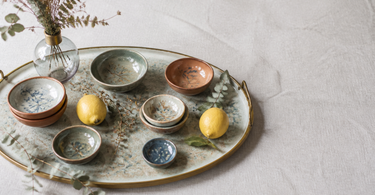
Trays and dishes are some of the most versatile things you can have in your home. A single ceramic dish gathers the chaos on the coffee table, keeps things tidy in the bathroom and elevates serving at the table. They work as a visual frame for everything from candlesticks and remote controls to olives and jewellery — and are easy to move when your needs change.
Very few home decor items appear in as many rooms and roles as trays and dishes. They're neither furniture nor decoration in the traditional sense, but they fill both functions — and switch easily from one to the other. A dish on the coffee table is an organising tool on Tuesday and part of a stylish table setting on Saturday. It's about understanding what the format allows you to do.
The coffee table: gather the clutter in one piece
The coffee table is the home's clearest "gathering point" for random objects. The remote control, a read magazine, half a pack of chewing gum and three coffee mugs — that's the standard picture. A tray or dish doesn't solve the clutter, but it defines it and gives it a frame that the eye accepts as order.
The principle is simple: everything within the edge of the tray belongs together. Visually, the brain groups the objects as one unit rather than many scattered objects. This creates calm, even though the contents vary from day to day.
What works well on the coffee table?
- A candlestick or two candles of different heights
- A small ceramic bowl for remote controls
- A vase with a single flower or dried stems
- A few books stacked flat
Stick to 3-5 items. The fewer, the more organised it looks — and the easier it is to wipe the table clean.
Tip: Choose a tray that's at least 5 cm smaller than the coffee table on all sides. If the tray covers the whole surface, you lose the visual contrast — and the table's shape disappears under the tray.
The bathroom: small dish, big overview
The bathroom is the room where things disappear most often. A small ceramic dish for soap, rings and earrings is one of the simplest solutions you can give the room. It's not just decorative — it's a concrete system for where things are.
A small ceramic dish with a low edge suits the soap bar and keeps soap water contained rather than letting it spread across the whole shelf surface. Material matters here: unglazed ceramic can absorb moisture over time, while glazed porcelain or stoneware is dense and easier to keep clean.
Practical considerations for the bathroom
- Choose glazed ceramic or dense stoneware — it's not porous and withstands daily contact with water and soap
- A diameter of 10-14 cm is enough for soap plus two or three pieces of jewellery
- Avoid dishes with a lot of ornamentation on the bottom — they're harder to wipe clean
The kitchen: the tray as a kitchen tool
In the kitchen, the tray is functional first and decorative second. When you gather salt, pepper, olive oil and possibly a salt and pepper set on one tray by the cooker, you cut down the time you spend hunting for things while cooking. It's the same logic that professional kitchens use with their "mise en place" — everything should have a fixed place.
A tray on the kitchen counter also has the advantage of being easy to move. Need the whole worktop? Just lift one thing instead of seven.
Ideas for the kitchen tray
- Spices you use daily (salt, pepper, chilli flakes)
- Oil and vinegar in decorative bottles
- A little jug for cold water by the coffee machine
- Apple cider vinegar, honey and other "table condiments"
If you've got an open-plan kitchen that opens onto the living room or dining room, the tray is also a decorative element — choose one with a colour or shape that matches the rest of the room.
Serving: from everyday meals to the party table
Dishes are the serving format that elevates the simple. Nuts in a hand are nothing. Nuts on a colourful dish on the table are part of a visual story. It sounds trivial, but it's about the food being presented as a choice — not an afterthought.
For tapas, olives, cheese and nibbles, a combination of large and small dishes works well. One large dish in the middle creates a centre, with the smaller dishes and bowls grouped around it. Feel free to use large dishes and bowls for bread or vegetables, and supplement with small dishes for dips and olives.
Serving size guide
| Dish size | Suits | Number of people |
|---|---|---|
| Ø 10–15 cm | Dips, butter, olives | 2–4 |
| Ø 20–28 cm | Tapas, cheese, cold cuts | 4–6 |
| Ø 30 cm+ | Bread, vegetables, cake | 6–10+ |
Materials: what suits what?
The choice of material isn't just about aesthetics — it determines which spaces and purposes the tray is suited to.
Ceramics and stoneware
The most common material for dishes and bowls in the home. Stoneware is fired at 1200–1300°C and is dense, impact-resistant and suitable for everyday use. Ceramics is a broader term, covering everything from porcelain to terracotta. Glazed variants are easy to keep clean; unglazed ones are more porous and require more care — particularly in damp rooms.
Ceramics from European manufacturers
Much of the ceramics you find from European manufacturers is made in Portugal, Spain or Poland — countries with long craft traditions in pottery. This means that sizes and glazes can vary slightly from piece to piece, which is a hallmark of handmade goods — not a flaw.
Terracotta
Fired red clay is porous and absorbs moisture. It works well on the terrace or as a plant pot cover indoors, but isn't ideal for soaps or fatty foods without a glaze.
Wood and bamboo
Natural trays in wood are popular in Scandinavian interiors. They're light, warm in expression and suit minimalist homes well. Avoid prolonged contact with water — and never use the dishwasher.
Tip: Mix materials deliberately. A stoneware dish next to a wooden tray adds depth and texture to the table. Use colour as the common thread, not the material.
Styling: how to use dishes and trays decoratively
An empty dish isn't wasted space — it's a pause. In interior design, dishes are often used as "base layers": a surface that defines an area on a shelf, table or chest of drawers. You don't need to fill them up for them to work.
The layering principle
Place a large dish down, and add a smaller object — a ceramic vase, a single ornament or a candlestick — on top of or beside it. This adds depth and movement to an otherwise flat surface. The eye naturally moves from the large to the small.
Colour and contrast
A colourful dish works as an accent in a neutral room. A white or raw dish provides calm in a room with lots of patterns and colours. Use the tray as the element that either tones down or activates the rest of the room.
Groupings
Three dishes of the same type but in different sizes create more calm than three dishes in three different styles. Variation in size is enough — you don't need to vary everything at once.
See the full range of dishes and bowls, if you're looking for the right size or colour for your particular use.
Frequently asked questions
What's the difference between a tray and a dish?
In everyday speech, the words are used almost synonymously, but a tray typically has higher edges and is designed for transport or storage, while a dish is flatter and mainly used for serving or decoration. In interior design, the two functions often overlap completely.
What's the best tray size for a coffee table?
A rule of thumb is that the tray should cover about 1/3 of the coffee table's surface. This gives enough room for 3-4 items without blocking the rest of the table. For a standard coffee table of 120 × 60 cm, a tray of about 40 × 30 cm works well.
Can ceramic dishes be used in the microwave?
Most glazed ceramic and stoneware dishes can withstand the microwave, but it depends on whether the glaze contains metals (e.g. gold lustre or metal rims). Always check the manufacturer's instructions. Dishes with metal details should never be put in the microwave.
How do I keep a ceramic dish clean?
Glazed dishes can usually withstand the dishwasher, but hand washing extends their lifespan and protects the glaze. Unglazed ceramics and terracotta should always be hand washed with lukewarm water — avoid soap, which can penetrate the porous material and leave a taste.
Can I use a decorative dish for food?
Yes, if the glaze is food-safe. Most dishes from European manufacturers are made for food and tested for lead and cadmium. Check the product description if you're unsure. Dishes with a heavily ornamented base are typically harder to clean, but still suitable for dry snacks like nuts and biscuits.
What should I put on a tray for decoration?
Stick to 3-5 elements with variation in height. A candlestick (tall), a small bowl (low) and a single ornament or flower creates balance. Use an odd number of elements — three or five looks more natural than two or four.
Summary
Trays and dishes solve a specific task in every room of the home: they gather, define and organise. On the coffee table, they keep remote controls and candlesticks together. In the bathroom, they give soap and jewellery a fixed spot. In the kitchen, they make cooking more manageable. And at the table, they lift the serving from practical to cosy.
The material determines where and how they're best used — glazed stoneware is the most flexible solution for everyday use in every room. Use size, colour and shape deliberately, and let the tray define the room's focal point rather than just filling a surface.
Explore our range of trays and dishes — from large serving dishes to small ceramic bowls for the bathroom.