
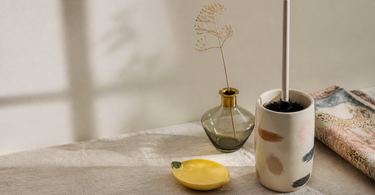
The toilet brush is the bathroom's most ignored object — but it's also one of the easiest to upgrade. Ceramic and brass stands hold up better in a damp environment than plastic and look like deliberate design choices rather than something you want to hide away. A design toilet brush doesn't cost much more than a standard model and gives the bathroom a lift that's out of proportion with the price.
Think about it for a moment: you spend time choosing the right bath mat, the perfect mirror and candlesticks for the shelves — and then there's a plastic toilet brush from the supermarket standing in the corner, ruining it all. The toilet brush is the one bathroom object most people actively try to make invisible. But it doesn't have to be that way. With the right material and a bit of design awareness, it can instead become the small, deliberate choice that finishes off the room.
Why the toilet brush actually matters
Interior design is about the whole picture. A bathroom where everything is well thought out except the toilet brush looks like a room that's half finished. It's not snobbish to think so — it's the same logic that applies to a kitchen with beautiful cabinet handles or a hallway with decorative hooks for the hallway instead of a couple of cheap plastic hooks.
The toilet brush is also one of the objects you see every single day, usually at a moment when you're not busy admiring the interior. That's exactly where overlooked details either irritate or satisfy. An object you don't like looking at draws more attention than one you don't notice at all — because you avoid looking in that direction.
Design toilet brushes in ceramic, brass or colourful materials solve that problem by turning the brush into something you're not ashamed of. They look like the objects around them — like part of the room, not like something practical waiting to be put away.
Tip: If your bathroom has white or neutral tiles, the toilet brush holder is one of the places you can allow yourself a pop of colour without committing to anything permanent. A coloured ceramic base doesn't change the tiles — but it changes the feel of the room.
Materials: ceramic, brass and what plastic gets wrong
The classic plastic toilet brush fails on two fronts: aesthetics and durability. Plastic discolours over time in a damp environment, collects limescale in the joints and looks worn out long before you notice it functionally. The bathroom is one of the home's most humid rooms, and the choice of material should reflect that.
Ceramic
Ceramic is dense, non-porous and naturally resistant to moisture. A ceramic stand doesn't discolour, doesn't absorb odours and is easy to wipe clean. The weight — typically between 400 and 800 grams for a standard base — provides stability, so the brush doesn't tip over if you knock it with your foot. Ceramic toilet brushes from European manufacturers also come in a wide palette of colours and glazes, from matte earth tones to glossy, intense colours.
Brass
Brass variants develop a patina over time, just as brass hooks and knobs do. That's not a flaw — it's the character of the material. Raw or brushed brass is well suited to the bathroom because it's corrosion-resistant in normal humidity levels, and the natural oxidation gives a warm, lived-in look that polished chrome or plastic can't imitate.
Other materials
Some manufacturers work with concrete-look, stoneware and composite materials that combine a heavy, stable base with a metal or wooden brush fitting. What the best solutions have in common is that they're designed with the damp environment in mind — which plastic fundamentally isn't.
| Material | Durability in moisture | Maintenance | Look |
|---|---|---|---|
| Plastic | Low — discolours and collects limescale | Easy, but short-lived | Functional, not decorative |
| Ceramic | High — non-porous and stable | Wipe clean with a cloth | Decorative, wide colour range |
| Brass | High — corrosion-resistant | Develops a natural patina | Warm, characterful |
| Stoneware/concrete look | High — dense and stable | Minimal | Raw, minimalist |
Design and colours — the toilet brush's overlooked potential
White bathrooms dominate Danish home decor. They're easy to keep clean, timeless and work as a neutral backdrop — but they can also feel clinical and unfinished if there isn't a single colour or shape element to break up the monotony.
The toilet brush is a low-risk project in that context. You're investing in an object that takes up relatively little visual space but is present every day. A ceramic base in a warm terracotta shade or a glossy cobalt blue costs no more than a mid-range plastic version — but signals something completely different about the room's intentions.
If you already have colourful plant pot covers or vases in your home, the toilet brush is an obvious place to carry that palette into the bathroom. It doesn't need to match exactly — it's more about working within the same colour family or expression.
For bathrooms with a more muted look — white, grey, black — a design toilet brush with an interesting shape works better than colour alone. Sculptural stands, organic forms or a base with a relief pattern add visual interest without competing with the rest of the room.
Practical guide: what to look for
When choosing a design toilet brush, there are a few practical parameters worth considering beyond the aesthetics:
- Base stability: A base that's too light tips over easily. Ceramic and stoneware bases weighing 400 grams or more are generally stable enough for daily use.
- Brush density: Dense, stiff bristles clean better than loose ones. The material of the brush itself — nylon or plant-based fibres — has limited impact on the result, but plant fibres wear out faster.
- Cleaning the holder: Open stands are easier to keep clean than closed ones. Ceramic and brass stands can be wiped down with a damp cloth and ordinary cleaning products.
- Space requirements: Most standard toilet brush stands have a diameter of 10-14 cm. Measure the base area before ordering, especially if your bathroom is small.
Tip: Replace the brush part every 6-12 months, but keep the holder. That's what you're investing in — the brush itself is a consumable.
If you want to create a more cohesive bathroom, it's worth thinking of the toilet brush as part of a wider curation. The bath mat and the toilet brush base are the two floor elements in the bathroom — if they work in the same direction colour-wise, the room is perceived as more thought-through, even if the rest is standard.
A surprisingly good gift idea
A design toilet brush is the kind of gift the recipient doesn't buy themselves — but really appreciates receiving. It falls into the category of "practical luxury": something used daily, but that most people don't prioritise spending money on for themselves.
As a housewarming gift it works particularly well, because newly moved-in people typically focus on the big purchases and forget the details. A ceramic toilet brush in a colour that suits the recipient's style shows a level of attention that stands out from the third light blue vase or the fifth set of tea towels.
Feel free to combine it with other bathroom objects — a candle or a small compact mirror — and you have a curated gift that costs under 500 DKK in total and still feels thoughtful.
Frequently asked questions
Are design toilet brushes just as functional as ordinary ones?
Yes. The brush part itself is standard on the vast majority of design toilet brushes and can be replaced independently of the holder. It's the base and holder that differ design-wise — the brush's cleaning ability depends mainly on fibre density and stiffness, not on whether the holder is ceramic or plastic.
How often should a toilet brush be replaced?
The brush part itself should be replaced every 6-12 months, depending on use and fibre quality. A holder in ceramic or brass can last for many years if cleaned regularly. So you pay for the holder once and for the brush on an ongoing basis — like a razor.
Does ceramic work well in a humid bathroom?
Yes. Glazed ceramic and stoneware are dense, non-porous materials that don't absorb moisture. They're naturally resistant to limescale and discolouration and can be cleaned with a damp cloth. Ceramic is actually one of the best-suited materials for humid rooms, and is used for tiles and sanitary ware for exactly that reason.
What does a design toilet brush typically cost?
A toilet brush in ceramic or brass from European manufacturers typically costs between 200 and 500 DKK. That's comparable to a mid-priced plastic variant from a specialised bathroom brand — but it lasts better and looks like a deliberate design choice rather than a necessity.
Can a toilet brush give a small bathroom a lift?
Absolutely. In a small bathroom, all surfaces are visible, and there's nowhere to hide. That means even small details — the toilet brush, the soap dispenser, the towel rail — carry disproportionately large visual weight. An object in ceramic rather than plastic can lift the whole look markedly, precisely because there's less competition for attention.
Should the toilet brush match the rest of the bathroom exactly?
Not exactly — but it should work within the same colour family or material logic. If you have warm, earthy tones in the bathroom, a ceramic base in terracotta or ochre will fit naturally in. Contrasts can also work well: a black or dark blue base in an all-white bathroom adds edge without being too loud.
Summary
The toilet brush is one of the places in the home where the difference between a deliberate and a random decision is clearest — and the cost of upgrading is lowest. A stand in ceramic or brass holds up better in the humid bathroom than plastic, requires minimal maintenance and looks like it belongs in the room. It's not a big investment, either in time or money, but it's the kind of detail that together helps make the difference between a bathroom that's functional and one that's thought-through.
Start by looking at what you already have in the bathroom: colours, materials, expression. Find a toilet brush that speaks the same language — and swap it out next time it needs replacing anyway.
Explore our range of design toilet brushes in ceramic and brass.
