
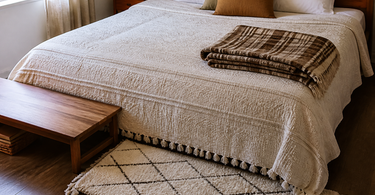
A bedspread covers the whole bed and is primarily decorative. A throw is a smaller, soft textile for the sofa or armchair – typically 130×170 cm. A rug (floor rug) lies on the floor and defines zones in the room. The three types overlap in materials but differ markedly in size, construction and primary function. Read on for precise measurements, material choices and specific use cases.
The difference between a bedspread, a throw and a rug seems obvious – until you actually have to choose. In practice, the three types are regularly confused, and retailers don't always use the terms consistently. This article gives you precise definitions, standard measurements, typical materials and specific situations where one type suits better than the others. So next time you're decorating your bedroom, living room or lounging areas, you'll know exactly what you're looking for.
Definitions: what's what?
The terms are used interchangeably in everyday language, but from a professional standpoint there are clear distinctions:
Bedspread
A bedspread is a textile placed on top of the duvets and pillows as a finishing touch to the bed. Primary function: aesthetics and protecting the bedding from dust and daylight. Secondary function: light extra warmth at night for those who sleep cold. It's designed to cover an entire bed mattress including the sides – and often the front pillows too.
Throw
A throw is a relatively small, soft and lightweight textile primarily intended for the sofa, armchair or the foot of the bed. The word comes from the Scottish "plaide" and traditionally denotes a folded blanket worn over the shoulder – today it's been reduced to a compact cosy textile. Key feature: easy to fold, move and use spontaneously.
Rug (floor rug)
A floor rug is a textile placed on the floor to define zones, dampen sound, insulate against cold flooring and add visual texture. It differs from the other two by needing to withstand mechanical wear from foot traffic and furniture.
The bedspread – function and sizes
A bedspread should cover the bed surfaces and hang neatly down the sides. Standard measurements follow the bed dimensions:
- 90 cm bed: bedspread typically 160–180 × 240–260 cm
- 140 cm bed: bedspread typically 200–220 × 240–260 cm
- 180 cm bed: bedspread typically 240–260 × 260–280 cm
The drop on the sides depends on taste and bed type. A bed height of 50 cm requires a significantly larger bedspread than a platform bed of 20 cm. Always measure your bed (width + 2 × desired drop + any pillow coverage) before buying.
Construction and filling
Bedspreads come in two basic types: quilted (quilted with a thin padding inside) and woven/knitted (without filling). Quilted models hold their shape better, while woven ones are easier to wash and dry. Many bedspreads are reversible – two colours in one product.
Take a look at our range of throws in different sizes and materials to compare exact measurements and constructions.
Tip: If you want to cover the pillows with the throw during the day, add an extra 40–50 cm to the length. Most people forget this and end up with a throw that only reaches the pillows – not over them.
The throw – the sofa corner's best friend
A plaid is designed for flexible use. It can lie folded over the arm of the sofa as decoration, be rolled out over your legs while watching TV, or be used as an extra layer in bed. The small size is intentional: it's not meant to cover a whole bed or floor.
Standard measurements for plaids
- Baby/children's plaid: approx. 75 × 100 cm
- Standard throw: 130 × 170 cm (most common)
- Oversized throw: 150 × 200 cm
130 × 170 cm is the classic size, as it fits one adult on the sofa and is easy to fold into a compact package. An oversized plaid of 150 × 200 cm can be used by two people or folded double for extra warmth.
Plaids for wall decoration
Plaids are increasingly used as wall decoration – hung on a rod or draped over a headboard. Here, the textures and patterns matter more than the warmth function. Leopard plaids are especially popular in this context, as the graphic pattern works as a standalone visual element in the room.
Browse our full range of plaids in all sizes and patterns – including knitted, fleece and wool-look.
The rug – the foundation of the floor
A rug serves a fundamentally different purpose than throws and plaids. It needs to withstand pressure from furniture legs, daily foot traffic and hoovering. The construction reflects this: most rugs are more densely woven, thicker and more durable.
Functions a rug fulfils
- Zoning: a rug under the sofa set defines the seating area in an open-plan layout
- Acoustics: textile on the floor significantly reduces reverberation
- Insulation: a cold wooden floor or tiles feel warmer with a rug
- Aesthetics: the rug visually anchors the room and ties colours and furniture together
Standard sizes for rugs
- Small (hallway/bathroom): 50 × 80 cm or 60 × 90 cm
- Medium (sofa area, smaller rooms): 140 × 200 cm or 160 × 230 cm
- Large (living room, bedroom): 200 × 300 cm or 240 × 340 cm
Rule of thumb for the living room: at least the sofa's two front legs should stand on the rug – otherwise the rug and sofa visually drift apart.
Explore our rugs in all standard sizes and find the right proportion for your room.
Materials and care
The three types of textiles share many of the same raw materials, but the priorities differ.
Bedspreads – materials
Cotton and cotton/polyester blends dominate, as they're easy to wash and don't generate too much heat. Knitted cotton and chenille are popular in Scandinavian interiors. Avoid heavy wool bedspreads if you wash at home – they require professional cleaning.
Throws – materials
Here, softness is key. The most common materials:
- Fleece/microfibre: extremely soft, low price, not breathable
- Knitted acrylic (wool look): warm, visual weight, machine-washable
- Cotton: breathable, cooler – suitable for summer
- Wool: natural temperature regulation, long-lasting, pricier
- Teddy/sherpa: thick and fur-like surface, popular for cosy looks
Rugs – materials
Here, durability and cleaning are crucial. Wool is durable and naturally dirt-repellent. Polypropylene (PP) withstands moisture and is used in hallways and kitchens. Jute and cotton are popular for a natural look but wear out faster. Viscose gives a silky sheen but is vulnerable to moisture.
Tip: Always check the wash label on throws and bedspreads before you buy. A throw in pure wool requires hand washing or a gentle 30°C wash – and flat drying. If you choose a low-maintenance alternative in acrylic, it can handle 40°C and the tumble dryer.
Comparison across the board
| Property | Bedspread | Throw | Bedspread |
|---|---|---|---|
| Primary placement | On top of the bed | Sofa, armchair, foot of the bed | The floor |
| Typical size | 200–260 × 240–280 cm | 130 × 170 cm | 140 × 200 – 240 × 340 cm |
| Primary function | Decoration + protection | Warmth + cosiness + decoration | Zoning + acoustics + insulation |
| Typical construction | Woven or quilted | Knitted, fleece, woven | Tufted, hand-woven, flat-woven |
| Durability requirement | Low | Low–medium | High |
| Washable at home (typically) | Yes (30–60°C depending on material) | Yes (30–40°C) | No (professional) or gentle wash |
| Price range (entry-level) | From approx. DKK 300 | From approx. DKK 150 | From approx. DKK 200 (small size) |
How to choose the right one
When you need to decide which type you need, you can ask yourself three questions:
1. Where will it be used?
If the answer is "in the bed" → a bedspread. If the answer is "on the sofa" or "can be moved around" → a throw. If the answer is "on the floor" → a rug. Sounds simple, but many people buy a throw for the bed and then wonder why it doesn't cover the whole surface.
2. Should it mainly insulate or decorate?
Throws in teddy or thick knit insulate well. Bedspreads in thin cotton are mainly decorative. Rugs in wool insulate against a cold floor surface and dampen sound – a functional investment, not just an aesthetic one.
3. How easy is it to maintain?
A throw is used frequently and should withstand regular washing. A bedspread is changed less often. A rug needs vacuuming weekly and treating for stains as they occur. Choose the material based on how much care you'll realistically give it.
Need some inspiration for what works at the foot of the bed? Bedspreads in soft materials can work as a middle ground – they cover the bed but are soft enough to pull up over your legs at night. And if you want to create a complete sofa corner with textiles, you can combine a throw in a matching colour with a rug under the coffee table.
Frequently asked questions
Can you use a throw as a bedspread?
Technically, yes, but a standard throw measuring 130 × 170 cm only covers about half of a 140 cm bed. It works as an extra layer at the foot of the bed or as a blanket over your legs in bed, but it's too small to cover the whole bed surface. An oversized throw (150 × 200 cm) can work on a 90 cm bed without side overhang.
What's the difference between a throw and a rug?
The word "tæppe" is used in everyday Danish for both types, which creates confusion. The key distinction is placement and construction: a rug is woven or tufted to withstand foot traffic and furniture load. A throw is soft, light and meant for the body – not the floor. Rugs have no place on a sofa functionally, and throws wear down quickly if used on the floor.
What size rug fits a standard sofa?
A typical 3-seater sofa is 200–240 cm wide. A rug measuring 200 × 300 cm is a good starting point: it extends under the full surface of the coffee table and under the sofa's front legs. In open-plan rooms, 240 × 340 cm may be needed to clearly define the zone. Measure your furniture's dimensions before deciding.
Are leopard throws for the sofa or the bed?
Leopard throws are mainly used on sofas and armchairs as a decorative and functional element. Many people also hang them as wall decoration or drape them over a headboard. The standard measurements that apply to throws in general (130 × 170 cm) also apply to leopard variants – they're not larger just because of the pattern.
Which materials are best for a bedspread if you sleep hot?
Choose a thin, woven bedspread in 100% cotton or bamboo. Both materials are breathable and temperature-regulating. Avoid polyester and synthetic fillings, which retain heat. A light cotton bedspread of 300–400 g/m² is enough to give a decorative effect without adding noticeable warmth in summer.
Should a rug have an anti-slip underlay?
Yes – on smooth floors like laminate, wood and tiles, an anti-slip underlay is pretty much essential for safety reasons. A rug without an underlay can slip when you step on the edge. An anti-slip underlay also extends the rug's lifespan by reducing friction against the floor surface. Buy the underlay in the same size as the rug, or slightly larger.
Summary
The three types of textiles – bedspread, throw and rug – are each designed for a specific context, and the differences go beyond just size. A bedspread is for the bed's surface and is measured precisely according to bed type and desired drop. A throw is flexible, compact and meant for the body – on a sofa, chair or as an extra layer in bed. A rug defines a space, dampens sound and needs to withstand daily use. If you choose based on these three parameters – placement, function and maintenance – you'll end up with the right product from the start and avoid costly mistakes.
Explore our range of bedspreads, throws and rugs – or find a graphic statement with our leopard throws.