
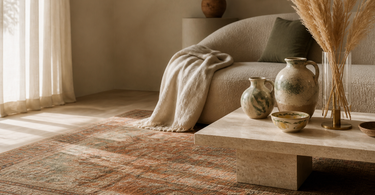
A rug ties a room together — it defines zones, dampens sound and gives the floor character. Choose the size based on where your furniture sits: sofa front legs on the rug in the living room, 60 cm out from the table edge under the dining table. The material determines durability and maintenance: wool is hard-wearing, cotton is easy to wash, jute is raw and rustic. Decorative animal rugs and wall hangings work both on the floor and the wall.
A rug is the first element that ties a room together — and the last thing many people remember to choose. It's a classic case of mispriorityisation, because the right rug genuinely changes a room's proportions, acoustics and mood. It dampens sound, defines zones in open-plan layouts, insulates against cold floors and gives your interior the character that furniture and wall colour alone rarely manage. This guide covers everything from types and sizes to materials, care and using rugs as wall decoration.
Types of rugs and textiles
The world of rugs is broader than most people expect. The category covers everything from classic floor rugs to decorative animal rugs and textile wall art. Here are the key types:
Floor rugs
The classic floor rug defines an area in the room. It's available from small doormat size to 200×300 cm and larger. Materials range from soft cotton to hard-wearing jute and heat-insulating wool. The choice of material matters a great deal for where the rug suits best — more on that in the materials section.
Wall rugs
Wall rugs have undergone a marked rehabilitation. Modern versions work like textile paintings: they dampen room echo, insulate the wall and add depth in a way that posters and mirrors simply can't. Graphic patterns in bold colours are especially in demand.
Animal rugs
Animal rugs are shaped like actual animals — tigers, leopards, bears, zebras — and are designed as decorative pieces with humour and personality. Most are hand-tufted or hand-sewn in cotton or wool with a level of detail that clearly sets them apart from mass-produced items.
Throws
A good-quality throw is technically a textile rather than a rug, but it belongs in the same category. Draped over the sofa, laid at the foot of the bed or rolled up in a basket in the reading nook — it's a functional piece of decor that gives a room a relaxed, lived-in feel. Merino wool, mohair and cotton are the most common materials.
Doormats
The most overlooked textile in the home. Coconut fibre mats are robust for outdoor use, while soft cotton mats work better indoors, where they can withstand more frequent washing. A well-chosen doormat sets the tone before guests have even stepped through the door.
Tip: Consider the rug's function before deciding on the material. High traffic and children call for cotton that can be machine-washed. A bedroom, where comfort is the priority, is better suited to wool or a blended fibre with a high pile.
How to choose the right size
One of the most common mistakes when buying a rug is choosing one that's too small. An undersized rug fragments a room and can, paradoxically, make it seem smaller. Here are the basic rules of thumb:
| Room / situation | Recommended approach | Typical size |
|---|---|---|
| Living room with sofa | The sofa's front legs should stand on the rug | 160×230 cm or 200×300 cm |
| Under the dining table | Minimum 60 cm out from the table edge on all sides | Depends on table size |
| Bedroom | Under the lower 2/3 of the bed — or two rugs, one on each side | 160×230 cm typically |
| Hallway / entrance | A runner to match the width of the hallway | 70–80 cm wide |
| Animal rugs | Decorative element — doesn't follow standard rules | Choose based on look |
The dining table rule deserves special attention: the rug needs to stick out far enough that the chairs are still on the rug when pulled out. Allow a minimum of 60 cm extra beyond the tabletop on all four sides. If you're struggling to picture it, it can help to lay newspaper or masking tape on the floor to visualise the size before you order.
A animal head rug in front of a fireplace or at the foot of a bed follows different rules — here, look and placement matter more than proportions relative to furniture.
Animal rugs: shape, function and humour
Animal rugs as a category have grown markedly in popularity within Scandinavian interior design over the past ten years. The Dutch brand Doing Goods is one of the main reasons for this. Their tiger rugs — particularly the Bombay series in orange and black — have become a reference point in the category, but the range extends far beyond that: leopards, bears, zebras, alligators, owls and dog rugs are all part of the collection.
All Doing Goods rugs are handmade in India. The material is cotton, and the back has a gum-like coating that keeps the rug in place on smooth floors — a practical detail that's often overlooked when comparing products in this category.
Doing Goods' animal rugs can be used on the floor as a decorative focal point or hung up as wall decoration. The back has a hanging loop for this purpose, so they're designed for dual use. Colourful variants in pink, turquoise and blue give you the option to match or contrast with the room's other colours.
The leopard rugs are almost as sought-after as the tiger versions and come in both natural earthy tones and bolder shades like pink and sage. Choosing a pink leopard over a natural-coloured one is a clear style choice — and that's exactly the point of this category.
Rugs as wall decoration
Hanging a rug on the wall isn't a new idea, but interest in it is steadily growing. The effect is different from a painting or a poster: the textile adds physical depth and dampens room echo, as the fibres absorb sound waves — particularly in the 500–4,000 Hz frequency range, which is where speech and music are mainly found.
Bongusta wall rugs are designed specifically with this purpose in mind. Graphic, geometric patterns in bold colours make them striking visual elements without feeling disruptive to the overall room. They come in sizes similar to large posters and can be used as an alternative focal point on the wall above the sofa or bed.
Tip: Use a rug pole or a length of dowel with clips to hang a rug. This distributes the weight evenly and avoids holes in the weave. For lighter rugs and animal rugs with a hanging loop, decorative nails or hooksfine without damaging the rug.
Doing Goods' animal rugs also work brilliantly on the wall. A life-size tiger head or leopard on a light-coloured wall creates the same playful and unexpected element as sculptural wall décor — just with a softer, more textured look.
Materials: wool, cotton and jute
The material's properties determine whether the rug is the right choice for the right room. Here are the three most common:
Wool
Wool is the most durable natural fibre for rugs. It's naturally dirt-repellent — wool fibres have a surface that repels water-based stains — soft underfoot and able to regulate moisture. A quality wool rug can last 20–30 years with proper care. New wool may shed a bit in the first few months, but that's normal and decreases with use and vacuuming. The downside is price and the fact that wool rugs generally need to be dry-cleaned or professionally washed.
Cotton
Cotton is the most flexible choice in the category. It's soft, affordable and — most importantly — machine washable at 30 degrees. Most handmade animal rugs are made from cotton, making them suitable for high-activity rooms and families with children. Cotton rugs flatten more over time than wool and are generally less hard-wearing in the long run.
Jute
Jute is a plant-based natural material with a distinctive raw, rough texture. Jute rugs are well suited to hallways, walkways and under the dining table, as they're durable and very easy to vacuum. On the other hand, they're not comfortable underfoot and aren't recommended for the bedroom. The colour range is naturally limited to beige and brown shades, making them easy to combine with Scandinavian and boho-inspired interiors.
| Material | Pros | Cons | Best for |
|---|---|---|---|
| Wool | Durable, dirt-repellent, soft | Expensive, requires professional washing | Living room, bedroom |
| Cotton | Washable, soft, affordable | Flattens, shorter lifespan | Children's room, everyday rooms |
| Jute | Sturdy, natural, easy maintenance | Rough, limited colour choice | Hallway, under the dining table |
Maintenance and care
Decorative rugs need a slightly different approach than the standard "vacuum once a week". Here are the key principles:
- Vacuum regularly on low suction power. High suction power can loosen fibres and wear down the tufting, especially on handmade rugs. Alternatively, you can take the rug outside and shake it.
- Treat stains immediately. Use a damp cloth and mild soap. Dab — never rub — and let the rug air-dry flat. Rubbing spreads the stain and can damage the fibres.
- Avoid prolonged direct sunlight. UV rays break down dyes over time. If the rug hangs on a sunny wall, you can rotate it periodically to ensure even exposure.
- Check the washing instructions individually.Many cotton rugs can withstand machine washing at 30 degrees, but this isn't universal. Wool rugs should be dry-cleaned or washed on a wool programme with minimal spinning.
- Use a rug underlay. An anti-slip underlay doesn't just protect against accidents — it also reduces mechanical wear, since the rug doesn't shift against the floor with every step.
Frequently asked questions
What size rug suits a standard living room?
It depends on the furniture layout, but as a rule of thumb, the sofa's front legs should stand on the rug. For a typical three-seater sofa, that means a rug of at least 160×230 cm. In large living rooms with a sofa group, 200×300 cm is recommended so all front legs are on the rug.
Can an animal rug be used as a wall hanging?
Yes. Many handmade animal rugs — particularly from Doing Goods — have a hanging loop on the back and are designed for dual use. On the wall, they work as sculptural wall décor, adding texture and humour in a way that prints and paintings can't.
What's the difference between a hand-tufted and a hand-stitched rug?
Hand-tufting is a process where a gun shoots yarn loops into a backing material, which is then glued. Hand-stitched rugs are knotted or sewn by hand and are generally more durable. Both methods produce quality results, but hand-stitched rugs typically have a denser, more even pile.
How do I stop the rug from slipping on smooth floors?
Use a rubber or latex anti-slip underlay beneath the rug. It keeps the rug in place, protects the floor surface from scratches, and reduces mechanical wear. Doing Goods' animal rugs have a built-in rubbery backing that solves the problem without any extra purchase.
Can jute rugs be washed in the machine?
No — jute cannot be machine washed. Water weakens the jute fibres and can cause the rug to shrink or lose its shape. Spot cleaning with a damp cloth is the recommended method, and the rug should air-dry completely before being used again.
What's a good rug size for under a dining table?
The rug should extend at least 60 cm beyond the table edge on all sides — ideally 70–75 cm — so the chairs remain on the rug when pulled out. Measure the table and add 120–150 cm to both dimensions for a reliable minimum calculation of the rug's size.
Summary
A rug isn't an afterthought — it's one of the first choices to make in an interior design process. Size determines the room's proportions, the material determines durability and care, and the type — whether it's a classic floor rug, a decorative animal rug or a textile wall hanging — says something about the function you want the room to serve. Wool lasts longest and best, cotton is easiest to maintain, and jute is the sturdy choice for high-traffic zones. Throws and animal rugs are both categories that give your home personality without requiring a complete renovation — and a colourful rug is often the quickest way to change the mood of a room.
Explore our range of rugs and textiles — from handmade animal rugs to graphic wall hangings and colourful floor rugs.