
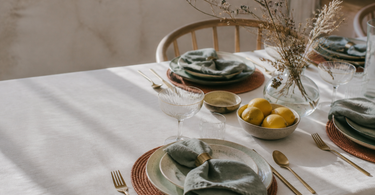
A good table setting starts with the plate and is built up layer by layer: ceramics as the base, candlesticks in varying heights as the centrepiece, glasses in suitable sizes and small details like salt and pepper sets that tie it all together. Stick to two or three colours, and choose materials with substance — stoneware, mouth-blown glass and beeswax candles give the table a calm and character that's hard to achieve with plastic and tealights.
A table setting isn't reserved for dinner parties and holidays. It's one of the quickest ways to change the mood of a meal — from routine to ritual. The principles are simple: start with a solid foundation of ceramics, add candles, and finish with the details that give the table personality. Below, we go through each layer, from the first plate to the last candle, with concrete advice on placement, material choices and colours.
Plates and ceramics: the foundation of the table
Everything starts with the plate. It's the first thing the guest sees, and the element that sets the tone for the rest of the table. Handmade stoneware ceramics are an obvious choice: the material has a natural weight and a surface that absorbs light differently to industrial porcelain. The glazes vary from piece to piece, and it's precisely that variation that gives the table character without you having to do anything extra.
The strategy for mixing is simple: choose a base colour — white, sand or light grey — and build up with accent colours in the smaller elements. Ceramics from European producers in lemon shades and soft pastel tones work well as an accent against a neutral base. See our selection of plates to find the right combination for your table.
How to mix plates correctly
You can happily mix plates from different series, as long as they share a common thread. This could be the colour scale (all shades of the same colour theme), the material (stoneware against stoneware) or the character of the pattern (organic shapes against organic shapes). Handmade ceramics are especially forgiving to mix, because the natural variations in the glaze automatically tie the pieces together visually.
Want to work with platters and bowls as part of the table setting, a couple of flat serving platters in the middle of the table can work as both a practical solution and decoration.
Tip: Allow for around 60 cm per place setting at a rectangular table — that gives room for plate, cutlery and glass without elbows bumping into each other. At a round table, you can go down to 50 cm, because the centre of the table frees up more space.
Candlesticks and centrepiece
Candlelight transforms a table more than any other single element. Faces soften, colours are drawn towards the warm spectrum, and the pace at the table naturally slows down. This isn't nostalgia — it's physics: candles emit light in wavelengths from 600–700 nm, i.e. the orange-red range, which the human eye perceives as warm and calm.
Choose candlesticks in varying heights. Three candlesticks measuring 8, 15 and 22 cm respectively create movement along the centre of the table without blocking eye contact across the table. Ceramic candlesticks with sculptural shapes — birds, hand-formed bodies, asymmetrical bases — add a decorative layer beyond the flame itself. See ceramic candlesticks and glass candlesticks for inspiration.
What else should go in the middle of the table?
Combine the candlesticks with low greenery — eucalyptus branches, olive twigs or rosemary. Place it in small bowls or platters spread along the axis of the table, so it doesn't form one big clump in the middle of the table. Dried flowers, fruit in bowls and pine cones in winter work just as well as fresh flowers and also last throughout the whole dinner.
Glasses and jugs
A table without glasses looks unfinished, and glasses are actually one of the elements that quickest lift the whole look. Mouth-blown glass in unique designs — from producers like Anna Von Lipa — has a lightness and transparency that contrasts nicely against heavy ceramics. See our glass selection, covering everything from water glasses to speciality glasses.
Size and type
For an everyday dinner, one glass per place setting is fine. For a celebration, you set two glasses: a water glass (typically 30–40 cl) and a wine glass (45–60 cl for red wine, 35–45 cl for white wine). Place the water glass directly above the knife and the wine glass diagonally to the right of it.
A jug with water or squash is both practical and decorative. Stoneware jugs match the plates and give the table a cohesive look; glass carafes provide transparency and lightness. Coloured glass in smoked or amber tones is a solid design choice: they add depth to the table and look gorgeous, even when empty. Explore jugs in various materials and sizes.
Details that complete the table
A salt and pepper set sits on the table at almost every single meal. It's therefore one of the few kitchen objects that deserves genuine attention. Choose a set in ceramic or porcelain with a shape you actually enjoy looking at — sculptural animal figures, minimalist cylinders or patterned surfaces. Quail salt and pepper set in animal shapes is a great example of how functional tableware doesn't have to look boring.
Other details that round off the table:
- Butter dish: Keeps the butter fresh and looks like more than a piece of foil.
- Egg cups: For brunch and Sunday mornings — ceramic egg cups are a small detail choice with a big visual effect.
- Small bowls for olives, dips or sauces: Used both for serving and as decorative elements in the centre of the table.
- Cloth napkins: A cloth napkin signals that you've thought about the details. Fold it simply — a rectangular fold is more elegant than origami variants.
The correct order for table setting
Classic table setting follows a logic that's easy to learn: a charger plate or placemat is placed first, then the dinner plate, and possibly a soup bowl on top. The knife goes to the right with the cutting edge facing the plate; the fork to the left. The glass is placed diagonally above the knife. The bread plate, if you use one, goes to the left above the fork. At formal dinners, cutlery is placed from the outside in, in the order it's used — the starter cutlery on the outside, the main course cutlery closest to the plate.
Everyday vs. festive
For everyday use, a nice plate, decent cutlery and one candle is enough to turn a Tuesday dinner into something a little more than routine. You don't need a tablecloth, placemats or a full centrepiece — a clean table with thoughtfully chosen materials works just fine.
For a celebration, you can build layer by layer:
| Element | Everyday | Celebration |
|---|---|---|
| Plate | Dinner plate | Side plate + dinner + starter |
| Glass | 1 glass | Water glass + wine glass |
| Cutlery | Fork + knife | Full set incl. dessert cutlery |
| Centrepiece | 1-2 candlesticks | Varying candlesticks + greenery |
| Napkin | Paper napkin | Fabric napkin |
| Extra | — | Placemats, bread plate, butter dish cover |
An informal hospitality tip: cups can easily be used as flower vases for casual dinners. Place three cups of different sizes with short-stemmed flowers down the centre of the table — it's charming and requires zero flower-arranging experience.
Colours and themes
A consistent colour theme is what sets a randomly put-together table apart from one that looks well thought out. The principle is simple: choose two to three colours and stick to them across all elements — plates, napkins, candles and flowers. You don't need to match exactly; you just need to avoid introducing colours that aren't present elsewhere on the table.
Four combinations that work:
- Natural: Sand, white, green — stoneware in neutral tones, eucalyptus, beeswax candles
- Festive: Gold, deep red, green — brass candlesticks, red candles, fir branches
- Summery: Lemon yellow, white, turquoise — ceramics with citrus motifs, fresh flowers, clear glass
- Minimalist: Black, white, grey — clean lines, glass candlesticks, no patterns
If you're unsure which direction to go, start with the ceramics. It's the element you have most of on the table, and it's easier to find candles and napkins that match your ceramics than the other way around.
Frequently asked questions
How much space should there be between place settings?
Allow for approx. 60 cm per place setting at a rectangular table. That gives enough room for plate, cutlery and glass without guests sitting too close together. At a round table, you can go down to 50 cm, as there's more free space in the middle of the table.
Can you mix different plates?
Yes — it can look completely right, as long as there's a common thread. Mix, for example, different patterns in the same colour range, or mix plain ceramics in related shades. Handmade stoneware ceramics are particularly well suited to mixing, because the natural variations in the glaze automatically tie the pieces together visually.
What can you use instead of flowers as a centrepiece?
Green branches (eucalyptus, olive, rosemary), dried flowers, fruit in bowls, or a collection of candlesticks in different heights. In winter, fir branches, pine cones and candles are a classic solution that also smells lovely. Dried flowers have the practical advantage of lasting the whole dinner — and the week after.
Where is the glass placed when setting a table?
The water glass is placed directly above the knife, and the wine glass is placed diagonally to the right of the water glass. For formal occasions with champagne, a third glass is added to the left of the others. The rule is: glasses are placed to the right of the plate, above the cutlery.
Is stoneware or porcelain best for table setting?
It depends on what you prioritise. Stoneware is heavier, more robust and gives an organic, warm feel — good for relaxed and informal table settings. Porcelain is thinner, lighter and more translucent with a formal touch. Most modern table stylists mix the two without any problems.
How do you choose the right colour theme for a table setting?
Start with the ceramics — it's the element you have the most of. Then find napkins and candles that draw on one of the colours in the ceramics. Choose a maximum of three colours, and let one of them be neutral (white, sand or black) to give the eye a rest. Use the other two as accent colours in candles, flowers and napkins.
Summary
A well-thought-out table setting is built up in layers: plates and ceramics as the foundation, candlesticks and greenery as the centrepiece, glasses and jugs as functional details, and small elements like salt and pepper sets that complete the whole. Stick to two to three colours, choose materials with substance — stoneware, mouth-blown glass, beeswax candles — and adjust the level of detail to the occasion. For everyday use, three well-chosen elements are enough. For celebrations, you can build layer upon layer without it needing to become stiff or formal. It's about creating a setting where the food and company can shine.
Explore our selection of plates, candlesticks and glasses — everything you need for a table setting with character.