
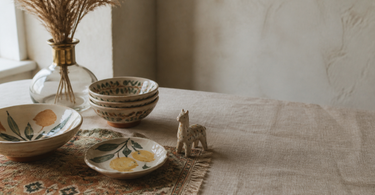
Sustainable interior design isn't about chasing certifications or buying "green" products — it's about buying right the first time. A handmade ceramic bowl made from clay and sand lasts for decades. A cheap plastic item from a discount shop might last a year. The cost per use is markedly lower for quality items, and so is the amount of waste. Choose materials with a long lifespan, production with decent working conditions, and an aesthetic you won't tire of.
The word "sustainable" is used today about almost everything — from shampoo to sofas. This makes it hard to navigate. The most direct route to a more sustainable home is neither an eco-label nor a green colour palette. It's asking one simple question before you buy anything: Will this still be here in ten years? If your answer is no, it's probably not a sustainable purchase — no matter what the packaging tells you.
Lifespan is the most important sustainability factor
Within life cycle assessment — the method used to calculate a product's total environmental impact from raw material to disposal — usage lifespan is one of the most decisive factors. A product might have a relatively high CO₂ footprint at the production stage, but if it's used intensively for 30 years, that footprint is spread across many thousands of "usage events". A cheap item with a low production footprint that's discarded after 18 months rarely fares better.
The maths behind the quality purchase
Take a concrete example: A ceramic cup made by a European craft producer might cost four times as much as an industrially manufactured counterpart. If the handmade cup lasts 20 years compared to two years for the cheap one, you've used fewer resources and generated far less waste over the same timeframe — and likely spent less money in total. This isn't luxury consumption. It's rational resource management.
Tip: Before you buy a new item for your home, check the base material and the joins. Ceramics without cracks in the glaze, glass without bubbles along the edge, and rugs with correctly knotted foundations are signs of quality that lasts. Always ask the retailer about origin and production method.
Natural materials: ceramics, glass and clay
In its basic form, ceramic is one of the simplest materials known to man: clay, water and heat. Glaze is typically based on quartz sand and metal oxides. Neither the raw materials nor the finished product contain synthetic polymers or hormone-disrupting substances. When a ceramic bowl is eventually discarded, it can be crushed and returned to the earth's cycle without any issues.
Glass is fundamentally the same: melted sand with the addition of soda ash and lime. It's 100% recyclable an infinite number of times without any loss of quality. A glass vase or a glass candlestick from hand-blown production doesn't just have a lower chemical footprint than plastic — it has a tactile weight and optical depth that make it hard to replace with anything new.
Comparison: Natural materials vs. synthetic alternatives
| Material | Raw material | Expected lifespan | Recyclable? |
|---|---|---|---|
| Fired ceramic | Clay, quartz, water | Decades–generations | Yes (inert material) |
| Mouth-blown glass | Quartz sand, soda ash, lime | Decades–generations | Yes (100% endlessly) |
| Hand-tied wool rug | Wool, natural dyes | 20–50 years | Yes (biodegradable) |
| Plastic decorative figure | Fossil raw materials | 2–5 years | No (down-cycling) |
| Moulded MDF/foil | Wood fibres, synthetic glue, PVC | 3–8 years | Rarely |
Rugs made from natural fibres — wool, cotton, jute — are also biodegradable and can, once truly worn out, be composted or used as insulation material. A colourful rug in hand-knotted wool isn't just an aesthetic choice; it's a material that's part of a cycle rather than a linear pattern of consumption.
Craftsmanship over mass production
Mass production optimises for one parameter: price per unit. That gives you cheap products, but often at the expense of durability, material quality and the people involved in making them. Handmade ceramics, mouth-blown glass and hand-knotted rugs optimise for other parameters: precision in the detail, material strength and — not insignificantly — human skill that can be passed down through generations.
A potter throwing a cup on a wheel can feel the thickness of the clay with their fingers and correct it as they go. A mould in a factory can't. That means handmade ceramics typically have a more even wall thickness — and thus more even thermal expansion — than industrial ceramics, which are more prone to cracking when temperatures fluctuate.
If you're looking at ceramic cups for coffee or tea, this is a concrete place to start: invest in one cup you love, rather than six you couldn't care less about.
Signs of quality craftsmanship — what to look for
- Uneven or slightly varied glaze — a sign of manual application
- Slight variation in shape and symmetry — acceptable and expected with throwing
- Weight and solidity in the base
- Mark or signature on the underside — traceability to the maker
- No sharp plastic finish; ceramics should feel like a natural material
Responsible production and fair working conditions
A product's sustainability doesn't depend only on the material, but also on who made it and under what conditions. Craft-based production in countries with lower wages doesn't have to be ethically problematic — on the contrary, it can help preserve local craft traditions and create stable jobs, when it's done right.
The key word is traceability. Can the maker tell you which factory or workshop the product comes from? Is there transparency about wage conditions? These questions aren't any more far-fetched to ask a homeware shop than a clothing shop — and they're questions that genuine makers can answer.
Production in collaboration with local craftspeople under documented, decent working conditions is a concrete example that "ethical trade" and colourful, characterful interiors can easily go hand in hand. A Doing Goods rug is not a compromise — it's a well-considered choice.
Tip: Look for manufacturers who publish the names of suppliers or production sites. That's a strong signal of real traceability. A link to "Our Story" is not the same as actual transparency about working conditions and pay levels.
Buy fewer, but better
The most underrated sustainability strategy isn't buying more recycled soap or opting for a certified collection. It's buying fewer things — and doing so thoughtfully. A home with ten well-chosen items that you love and actively use generates less waste, uses fewer resources and takes less time to maintain than a home that's continually topped up with seasonal trends.
It requires a shift from "what's cheapest?" to "what will I still want in five years?" — and that's actually not an expensive question to ask. A single unique candlestick in heavy ceramic or hand-blown glass can serve as the centrepiece of a living room for decades, while a set of cheap tea light holders typically ends up in the bin before the calendar's even changed.
Practical checklist: Sustainable homeware purchases
- Will you still want this item in five years?
- Do you know the origin and composition of the material?
- Is the product repairable or can it be recycled?
- Is the production traceable — and is it documented?
- Are you buying it to fill a void, or because it solves a real need?
- Is the price per year of use reasonable given the product's expected lifespan?
Invest in, for example, plates and bowls in fired ceramic that you use daily rather than tuck away — functional art that thrives on being used actually holds up better than items that just gather dust.
Frequently asked questions
Is handmade ceramic really more sustainable than mass-produced?
In most cases, yes — not because the production process is inherently greener, but because handmade ceramic typically lasts significantly longer. Durability is the single most important factor in a life-cycle analysis. An item that lasts 30 years spreads its production footprint over a far longer period of use than one that's discarded after two.
Can ceramic and glass be recycled?
Glass is 100% recyclable an unlimited number of times without any loss of quality — provided it's sorted correctly. Fired ceramic (stoneware, earthenware, porcelain) isn't recyclable in the traditional sense, but it's an inert, natural material that doesn't release toxins when disposed of. Crushed ceramic is also used in construction as aggregate and drainage material.
What should I look for to assess a rug's sustainability?
Three things: material, production and lifespan. Wool and cotton are biodegradable and renewable. Hand-knotted or hand-woven rugs are typically more durable than machine-tufted synthetic fibre. And traceable production — ideally with documentation of working conditions and pay levels — is a strong signal of real accountability behind the product.
Is more expensive homeware always more sustainable?
Price and sustainability aren't the same thing, but they often correlate. A high price typically reflects material costs, craftsmanship time and decent working conditions — factors that all point towards higher quality and a longer lifespan. The reverse isn't always true: an expensive designer piece in synthetic material can still have a short lifespan and a high footprint.
What is "fair trade" in a homeware context?
In homeware, "fair trade" is often used loosely, but the core idea is the same as with food: that producers and craftspeople in the supply chain are paid fairly and work under acceptable conditions. Traceability to the specific production site and documentation of pay conditions are the strongest indicators — far stronger than a generic "ethically produced" label on the packaging.
Can I decorate my home colourfully and sustainably at the same time?
Absolutely. Natural dyes are used in, among other things, wool rugs and ceramic glazes. Many of the most characterful and colourful products on the market are exactly those that are handmade and produced from natural materials — colour and sustainability aren't opposites. It simply requires you to be mindful of the origins of materials and processes.
Summary
Sustainable interior design is a matter of priorities, not about finding the perfect green solution. Choose materials you understand: clay, sand, wool, cotton. Choose production you can put a name and place to. And choose objects you care about enough to still be using in ten years. The maths is simple: lifespan × intensity of use divided by resource consumption gives the real sustainability score. A hand-knotted wool rug, a cup thrown on a potter's wheel and a mouth-blown glass vase aren't symbolic choices — they're rational ones. Buy right from the start, and buy much less often.
Explore our range of selected quality products for the home — curated with durability and craftsmanship as the top priority.