
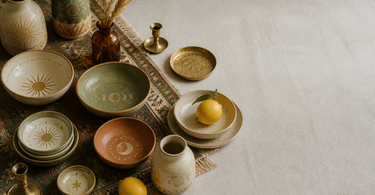
Sun and moon motifs are among the most enduring symbols in the history of interior design — and they still work today. You can work with the motif across many different object types: brass drawer knobs and handles, mirrors with a sunburst frame, ceramic wall décor and decorative ornaments. The result is a room with a mythological focal point that doesn't need a fully committed theme to work.
It's no coincidence that sun and moon keep turning up in home décor. The motifs have roots in virtually every culture in the world and carry a universal symbolism — cycle, opposites, time. In an interior design context, they add a layer of storytelling to otherwise functional objects: a drawer is a drawer, but with a crescent-shaped brass handle it becomes something that invites you to take notice. This article is about how you can actually use the motif in your home — from the smallest details to the larger wall surfaces.
Why celestial motifs endure
Within interior design, people tend to distinguish between trends and classics. The sun and moon motif falls into the latter category — not because it's invisible or neutral, but because it's rooted in a symbolism that doesn't fade with the seasons. It has appeared in the geometric suns of the art deco movement, in the boho aesthetic of the 1970s, and in today's fascination with the occult and astrological. Each time in a new interpretation, yet still recognisable.
It's also a motif that scales well. It works on a knob with a diameter of 3 cm, and it works on a mirror with a diameter of 80 cm. That flexibility makes it useful if you don't want to redecorate an entire room but still want to give it a sense of direction.
Symbolism without going all-in on a theme
One of the pitfalls of motif-based décor is that it easily slides into caricature — the room taken over by a single image. Sun and moon avoid this because the motifs can appear individually and still communicate something. A crescent moon on a knob on the bedroom dresser doesn't need to be surrounded by stars and planets to feel intentional. It's enough on its own.
Tip: Mix the motif with materials rather than piling up symbols. A brass moon handle next to a ceramic vase and a natural material like rattan creates depth without feeling like a themed room.
Knobs and drawer handles with sun and moon
It's in the small details that a space either comes together or feels messy. Hooks and knobs are an obvious place to start, precisely because they're easy to swap out and cheap to experiment with. A new set of knobs can completely change the character of a piece of furniture — from an anonymous IKEA look to something with personality.
Brass as the go-to material
Knobs and handles with a sun and moon motif are most commonly made from brass, and not without reason. Brass has a warm, golden tone that naturally supports celestial motifs — it's reminiscent of sunny yellow without becoming harsh. On top of that, brass develops a patina over time, taking on a slightly darkened surface that gives objects a worn, organic look. It's one of the few metals that actually gets better looking the more it's touched.
If you need knobs for the bedroom dresser, crescent moon shapes are an obvious choice: round enough to feel ergonomically comfortable, distinctive enough to say something about the room. Doing Goods knobs are a great example of how the motif can be interpreted in a playful, light way rather than a heavy, decorative one.
Drawer handles — where function meets form
Where knobs are turned, handles are pulled. The function differs, and the shape should reflect that. Drawer handles in sun and moon shapes are typically curved and suit wider drawers well, such as in a bathroom cabinet or a side dresser. The width of the handle matters: a handle mounted on a narrow drawer will look overwhelming, while the same handle on a wide drawer finds its proportion.
| Type | Best for | Typical width | Mounting |
|---|---|---|---|
| Knob (crescent moon) | Dresser, bedside table, cabinet door | 3–5 cm | Single screw |
| Drawer handle (arch) | Wide drawer, bathroom furniture | 8–15 cm | Two screws, fixed distance |
| Hook (sun/moon) | Entrance hall, bathroom, wardrobe | 6–10 cm | Wall-mounted |
Mirrors with a sunburst frame
A mirror with a sunburst frame isn't just a mirror — it's a wall piece that brings light and movement to a surface, even when no one's looking at it. The rays act as a kind of sculptural frame, projecting the idea of the sun out into the room. It's one of the few home elements that's both functional and decorative at the same time, without one compromising the other.
In sunburst mirrors the number, length and material of the rays vary considerably. Shorter, more uniform rays give a geometric, controlled expression — close to art deco. Longer, uneven rays lean towards the natural and organic. Brass is the dominant material, but there are versions in black lacquered metal and natural materials such as bamboo and rattan.
Placement and lighting conditions
A sunburst mirror sits best on a wall that receives natural light during the day — the ray effect is enhanced when light hits the metal surface at an angle. Above a side table in the hall, on a plain wall in the living room, or as a companion to a candlestick in the bedroom are all tried-and-tested placements. Avoid hanging it directly above a light source, as the reflection can become too intense.
If you have a smaller room, a large sunburst mirror can, paradoxically, make it feel more spacious — the rays draw the eye out from the mirror's centre and make the wall appear wider. A diameter of 60–80 cm is a good starting point for most rooms.
Ceramic wall decor with sun and moon
Ceramic wall décor with celestial motifs is a category that has seen marked growth in recent years, driven by interest in handmade, tactile materials. Ceramic adds a texture and irregularity that metalwork and glazed porcelain can't deliver — even two pieces from the same production run will never be identical.
Individually or in groupings
A ceramic sun or crescent moon can be hung individually as a pure accent point, or you can build a composition of several pieces in different sizes. If you choose to group them, there are two approaches: the symmetrical (equal spacing, equal height) and the organic (varying spacing and level). The organic approach works best with ceramics, because the material's irregularity already carries a natural rhythm.
For wall decor in general, you should consider the character of the wall before choosing the size of the motif. A plain, light wall can carry a large, dark ceramic piece. A brick wall or a patterned wallpaper requires a piece with a clear outline and a limited colour spectrum.
Tip: Try hanging wall decor at different heights and combine two sizes — for example, one larger sun centrally and two smaller crescent moons asymmetrically to the side. Lay out the spacing with paper templates on the floor before putting in the first nails.
How to style the motif in practice
It's one thing to know what sun- and moon-themed products exist. It's another to put them together in a way that feels considered. Here are a handful of principles to help.
Material repetition rather than motif repetition
Rather than stacking sun upon sun, you can let the material be the common thread. If you choose brass as the recurring metal — in the drawer handle, in the mirror's frame and in a candlestick on the chest of drawers — the room will feel cohesive, even though the motifs differ. It's more subtle and more enduring than buying everything from the same series.
Sun and moon as a nighttime duo in the bedroom
The bedroom is the most obvious location for moon-related décor — the motif resonates naturally with the room's function. A half-moon knob on the bedside table, a ray-shaped mirror next to the window and a ceramic candlestick on the chest of drawers is enough to give the room a clear visual language without overdoing it.
The hallway as a portal
The hallway is the first and last room you see. A set of hooks with sun- or moon-inspired shapes turns the hallway into more than just a place to hang jackets. It signals an aesthetic intention right from the threshold. Feel free to combine it with a small round mirror and a slim shelf in brass or light wood.
Be patient with the composition
Sun and moon décor is easy to overdo a room with — the motif is visually striking, and too many pieces at once compete for attention. Start with one key product (e.g. the mirror or the knob), live with it for a couple of weeks, and then add one element at a time. You'll notice when the room is done — that's the moment you stop looking for something more.
Frequently asked questions
What's the difference between a knob and a drawer handle?
A knob is a single, round or shaped handle that's turned or pulled, and is fitted with one screw. A drawer handle is an elongated handle that's pulled horizontally, and requires two mounting points. Knobs suit doors and small drawers, while handles give a better grip on wider drawers.
Can I swap knobs on IKEA furniture?
Yes, in most cases. IKEA uses standardised screw holes with a diameter of 3–5 mm. Most aftermarket knobs come with screws in standard lengths that fit the typical door thickness of IKEA furniture, which is 18–19 mm. Check the handle's mounting distance before ordering drawer handles — it needs to match the existing hole-to-hole measurement.
Which rooms suit sun and moon décor best?
The bedroom and the living room are the most natural rooms, but the motif works well everywhere. In the hallway, it creates an intentional welcome. In the bathroom, it adds mystique to a room that's otherwise very functional. The only room that rarely benefits is the kitchen, where the motif can seem out of place among utensils and appliances.
How do I maintain brass knobs and handles?
Brass naturally develops a patina over time and takes on a warm, darkening surface. If you want to keep the shiny finish, you can polish it with a soft cloth and a mild brass cleaner 2–4 times a year. If you want to keep the patina, simply avoid polishing — fingerprints become part of the surface and are part of the brass's character.
How do I hang a heavy ceramic wall hanging?
Ceramics can weigh anywhere from 200 g to over 2 kg depending on the size. For pieces over 500 g, we recommend a screw straight into a wall stud or a plasterboard screw anchor suited to the wall type. Always use a spirit level to make sure the hanging piece sits level — even a slight tilt is visible on circular shapes.
Can sun and moon décor be combined with other motifs?
Yes, and it often works best when you mix motif categories. Celestial motifs pair well with botanical elements (leaves, branches), abstract shapes and animal motifs. What doesn't work is too many symbol-laden motifs in one room — it creates visual noise. Choose two primary motifs and stick to them.
Summary
Sun and moon décor is one of the few themes that can be worked into almost any room and budget — from a single half-moon knob on the bedside table to a fully thought-through bedroom with a ray-shaped mirror, ceramic wall décor and brass details. The strength lies in the motif's cultural weight and its visual flexibility: it can be used sparingly and subtly or more explicitly, depending on how much of a mark you want to leave on the room. Choose materials consistently — brass is the obvious common thread — and add elements gradually rather than buying everything at once.
Explore our range of sun and moon décor — from brass knobs and drawer handles to ceramic wall décor and mirrors with ray frames.