
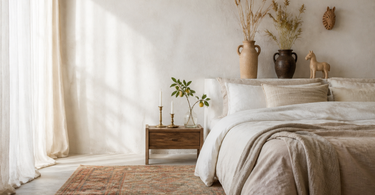
A well-functioning bedroom is about layers: soft light from several sources rather than a single ceiling light, a rug that extends at least 60 cm out on each side of the bed, and a wall surface above the bed that draws the room together. Muted colours — dusty blues, sage, sandy tones — visually lower the pulse rate. Plants, textiles and personal details are the elements that turn a bedroom into a retreat rather than just a place to sleep.
The bedroom is the room that hits you twice a day — when you close your eyes and when you open them again. Yet it's often the room that gets the lowest priority when decorating a home. It doesn't have to be that way. With a few conscious choices — about light, textiles, colour and surfaces — you can transform even a small bedroom into a place you actually look forward to retreating to. This guide covers the elements that make the biggest concrete difference.
Candlesticks and soft light — set the mood
Bright ceiling light is the quickest way to ruin a bedroom's atmosphere. The light is too direct, too white and too uniform. Instead, you should build up the lighting in layers: a primary source (for example a table lamp on the bedside table) and two to three secondary light sources in the form of candles and candlesticks.
Candlesticks on a dresser or bedside table give off a warm, flickering glow that actively signals relaxation to the nervous system. It's not just about aesthetics — light with a lower kelvin rating (below 3000 K, the warm yellow spectrum) inhibits melatonin production far less than cold LED light above 4000 K.
Choosing candlesticks for the bedroom
Brass candlesticks and ceramic candlesticks suit the bedroom's look well, as they have a matt, warm surface that doesn't reflect harshly. Place them in groups of three at varying heights — this gives a natural, effortless look rather than a symmetrical pharmacy display.
Feel free to combine with candles in earthy or neutral shades. Scented candles can work, but choose subtle, earthy scents such as cedarwood or lavender — strong floral scents can disturb sleep quality.
Tip: Place a dimmable bedside lamp or a rechargeable table lamp on the bedside table — so you can read without switching on the big ceiling light. This gives you full control over the light intensity from the bed, without having to get up to switch it off.
Rugs under and beside the bed — warmth and comfort
The rule of thumb is simple: the rug should extend at least 60 cm out on each side of the bed. This ensures that you step onto a soft surface in the morning, and that the rug visually anchors the bed in the room instead of looking like a stamp under the furniture.
If you have a standard double bed of 160 cm, the rug should therefore be at least 280 cm wide. The alternative is two smaller rugs placed along each side — a format that works well in practice and allows you to play with pattern and colour.
Materials that work in the bedroom
Natural fibres such as wool and cotton are the best choices here. Wool regulates temperature and moisture, is naturally dirt-repellent and holds up well over time. Cotton is softer to walk on and easier to wash. Synthetic fibres such as polypropylene can be an alternative for families with allergies — they're easy to clean and almost as soft.
A rug with a muted pattern — geometric or organic — breaks up the uniformity if the rest of the bedroom is kept in neutral colours. Colourful rugs can definitely work, but choose one dominant colour rather than lots, and keep the other textiles more muted.
| Material | Advantages | Disadvantages | Suits |
|---|---|---|---|
| Wool | Temperature-regulating, durable, naturally stain-resistant | Can feel scratchy, pricier | Cold bedrooms, allergy-friendly rooms |
| Cotton | Soft, washable, cheaper | Wears out faster, absorbs moisture | Families, light-filled rooms |
| Polypropylene | Easy to clean, allergy-friendly, budget-friendly | Less natural feel, static electricity | Allergy sufferers, high-traffic rooms |
| Jute/sisal | Natural look, hard-wearing | Harsh to walk on, absorbs moisture | Layer under a soft rug |
Wall décor above the bed
The wall above the bedhead is the bedroom's natural focal point — and the first thing your eyes meet when you wake up. It deserves a decision rather than being left bare.
A wall hanging in woven textile or macramé adds texture and softens the sound in the room, as it absorbs sound waves. A decorative mirror reflects light and gives the room visual depth — especially effective in bedrooms with just one window. Choose a round or oval mirror rather than a rectangular one for a softer look.
Gallery wall in the bedroom
A small gallery wall with wall decoration in varied sizes and materials — frames, ceramic hangings, pressed botanical prints — adds personality without feeling overwhelming. The key is to keep the colours cohesive: two to three tones from the same family, and materials that speak the same language (e.g. ceramics and natural materials, or metal and glass).
Avoid hanging single pictures symmetrically on both sides of the bed, unless you're going for a hotel-room look. An asymmetric composition that extends to one side feels more alive.
Plants and pot covers
Plants contribute two things to the bedroom: visual calm (green is the colour spectrum the eye rests on most easily) and a modest improvement in air quality. Aloe vera, peace lily and snake plant are the three classics — all thrive in partial shade and need minimal watering.
Pot covers lift a simple plastic pot into a decorative element. Ceramics in earthy tones, terracotta or matte white suit most bedroom palettes. Place a larger plant (such as a monstera or a fig tree) in a corner as a volume element, and supplement with two to three smaller plants on a shelf or bedside table.
Tip: Avoid strongly scented plants in the bedroom — jasmine and hyacinth can disrupt sleep quality for those sensitive to scent. The snake plant (Sansevieria) is one of the few plants that releases oxygen at night rather than during the day, which technically gives slightly better air quality while you sleep.
Colours that create calm
The colour choice in the bedroom is about reducing visual noise. Muted, natural colours work best: dusty blues, warm greys, soft sage green and sandy tones. These shades are characterised by low saturation (they're grey-mixed rather than pure) and medium to low brightness — a combination that visually lowers the pulse rate and signals rest.
Bold primary colours and sharp contrasts on large surfaces (walls, bedding, large textiles) create visual activation — the opposite of what you want. Instead, use them as accents: a cushion in terracotta, a candlestick in copper-green, a plant in an ochre pot cover.
Dark tones in the bedroom
Black, deep green and midnight blue on a single wall — typically the headboard wall — can give the bedroom a cocoon-like feel that's highly effective for sleep. The key is to counterbalance with warm textiles: wool fabrics, linen and soft rugs that prevent the room from feeling cold and clinical. A dark colour also absorbs the light from candlesticks particularly beautifully and provides stronger contrast against the flame.
Storage and personal details
A calm bedroom requires order — not because minimalism is the right choice, but because visible clutter increases cognitive load. This is documented in research on the psychology of the built environment: clutter in the field of vision activates the prefrontal cortex and makes it harder to settle down.
Practical solutions include baskets on shelves, jewellery bowls on the chest of drawers and decorative boxes for everything that would otherwise just be put down. A small ceramic bowl by the bed gathers your phone, creams and whatever else lands there in the evening — turning it into a conscious choice rather than clutter.
Cushions: number and materials
There's no fixed rule, but a useful rule of thumb: two sleeping pillows plus two to four decorative cushions in varying sizes. The decorative cushions are your easiest way to introduce accent colours — and the cheapest to swap out when you want to refresh the look. Choose materials that invite touch: washed linen, velvet or coarse cotton with a visible weave.
Personal details are what set a bedroom apart from a hotel room. A stack of books, a family heirloom, a plant that's grown large over three years — the things that have a time and a story are what give the room character.
Frequently asked questions
Should you have a rug in the bedroom?
It's not a requirement, but on a wooden floor, a rug by the bed makes a noticeable difference in comfort — both to stand on in the morning and acoustically. If you already have carpeted flooring, you can happily do without one. A rug also visually pulls the room together and anchors the bed within the space.
Which plants are best suited to the bedroom?
Plants that tolerate partial shade and infrequent watering are the best choices: aloe vera, snake plant (Sansevieria), peace lily and pothos. Avoid strongly scented plants such as jasmine. The snake plant is especially popular in the bedroom because it's one of the few plants that releases oxygen at night.
How many candlesticks are appropriate in a bedroom?
Two to five is a good starting point. Group them in odd numbers — three on a chest of drawers, two on the bedside table — as this feels more natural than symmetrical pairs. Vary the heights. Remember to keep them at least 30 cm from flammable material such as curtains and textiles.
What should I hang above the bed?
A wall hanging, mirror, a small gallery wall or a single large art print are all solid choices. Avoid heavy, unsecured objects directly above the sleeping area. A textile wall hanging is a popular choice because it's light, adds texture and softens the sound in the room a little.
Which colours work best in the bedroom?
Muted, grey-blended shades work best: dusty blue, sage green, sand and warm grey. They have low colour saturation, which visually feels calming. Avoid bold primary colours on large surfaces. Dark tones on a single accent wall can create a pleasant cocoon effect — balance them with warm textiles.
How do I make the bedroom feel bigger?
A mirror on the wall reflects light and adds visual depth. Light bedding and light walls open the room up. Avoid filling floor space with too much furniture. A large rug that covers most of the floor works, paradoxically, better than a small one, because it creates a cohesive look.
Summary
A bedroom that creates calm isn't the result of a single decision — it's built up layer by layer. Start with the light: swap one harsh ceiling light for several warm candlesticks and a good bedside lamp. Add a rug that covers properly, choose colours with low saturation, and give the wall above the bed a purpose rather than leaving it empty. Plants bring life and greenery that rest the eye. Order removes cognitive noise. And the personal details — the things with a story — are what make the room yours. Build it up slowly, and prioritise what you actually use and feel every single day.
Explore our range of bedroom candlesticks, rugs and wall hangings — and find the elements that give your bedroom calm and character.