
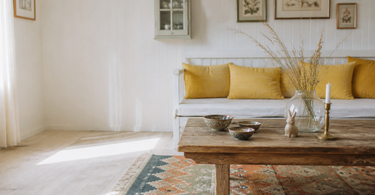
Summerhouse decor is all about daring a bit more than you would at home. Colourful rugs, mismatched ceramic sets and candles create cosiness without needing a well-thought-out plan. Let vases from the windowsill meet flowers from the garden, hang colourful hooks in the hallway and mix plates that don't match. The result is a relaxed atmosphere that's hard to copy — and even harder to leave.
The summerhouse is the place where the rules are a little looser. Things don't have to match perfectly — in fact, that's exactly what gives it character. Summerhouse decor is about blending the practical with the personal and daring a bit more than you would at home. That doesn't mean you need to fill every corner. It means you can allow yourself the colours, the animal prints and the slightly quirky combinations that you might otherwise steer clear of in everyday life.
Colours belong in the summerhouse
If you stick to neutral tones in your everyday home, the summerhouse is the perfect place to experiment. A colourful rug is one of the quickest ways to set the tone for an entire room — and it doesn't require a drill. Choose warm shades like terracotta and ochre for a Mediterranean feel, or blue and green tones if you want to play on that Nordic coastal vibe.
Animal print rugs are especially popular in summerhouses. They're relaxed, fun to walk on barefoot, and work both as flooring and a conversation starter. A tiger or leopard print rug by the sofa has practically become a summerhouse classic, and it's not hard to see why — the pattern has enough character to stand on its own without support from the rest of the decor.
If you want a more cohesive colour scheme, you can complement the rug with a wall hanging at the opposite end of the room. It ties the colour palette together without requiring a coordinated shopping list.
Tip: If you're unsure about colour, start with the rug. It's easier to build the rest of the room around a concrete starting point than to find a rug for a room that's already finished.
Vases and flowers from the garden
One of the summerhouse's real special features is access to fresh flowers — from the garden, the roadside or the local market. It doesn't take much: a couple of vases on the windowsill, and suddenly an otherwise anonymous room looks like someone actually lives there.
The vases don't have to match. A ceramic vase next to a piece of coloured glass gives a relaxed look that suits the summerhouse style. Small vases on the windowsill work well for a single stem or a handful of clover — the informal arrangement is the whole point.
If the summerhouse has a large dining area or a long table, a large vase with wildflowers or green sprigs can act as a natural centrepiece. Alternatively, a jug with a wide neck can do the same job — and doubles as a water jug for the rest of the week.
Colourful vases as decoration in their own right
A vase doesn't need to hold flowers to work. Colourful vases in ceramic have enough shape and colour to stand alone on a shelf or in a window frame. A collection of three vases in different heights and shades — say, deep blue, olive green and a warm clay tone — looks better than a single perfect vase in the "right" colour.
Evening atmosphere
When the sun sets over the summerhouse, the candles take over. It's hard to overstate what a few well-placed candles do for the atmosphere — both on the terrace and at the dining table indoors.
Coloured candlesticks in ceramic add a visual layer even during the day, where they work as decoration. In the evening, they create the warm play of light that is the very definition of summerhouse cosiness. If you set glass candlesticks in various colours out into the dusk, the light refracts through the glass and creates an effect you simply can't buy with electric light.
Light on the terrace
The terrace is the summer house's extended living room — and it deserves the same attention as the rooms indoors. Place a couple of candlesticks directly on the table or on a low wall. Feel free to use a shiny mix of tall and short candlesticks to break up the flat surface. Remember that wind and night dew are hard on candles and tablecloths, so look for solutions that last, even when the weather changes.
| Type of candlestick | Best for | Note |
|---|---|---|
| Ceramic candlestick | Indoor table, shelves | Retains heat, decorative in its own right |
| Glass candlestick | Terrace table, window sill | Play of light in coloured glass in the evening |
| Crystal candlestick | Dining table, festive occasion | Refracts light in many directions |
The walls deserve some attention
Summer houses often have white or wood-panelled walls, which are easy to decorate without leaving big marks. That's an advantage — you don't need to put nails in the masonry or repair anything before you head home again.
A couple of posters in light frames don't take long to hang and give a room personality. If you want something with more texture, a hung tapestry is a strong alternative to traditional art — it dampens sound a little, is easy to take down again and works as a wall filler in rooms with high ceilings.
The hallway as a functional welcome space
The hallway in a summer house gets intense use: towels, sun hats, beach bags, sandals and everything else that piles up over a summer week. Hooks for the hallway solve the double problem — things have somewhere to hang, and the wall doesn't look empty.
Colourful hooks in ceramic or metal are especially popular here, because they're visible enough to count as decoration. A row of five to seven hooks in varying colours creates a look that's organised and playful at the same time.
The kitchen: mix and match
The summer house kitchen is where the "don't match" concept really makes sense. A stack of ceramic plates in three different colours looks better than a matching set bought together — and is much easier to add to as plates get broken.
Mix colourful plates with a couple of hand-painted bowlsand a jug with a lemon or fruit motif. The relaxed southern European look — as if the kitchen has come together over many summers — is exactly the vibe that suits long summer lunches with leftover salad and bread.
Also consider filling the kitchen windowsill with pots and planters for herbs. Basil, parsley and rosemary thrive in the summer light, and ceramic planters turn it into part of the décor rather than just a practical solution.
Tip: If you're buying ceramics for the summer house, go for handmade or hand-painted ceramics from European makers. The variations in colour and shape from piece to piece are an advantage, not a flaw — it's exactly what gives mixed sets a cohesive and authentic look.
Frequently asked questions
How do I choose the right rug for the summer house?
Start by considering how much wear the rug needs to withstand. Summer houses are tough on rugs — sandy feet, wet swimsuits and frequent use call for a material that can be washed or brushed clean. A flatwoven rug is easier to maintain than a thick pile rug. Then choose colour and pattern based on the mood you want in the room.
Can I use ceramics outdoors in the summer house?
Ceramics aren't frost-proof and shouldn't be left outside during winter, but they're perfectly suited for terrace use in summer. Ceramic vases, candlesticks and bowls hold up well in dry weather. Avoid letting them stand in stagnant water, as this can damage the surface over time. Bring them inside if rain is on the way.
Which flowers work best in summer house vases?
Wildflowers, clover, cornflowers and wild grasses hold up surprisingly well and don't require a florist. If you cut them in the morning and put them in fresh water with a little sugar, they'll last two to three days. In ceramic vases — which keep the water cooler than glass — the flowers typically last a bit longer.
How do I hang decorations in a summer house without causing damage?
Command strips can hold up to 2-4 kg and leave no marks on wood or painted walls. They're ideal for light posters and frames. For heavier wall decorations or rows of hooks, it's better to use existing nails or drill a single hole that's easy to fill in again.
Are animal-print rugs a passing trend?
Animal-print rugs have existed as an interior element for decades and aren't a new phenomenon. Tiger and leopard motifs can be traced back to 1970s and '80s interior design. They're popular today, but history suggests they go in and out of fashion rather than disappear entirely — and in a summer house, it matters far less anyway than in a permanent home.
What's the easiest way to give the summer house new life?
Change the textiles: a new rug, new cushion covers and a couple of candlesticks can transform a room in under an hour without needing new furniture or paint. Textile elements are easy to transport, store and swap out — and they give far more visual impact per pound than most other decorating investments.
Summary
Summer house décor isn't a discipline with fixed rules — it's more of an invitation to experiment. A colourful rug on the floor, a vase of wildflowers on the windowsill, coloured candlesticks on the dining table and a row of practical hooks in the hallway: together, that's enough to turn an otherwise neutral room into a place that feels like your own.
The heart of it is mixing rather than matching, and letting the practical have an aesthetic dimension too. Ceramic plates in mixed colours, herbs in coloured planters and a vase that doubles as a water jug — these are the kind of details that make the summer house more than just a place to sleep.
Explore our range of home décor for the summer house — from rugs and candlesticks to vases and hooks.
