
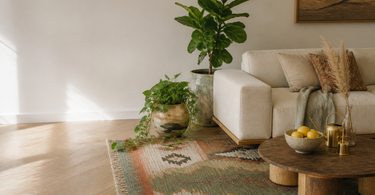
Plants are best styled by thinking of the pot cover as a design choice — not just a practical solution. Mix heights: a large floor plant next to a group of small plants creates dynamism. Moisture-loving plants thrive in the bathroom. Hanging plants on hooks save worktop space and add greenery at eye level. And if you choose a ceramic pot cover with a pattern or colour, it elevates even a dull green plant into something worth looking at.
Plants are one of the quickest and cheapest tricks in home decor — but most people only think about the plant itself. That's a mistake. The pot cover, the placement, and how you mix sizes and materials are at least as crucial to whether the result feels considered or random. This guide gives you concrete principles for working with plants as a deliberate decorating choice, from the living room floor to the bathroom shelf.
The pot cover as a design element
A pot cover isn't just a container that hides the plastic pot. It's the visual focal point of the whole plant experience — and it deserves the same attention as any other decoration in the room.
Colour and pattern over a neutral background
A ceramic pot cover with a bold pattern or a strong colour can elevate even the most anonymous green plant. The idea is simple: the plant provides the organic and living element, the pot cover provides the character. You don't need to choose exotic plants if the container is interesting enough on its own.
Colourful pot covers and herb pot covers come in ceramic from European makers, with everything from hand-painted floral patterns to graphic geometric designs. Many are thrown or cast in limited runs, so the surface texture varies from piece to piece — that's a feature, not a flaw.
Match the room's colour palette
Start by identifying two or three dominant colours in the room — from the rug, the cushions or the wall. Then choose a pot cover that either repeats one of those colours or uses a complementary tone. A terracotta-coloured pot cover, for example, works well in rooms with warm earthy tones, while a cobalt blue ceramic cover contrasts nicely with neutral white or grey walls.
Tip: If you've got a plastic pot with drainage, you can place a small saucer or a piece of foam in the bottom of the pot cover instead of raising the whole plant on stones. This gives you fewer centimetres to work with — and it's easier to adjust if you swap the plant.
Size doesn't always match 1:1
A pot cover doesn't need to fit snugly around the plastic pot. A pot cover that's 2-3 cm wider than the pot gives a looser, more natural look — and makes it easier to water and let the roots breathe. Always check the internal diameter before buying: most ceramic pot covers are listed with internal measurements in centimetres.
Take a look at our range of large pot covers for floor plants and small pot covers for windowsill plants — the sizes are clearly stated on each product page.
Mix size and height
Variation in height is the simplest way to create visual dynamism. A single large plant often looks isolated. Two plants of the same size side by side look symmetrical and a bit dull. But a large floor plant — for example a monstera or ficus at 80-120 cm — next to a group of three to five smaller plants at varying heights from 10 to 40 cm: that creates depth and movement in the room.
The principle of odd numbers
In visual composition, groups with an odd number of elements are almost always more interesting than even ones. Three or five plants in a group work better than two or four — the eye doesn't know where to "land", and that creates a livelier feel.
Use tall and small vases for cuttings and single sprigs
Plants don't always need to come with roots. Cuttings or single sprigs in water in small vases or ceramic vases are a great addition to a group of potted plants. They add variation in shape — and let you experiment with colour and material without committing to a whole plant.
| Plant placement | Recommended container height | Materials that work |
|---|---|---|
| Floor plant | 25-40 cm plant pot cover | Ceramic, terracotta |
| Shelving or shelf | 10-20 cm plant pot cover or vase | Ceramic, glass, brass |
| Windowsill | 8-15 cm container | Ceramic, terracotta |
| Hanging basket/hooks | The pot decides — min. 12 cm | Hanging basket, macramé |
Plants in the bathroom
The bathroom is an underrated room for plants. The humidity from showers and baths creates a microclimate that's perfect for moisture-loving tropical plants — and it needs far less watering than in the living room or bedroom.
Plant types that thrive
Calathea, monstera, pothos and ferns all tolerate high humidity and manage with low to medium light. Epiphyllum (orchid cactus) and orchids are other good choices if the bathroom has a windowsill with daylight. Avoid succulents and cacti — they need a dry environment and lots of direct sun.
Placement and container
A windowsill is the ideal spot if there's natural light. If there's no window, a shelf 30-50 cm from an artificial light source (e.g. a warm LED bulb) can work for many shade-tolerant plants. Choose a colourful plant pot cover in ceramic — ceramic is water-resistant and hygienically easy to wipe down, and the extra colour in an often white room is always a good move.
Check that the plant pot cover has a glazed surface on the inside if you're not using a saucer — unglazed terracotta will absorb moisture over time and can leave marks on shelves or tiles.
Hanging plants
Hanging plants are an effective trick in rooms with limited floor and shelf space. They draw the eye upwards, make use of vertical space and add greenery at a level you don't normally see it.
Hooks and pegs as a starting point
A sturdy hook in the ceiling or wall is the foundation. Hooks and knobs in ceramic or brass can be mounted on the wall and used to hang baskets, macramé hangers or dedicated hanging plant hooks. Always check the weight capacity before hanging heavy pots — waterlogged soil in a 15 cm pot can easily weigh 2-3 kg.
Plant types for hanging
Hoya, tradescantia, string of pearls and pothos are the classic choices for hanging plants. They have long shoots that naturally fall down and create movement. Place them in a light, well-drained soil — heavy, compact soil puts unnecessary strain on the fixture and gives poor air circulation to the roots.
Tip: If you need to water a hanging plant that's tricky to reach, a long-spout watering can can make it far easier than a standard can. Check watering needs thoroughly before placement — it's a hassle to take down a heavy fixture every other day.
Materials and maintenance
The material you choose for your plant pot cover and vase affects more than just the look — it also determines how easy it is to keep clean, and whether it can withstand the specific conditions in the room you place it in.
Ceramic
Ceramic is the most widely used material for plant pot covers for good reason: it's heavy enough to hold large plants stably, it's easy to clean, and it stays looking good over time. Glazed ceramic is waterproof and resistant to most chemicals. Unglazed ceramic — typically terracotta — is porous and "breathes", which is good for the roots, but requires a saucer underneath to avoid moisture damage to the surface below.
Glass and brass
Glass vases are ideal for cuttings and water propagation, but impractical for soil — they let light through everything, and algae grow quickly in transparent material. Brass details on hooks and fixtures develop a natural patina over time and only need the occasional wipe with a dry cloth.
Caring for plant pot covers
Clean ceramic plant pot covers with lukewarm water and a soft sponge. Avoid harsh scouring agents that can scratch the glaze. Empty any standing water at the bottom of the plant pot cover at least once a week to avoid root rot and bacterial growth.
Frequently asked questions
What size plant pot cover should I choose for my plant?
Measure the outer diameter of the plastic pot and choose a plant pot cover with an inner diameter that's 1-3 cm larger. This gives you room to move the plant in and out without hassle, and gives the roots a bit more air circulation. Always check the product description for the inner measurement — that's the relevant figure.
Can I use a ceramic plant pot cover without a hole outdoors?
No — or at least, only with great caution. Without a drainage hole, rainwater will collect at the bottom and cause root rot. Outdoors, it's best to use plant pot covers with a hole, or alternatively place the plastic pot on top of a layer of coarse gravel at the bottom of a hole-free ceramic pot, so water can drain away from the roots.
Which plants are suited to the bathroom?
Calathea, pothos, ferns and monstera all thrive in high humidity and tolerate low to medium light. Orchids are a good choice if the bathroom has a bright windowsill. Avoid succulents and cacti — they need a dry climate and plenty of direct sun to survive.
How many plants are too many in one room?
There's no fixed rule, but a good starting point is to think in groups rather than single plants spread out. Three to five plants in one cluster, combined with a single floor plant elsewhere in the room, gives more direction than ten scattered pots. Light and care are the real limiting factor.
Should the plant pot cover match other ceramic elements in the room?
Not necessarily — but they should speak the same colour language. It's more interesting to mix patterns and shapes in the same colour tone than to match everything identically. A cobalt blue plant pot cover next to a cobalt blue vase creates cohesion, even though the two pieces look completely different.
What's the difference between a plant pot cover and a jar/pot?
A plant pot cover is designed to hold an existing plastic pot — it typically has no drainage hole and is meant to hide the functional plastic pot. A pot is used directly as a plant container with soil and usually has a drainage hole in the bottom. Many ceramic pieces are sold with both uses in mind.
Summary
Plants work best in your décor when you treat them as a deliberate design choice — not an afterthought. The plant pot cover is the visual anchor: choose one with a colour or pattern that plays off the room's existing palette. Mix heights and sizes in groups of odd numbers to create dynamism. Make use of the bathroom's humidity for tropical plants, and use hooks and fixtures for hanging varieties that make use of vertical space. The choice of material — ceramic, glass, brass — affects both aesthetics and practical upkeep, so it's worth thinking through before buying.
Explore our range of pot covers and herb pot covers — from colourful ceramic covers to classic neutral variants in all sizes.