
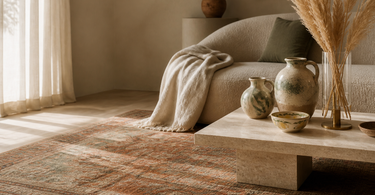
A rug ties a room together — it defines zones, dampens sound and gives the floor character. Choose a size based on where the furniture sits: the sofa's front legs on the rug in the living room, 60 cm out from the table edge under the dining table. The material determines durability and upkeep: wool is hard-wearing, cotton is easy to wash, jute is raw and rustic. Decorative animal rugs and wall hangings work both on the floor and on the wall.
Dims Studio's own figures: Among the rugs sold at Dims Studio, 70% were wholly or partly made of wool and 59% of cotton (more than 1,000 items sold, from November 2025 to October 2026), and the rugs have an average of 4.9 out of 5 stars across 40 customer reviews.
A rug is the first element that ties a room together — and the last thing many people remember to choose. It's a classic case of misplaced priorities, because the right rug actually changes a room's proportions, acoustics and mood. It dampens sound, defines zones in open-plan layouts, insulates against cold floors and gives the interior the character that furniture and wall colour alone rarely manage. This guide covers everything from types and sizes to materials, care and the use of rugs as wall decoration.
Types of rugs and textiles
The world of rugs is broader than most people expect. The category covers everything from classic floor rugs to decorative animal rugs and textile wall art. Here are the main types:
Floor rugs
The classic floor rug defines an area of the room. It comes in sizes from small doormats to 200×300 cm and beyond. Materials range from soft cotton to hard-wearing jute and heat-insulating wool. The choice of material has a big impact on where the rug is best suited, more on that in the materials section.
Wall hangings
Wall hangings have undergone a remarkable rehabilitation. Modern versions work as textile paintings: they dampen room echo, insulate the wall and add depth in a way that posters and mirrors simply can't. Graphic patterns in bold colours are particularly in demand.
Animal rugs
Animal rugs are shaped like actual animals — tigers, leopards, bears, zebras — and are designed as decorative pieces with humour and personality. Most are hand-tufted or hand-sewn in cotton or wool with a level of detail that clearly sets them apart from mass-produced items.
Throws
A good-quality throw is technically a textile rather than a rug, but it belongs in the same category. Draped over the sofa, laid at the foot of the bed or rolled up in a basket in the reading nook — it's a functional piece of decor that gives a room a relaxed, lived-in feel. Merino wool, mohair and cotton are the most common materials.
Doormats
The most overlooked textile in the home. Coir mats are robust for outdoor use, while soft cotton mats work better indoors, where they can withstand more frequent washing. A well-chosen doormat sets the tone before guests have even stepped through the door.
Tip: Think about the rug's function before deciding on the material. High traffic and children call for cotton, which can be machine washed. A bedroom, where comfort is the priority, suits wool or a blended fibre with a high pile better.
How to choose the right size
One of the most common mistakes when buying a rug is choosing one that's too small. An undersized rug makes a room feel fragmented and can, paradoxically, make it look smaller. Here are the basic rules of thumb:
| Room / situation | Recommended approach | Typical size |
|---|---|---|
| Living room with sofa | The sofa's front legs should stand on the rug | 160×230 cm or 200×300 cm |
| Under the dining table | At least 60 cm out from the table edge on all sides | Depends on table size |
| Bedroom | Under the lower 2/3 of the bed, or two rugs, one on each side | 160×230 cm typically |
| Entrance hall / corridor | A runner that matches the width of the hallway | 70–80 cm wide |
| Animal rugs | Decorative element, doesn't follow the standard rules | Choose according to the look you want |
The dining table rule deserves special attention: the rug needs to stick out far enough that the chairs are still on the rug when pulled out. Allow for a minimum of 60 cm extra beyond the tabletop on all four sides. If it's hard to picture, it can help to lay newspaper or masking tape on the floor to visualise the size before you order.
A animal-head rug in front of a fireplace or at the foot of a bed follows different rules, here, look and placement matter more than proportions in relation to furniture.
Animal rugs: shape, function and humour
Animal rugs as a category have grown markedly in popularity within Scandinavian interior design over the past ten years. The Dutch brand Doing Goods is one of the main reasons for this. Their tiger rugs, particularly the Bombay series in orange and black, have become a reference point in the category, but the range extends far beyond that: leopards, bears, zebras, alligators, owls and dog rugs are all part of the collection.
All Doing Goods rugs are handmade in India. The material is cotton, and the back has a rubber-like coating that keeps the rug in place on smooth floors, a practical detail that's often overlooked when comparing products in this category.
Doing Goods' animal rugs can be used on the floor as a decorative centrepiece or hung up as wall decoration. The back has a hanging loop for this purpose, so they're designed for dual use. Colourful variants in pink, turquoise and blue let you match or break with the rest of the room's colour palette.
The leopard rugs are almost as sought after as the tiger versions and come in both natural earth tones and bolder shades like pink and sage. Choosing a pink leopard over a natural-coloured one is a clear style statement, and that's exactly the point of this category.
Rugs as wall decoration
Hanging a rug on the wall isn't a new idea, but interest in it is steadily growing. The effect is different from a painting or a poster: the textile adds physical depth and dampens room echo, because the fibres absorb sound waves, particularly in the 500–4,000 Hz range, which is where speech and music are primarily found.
Bongusta wall rugs are designed specifically with this purpose in mind. Graphic, geometric patterns in bold colours make them striking visual elements without feeling disruptive to the overall room. They come in sizes comparable to large posters and can be used as an alternative focal point on the wall above the sofa or bed.
Tip:Use a curtain rod or a piece of dowel with clips to hang a rug. This distributes the weight evenly and avoids holes in the weave. For lighter rugs and animal hides with a hanging loop, decorative nails or hooks work nicely without damaging the rug.
Doing Goods' animal hides also work brilliantly on the wall. A tiger head or a leopard in natural size on a light wall creates the same playful and unexpected element as sculptural wall decor, just with a softer, more textured look.
Materials: wool, cotton and jute
The material's properties determine whether the rug is the right choice for the right room. Here are the three most common ones:
Wool
Wool is the most durable natural fibre for rugs. It's naturally dirt-repellent, wool fibres have a surface that repels water-based stains, soft underfoot and able to regulate moisture. A quality wool rug can last 20 to 30 years with proper care. New wool may shed a bit in the first few months, but that's normal and decreases with use and vacuuming. The downside is the price and the fact that wool rugs should generally be dry cleaned or washed professionally.
Cotton
Cotton is the most flexible choice in the category. It's soft, affordable and, most importantly, machine washable at 30 degrees. Most handmade animal hide rugs are made from cotton, making them suitable for high-activity rooms and families with children. Cotton rugs flatten more over time than wool and are generally less hard-wearing in the long run.
Jute
Jute is a plant-based natural material with a distinctive raw, rough texture. Jute rugs are suitable for hallways, walkways and under dining tables, as they're durable and very easy to vacuum. On the other hand, they're not comfortable underfoot and aren't recommended for the bedroom. The colour range is naturally limited to beige and brown tones, which makes them easy to combine with Scandinavian and boho-inspired interiors.
| Material | Pros | Cons | Best for |
|---|---|---|---|
| Wool | Durable, dirt-repellent, soft | Expensive, requires professional washing | Living room, bedroom |
| Cotton | Washable, soft, affordable | Flattens, shorter lifespan | Children's room, everyday rooms |
| Jute | Robust, natural, easy maintenance | Rough, limited colour choice | Hallway, under dining table |
Care and maintenance
Decorative rugs require a slightly different approach than the standard "vacuum once a week". Here are the key principles:
- Vacuum regularly on low suction. High suction can loosen fibres and wear on the tufting, especially on handmade rugs. Alternatively, you can take the rug outside and shake it.
- Treat stains immediately. Use a damp cloth and mild soap. Dab, never rub, and let the rug air dry horizontally. Rubbing spreads the stain and can damage the fibres.
- Avoid prolonged direct sunlight. UV radiation breaks down dyes over time. If the rug is hanging on a sunny wall, you can rotate it at regular intervals to ensure even exposure.
- Check the washing instructions individually. Many cotton rugs can withstand a 30-degree machine wash, but this doesn't apply universally. Wool rugs should be dry-cleaned or washed with a wool programme and minimal spinning.
- Use a rug underlay. An anti-slip underlay doesn't just protect against accidents, it also reduces mechanical wear, because the rug doesn't shift against the floor with every step.
Frequently asked questions
What size rug suits a standard living room?
It depends on the furniture layout, but as a rule of thumb, the sofa's front legs should stand on the rug. For a typical three-seater sofa, that corresponds to a rug of at least 160×230 cm. In large living rooms with a sofa group, 200×300 cm is recommended, so all the front legs are on the rug.
Can an animal rug be used as a wall hanging?
Yes. Many handmade animal rugs, particularly from Doing Goods, have a hanging loop on the back and are designed for dual use. On the wall, they work as sculptural wall decoration and add texture and humour in a way that prints and paintings can't.
What's the difference between a hand-tufted and a hand-sewn rug?
Hand-tufting is a process where a gun shoots loops of yarn into a backing material, which is then glued. Hand-sewn rugs are knotted or sewn manually and are generally more durable. Both methods produce quality results, but hand-sewn rugs typically have a denser, more even pile.
How do I stop the rug from sliding on smooth floors?
Use a rubber or latex anti-slip underlay beneath the rug. This keeps the rug in place, protects the floor surface from scratches and reduces mechanical wear. Doing Goods' animal rugs have an integrated rubber-like backing that solves the problem without any extra purchase.
Can jute rugs be washed in the machine?
No, jute can't be machine washed. Water weakens the jute fibres and can cause the rug to shrink or lose its shape. Spot cleaning with a damp cloth is the recommended method, and the rug should air dry completely before being used again.
What's a good size rug for under a dining table?
The rug should extend at least 60 cm beyond the edge of the table on all sides, ideally 70–75 cm, so the chairs stay on the rug when pulled out. If you measure the table and add 120–150 cm in both dimensions, you'll get a reliable minimum calculation for the rug's size.
Summary
A rug isn't an afterthought, it's one of the first choices that should be made in a decorating process. Size determines the room's proportions, the material determines durability and care, and the type, whether it's a classic floor rug, a decorative animal rug or a textile wall hanging, says something about the function you want the room to serve. Wool lasts the longest and best, cotton is the easiest to maintain, and jute is the sturdy choice for high-traffic zones. Throws and animal rugs are both categories that give your home personality without requiring a complete renovation, and a colourful rug is often the quickest way to change the mood of a room.
Explore our range of rugs and textiles, from handmade animal rugs to graphic wall hangings and colourful floor rugs.