
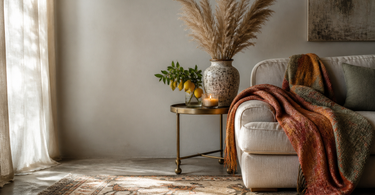
Romantic ambience isn't about roses and red hearts — it's about layers of soft light, textures and details that invite you to slow down and be present. Candles in groups, fresh flowers in a ceramic vase, a woollen blanket over the sofa and a carefully laid table for two are the four concrete steps that shift an everyday room into a completely different mood. No extravagance required.
Romantic decor is one of those topics that quickly slips into cliché. But there's a difference between decorating for a film scene and styling a room that actually feels inviting and intimate — not just for one evening, but generally. It doesn't take a florist's budget for lavish bouquets or a stockpile of tealights. It takes a few deliberate choices about light, materials and details that together create an atmosphere you actually want to spend time in.
Light as a mood-setter
Electric light is practical, but it's rarely romantic. The problem is direction: a ceiling lamp lights a room from one angle and with one colour temperature. Candles do the opposite — they place many small light sources low and spread out, cast moving shadows and give the room a warm, yellow-orange tone that typically sits around 1,800 kelvin. That's warmer than even the warmest white LED bulbs on the market.
What matters isn't the amount of light, but how it's distributed. Place candlesticks in groups — three of varying heights on a coffee table create more depth than a single candlestick in the middle. Use the windowsill, the bathroom and the bedside table as secondary light surfaces. When candles occupy five to six different points in a room, the character of the room changes markedly.
Choosing a candlestick
The material of the candlestick determines how the light behaves. Glass candlesticks reflect and refract the light, creating prism effects that move along walls and ceilings. Ceramic absorbs the light and gives off a more matte, warm glow. Crystal candlesticks sit somewhere in between — they cast contoured, sharp reflections that are more dramatic than what clear glass offers.
Tall candlesticks for taper candles are classic, but lower, wider candlesticks for pillar candles create a more grounded, cosy mood. Feel free to combine both types within a group.
Tip: Place a mirrored surface behind a group of candlesticks — a mirrored tray or simply a small round mirror — and you visually double the number of flames, deepening the sense of the room considerably without adding a single extra candle.
Flowers and vases
Fresh flowers are one of the quickest ways to bring a room to life. But it's the vase that determines whether it looks considered or accidental. A generic glass vase from the supermarket dilutes the story — a vase with character elevates it.
For a bedside table or a windowsill, small vases are perfect. They don't need many flowers — three to five stems are enough — and they're easy to adjust and move around. A single stem in a narrow-necked vase can be a statement in itself.
Shape and colour
Ceramic vases in organic shapes suit most types of flowers, because they have a tactile quality that complements the natural. Ceramic vases from European makers are typically thrown or hand-built and have a surface with variation — not the uniform glaze you find in mass-produced products. It's that variation that makes them interesting to look at, even when they're empty.
For colourful flowers — anemones, ranunculus, tulips — neutral, stoneware-coloured vases work well. For simpler bouquets of greenery and white, a vase in a saturated colour can take over as the visual focal point.
Want to take it a step further? You can add a wall vase— a single stem mounted on the wall takes up minimal space and adds a dimension to the room that's surprisingly effective in a bedroom or hallway.
Soft textiles and texture
A romantic atmosphere isn't just a visual phenomenon — it's just as much about what you can feel. A cold, hard room is difficult to relax in, no matter how many candles are burning. Textiles are the quickest way to change a room's tactile quality.
A blanket over the sofa or the end of the bed makes a real difference: it lets you snuggle up close without worrying about the temperature, and it adds a visual layer to the furniture. Choose qualities with substantial weight — thin polyester doesn't give the same sense of comfort as a woven wool or cotton blanket.
Blankets with a characterful pattern or an interesting texture work better than plain smooth fleece, because they hold the eye and give the room a single visual element that feels considered rather than purely practical.
| Textile type | Feel | Best for |
|---|---|---|
| Woven wool | Warm, heavier | Sofa, bed, cold seasons |
| Cotton (tightly woven) | Soft, breathable | All year round, bedroom |
| Wool floor rug | Cushioning, warm underfoot | Bedroom, living room |
| Wall hanging / tapestry | Decorative, sculptural | Accent on wall or sofa |
A floor rug under the bed or in front of the sofa dampens the acoustics of the room — an element you rarely think about, but one that greatly affects whether a room feels intimate or echoey. The room becomes sonically closer and more enveloping.
Table setting for two
A set table is one of the clearest signals that this meal is more important than an everyday one. It doesn't have to be extravagant — but it should be deliberate.
The starting point is candles on the table, as already mentioned. The next layer is tableware: cups and plates with character, not the worn-out everyday set. Objects with a handcrafted quality — visible brushstrokes, uneven glazing, a hand-cast jug — signal that effort has been made, and it shows.
The jug as centrepiece
A jug in the middle of the table serves a double function: it's both practical and decorative at once. A jug for water, coffee or wine in ceramic or glass is a single element that lifts the table from "laid table" to "scenography". Choose one with a shape that interests you — not the least eye-catching one.
Place plates, glasses and cutlery symmetrically, but do allow a single asymmetric element — a small bunch of flowers off to the side, a single candle placed slightly off-centre — that breaks the overly clinical symmetry and brings the table to life.
Tip: Use a piece of fabric or a square scarf as an improvised table runner if you don't have one. It adds texture and colour without requiring a specific shopping trip — and it looks far more intentional than a bare tabletop.
Bringing it all together
The four elements — candles, flowers, textiles and table setting — work best when they address the same space at once. A romantic atmosphere isn't created by a single gesture, but by the combined effect when all senses are involved: the visual (light, colours, shapes), the tactile (rugs, ceramics under your fingers), the olfactory (candles with a light scent, fresh flowers) and the auditory (a room with textiles dampens sound and creates a more intimate acoustic).
In practice, this means you don't need to buy new things for everything. Go through what you already have, and gather the items with the most character — the ceramic vases that usually stand scattered about, the candlesticks that only came out at Christmas, the rug lying in the cupboard. Place them deliberately rather than randomly.
If you want to add more, decorative elements such as ornaments and wall décor are a simple way to add an extra layer to a room without changing the furnishing. A single ceramic hanging or a relief on the wall behind the bed creates a natural focal point that works both with and without candles.
Frequently asked questions
Which candles work best for a romantic atmosphere?
Choose unscented or lightly scented candles in warm tones — white, cream or deep terracotta. The flame is the most important factor: candles with a wide wick hole burn better and give more light per centimetre. Place them in groups of three to five, spread across the room rather than gathered in one spot.
Which flowers suit a small vase on the bedside table?
Ranunculus, anemones and tulips keep well for three to five days and have a compact shape that suits narrow vases. Avoid strongly scented flowers in the bedroom — jasmine and hyacinth can feel overwhelming in a closed room at night. Three to five stems are enough for a small vase.
Can you create a romantic atmosphere in a small room?
A small room has an inherent intimate quality that's actually an advantage. It takes fewer elements to reach the right density. Focus on two to three candles, one textile and one visual focal point — for example a vase of flowers or a mirror reflecting the light. Avoid overfurnishing; the room should feel deliberate, not crammed.
What's the quickest way to change the mood in the living room?
Turn off the ceiling light and light three to five candles instead. It takes under two minutes and changes the character of the room more than any other single move. Add a throw pulled out and a flower or sprig in a vase if you have one to hand.
Is there a difference between ceramic and glass vases for flowers?
Yes — with ceramic vases you can't see the water level, which means you need to remember to change the water more often (roughly every other day). Glass vases show the water level clearly and give a more airy look. Ceramic keeps the water slightly cooler in warm weather, which marginally extends the flowers' lifespan.
Which colours suit romantic décor?
Warm earthy tones — terracotta, ochre, dusty pink, cream — create an enveloping feeling. Dark shades like bottle green, petrol and burgundy work well in the bedroom, because they absorb the light and add depth. Avoid sharp cold colours; they create distance rather than closeness in candlelight.
Summary
Romantic decorating is about creating a space that invites presence — not about imitating a film set. The four concrete steps are candles spread in groups around the room, fresh flowers in a vase with character, a soft textile that offers physical comfort, and a carefully laid table that signals intentionality. None of it requires a big budget — it requires attention. Gather the items you already have, place them deliberately and turn off the ceiling light. That's where the atmosphere begins.
Explore our range of candlesticks for candles, vases for flowers and rugs for the living room and bedroom — all gathered in our décor range.