
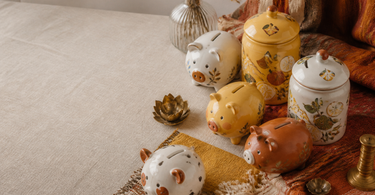
A piggy bank isn't just a tin for loose change — hand-painted ceramic versions work just as well as decoration on a shelf. They come in many shapes, from classic pigs to exotic animals, and make a great gift for children and adults for christenings, birthdays and confirmations. You can also use them to store small items or simply leave them as a pure ornament.
A piggy bank is one of those rare objects that doesn't need to justify its place in a home. It does something practical — collects coins and notes — while also looking like a deliberate decorative choice. This is largely because the best examples are made with the same care as a vase or a piece of tableware ceramics. Here's what you need to know before choosing one.
What exactly is a piggy bank?
The origin of the piggy bank is debated, but the most widespread theory points to medieval Europe, where "pygg" was the term for a cheap type of clay used for storage jars. Over time, the jar shape evolved into pig figures — and the name stuck. The classic model is a hollow figure with a coin slot on top and a hole in the bottom, sealed with a stopper.
Today, piggy banks are made from many materials: plastic, metal, resin and ceramic. The ceramic version is the most durable and tactilely satisfying — and the only one that can reasonably sit alongside your other home décor choices without looking out of place.
Tip: Before buying, check whether the bank has a removable stopper in the bottom — this saves you from having to smash it when it's time to get the money out. Most ceramic models intended for actual use have this feature.
Ceramic piggy banks: material and craftsmanship
Ceramic is porous and relatively heavy, giving piggy banks made from this material a natural stability — they don't tip over from a light knock. The mass also absorbs sound, so coins landing inside the bank produce a muffled, deep clink rather than the sharp plastic clatter.
Hand-painted surfaces
Many ceramic piggy banks are hand-painted, which means that two examples of the "same" model are never identical. Brushstrokes vary, the intensity of the colours fluctuates slightly from one firing to the next, and details like eyes or patterns are never placed in exactly the same spot. This is a mark of quality, not a flaw. See our range of Quail piggy banks in hand-painted ceramic — available as pigs, cats and more exotic animals, among others.
Animal shapes and motifs
The classic pig is still popular, but the range is broader than that. European makers produce piggy banks shaped like hippos, elephants, dogs and birds — all in the same hand-painted ceramic. The shape dictates the personality: a small round pig conveys something different to a long, slender giraffe. At Quail, animal motifs are used consistently, and the piggy banks follow the same aesthetic universe as the brand's vases and egg cups.
| Material | Durability | Sound level (coins) | Decoration |
|---|---|---|---|
| Ceramic (hand-painted) | High | Muffled | High |
| Plastic | Medium | Sharp | Low |
| Metal (tin/iron) | High | Metallic | Medium |
| Resin | Medium | Medium | Medium |
Piggy banks for children
A piggy bank for a child does two things at once: it introduces the idea of waiting before spending money — and it decorates the shelf in the meantime. It's one of the rather few educational tools that doesn't require an app or a subscription.
Children respond positively to figures with a clear identity — animals that resemble something they know, with big eyes and bright colours. A piggy bank that visually recalls a favourite from a picture book is hard to ignore. That's exactly the mechanism the hand-painted ceramic figures tap into: they're characterful enough to have a name.
For the youngest children (under 3 years), however, you should choose a model in plastic or rubber, as ceramic can break and pose a risk. From school age and up, ceramic is an obvious choice — and a piggy bank can easily follow the child into adulthood as a decorative keepsake.
If you're looking for other fun and colourful items for a child's room, ornaments and porcelain figurines can nicely complement the shelf display.
Piggy banks as a gift
A ceramic piggy bank is a classic gift for major life events — christenings, first birthdays, confirmations, graduations — because it combines the symbolic with the practical. It says: "here's a place for your first savings." It's a gift with a role.
When does it make sense?
- Christening/naming ceremony: A hand-painted ceramic piggy bank is an alternative to silver jewellery and holds up well over time.
- Confirmation: A more grown-up model in a neutral colour or with a simple motif suits a teenager who's about to move out of home.
- Birthday: Give it as part of a set with, for example, a gift card inside the bank — it adds a little drama to the presentation.
If you want to put together a gift set with a bit of extra personality, you can combine a piggy bank with something from our Selected by Dims Studio range — a curated collection that's well suited to gift-giving. Also see our decoration collection for further ideas.
Tip: Put a note (or a single coin) in the bank before handing it over — it's an old tradition said to bring luck to the owner. It costs 50 øre and adds a personal touch to the gift.
More than saving: other uses
The piggy bank as a functional money box is one thing — but many people don't use them for money at all. And that's perfectly legitimate.
A hand-painted ceramic figure of a good size (typically 15-22 cm long) stands upright, is heavy enough not to be knocked over, and looks interesting from every angle. That makes it a natural ornament on a shelf, a windowsill or a bathroom ledge. Placed next to vases or candlesticks it keeps its visual presence without overpowering its surroundings.
Alternatively, the piggy bank can be used to store small bits and bobs: hair ties, rings you take off at night, rubber bands, buttons. It's not romantic, but it's practical — and the figure still looks good, even when it's filled with everyday odds and ends rather than savings.
How to choose the right piggy bank
Three questions will help you get there:
1. Who is it for?
A child under school age? Choose a sturdy model with a clear animal shape and bright colours. An adult with an eye for ceramics? Go for hand-painted pieces with natural variations in the glaze. A teenager? Find something that doesn't scream "kid's stuff" — a piggy bank with a geometric pattern or monochrome glaze works better.
2. What size suits the space?
Most ceramic piggy banks fall within a length of 10-25 cm. A small model (under 15 cm) can easily get lost on a large shelving unit — unless it's part of a group of figures. A model of 20+ cm can stand alone and carry its spot.
3. Open or closed base?
If the piggy bank is actually going to be used for savings, a removable plug in the base is essential. If it's mainly meant as decoration, it's irrelevant — but it's always nice to have the option.
Frequently asked questions
What is a piggy bank made of?
Piggy banks come in many materials: ceramic, plastic, metal and resin. Ceramic is the most durable and decorative choice — hand-painted pieces are unique in surface and detail and hold up well over many years, provided they're not dropped.
Can you get the money back out without smashing the piggy bank?
Yes — most ceramic piggy banks meant for actual use have a removable plug or rubber stopper in the base. Check the product description before buying if this matters to you. Decorative models don't always have one.
From what age is a ceramic piggy bank suitable?
Ceramic isn't suitable for children under 3, as it can break. From around 4-5 years old and up, it's not a problem, provided the child understands it's not a toy figure. A piggy bank from confirmation age and up is an obvious choice as a lasting item.
What does a ceramic piggy bank typically cost?
Hand-painted ceramic piggy banks from European makers typically range from 200-400 DKK depending on size and design. That's more than a plastic version, but the durability and decorative appeal justify the price difference — and the gift doesn't need any extra wrapping.
Is a piggy bank a good gift for a christening?
Yes. A hand-painted ceramic piggy bank is a classic christening gift that combines the symbolic (saving for the future) with the decorative. It survives on children's shelves well into adulthood and is an alternative to the more expected silver jewellery.
Can a piggy bank be used for anything other than money?
Absolutely. Many people use them as pure decoration on a shelf or windowsill. You can also use them to store small bits and bobs like rings, hair ties or buttons. It doesn't change its look — the figure looks just as it always has.
Summary
A hand-painted ceramic piggy bank is one of those rare cases where function and decoration point in the same direction. It collects coins, looks characterful on a shelf, and makes a great gift for most of life's occasions. Choose the size to suit the space, check whether the base is removable if you plan to use it actively, and make sure the design and look suit the recipient. The ceramic takes care of everything else. See all piggy banks in our range and find one that suits your home or your next gift.
Explore our selection of ceramic piggy banks — hand-painted, characterful and ready for the shelf or the gift wrap.