
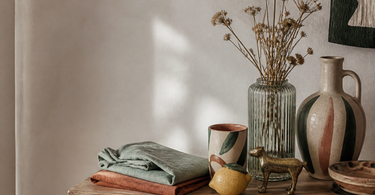
Ornaments and figurines are the details that create personality on shelves and in windowsills. Choose from hand-blown glass figurines, ceramic porcelain figurines and fun ornaments in unexpected shapes — and mix materials and sizes to create depth. Glass catches the light best in the windowsill, ceramic works everywhere, and brass adds warmth to a mix. The result is a shelf that says something about you.
A shelf without ornaments is a shelf that just stores things. Add a couple of figurines, and suddenly the room says something. But what works where, and how do you avoid it all just looking cluttered? It's about material choice, proportions and a bit of knowledge about how light and surface play together. Here's what you need to know.
What actually is an ornament?
Ornament is a broad term — it covers everything from a small 5 cm figurine to a larger sculptural object that anchors the whole shelf. What sets an ornament apart from other decoration is that it's primarily there for its own sake: not as a container, not as a light source, but as a visual statement.
The material largely determines what an ornament can do. Glass is transparent and reacts to light. Ceramic and porcelain are matte or glazed and absorb light differently. Brass reflects. Resin can be shaped into almost anything. When you combine them on the same shelf, you create layers — and layers are what make the difference between a shelf that looks considered and one that looks random.
The ornaments you find with us range from completely classic figurines to distinctly playful shapes. Both have their place — depending on what the rest of the room does.
Glass figurines: light and delicacy
Hand-blown glass figurines are perhaps the most technically demanding category. A skilled glassblower can spend 10-20 minutes on a single figurine, and the process leaves natural variations in thickness and colour — two seemingly identical figurines will never be completely identical.
Placement makes all the difference
Glass is designed to react to light, and you make the most of this by placing the figurines where they actually get light. A windowsill is the obvious choice: here daylight can pass through and cast coloured reflections on the wall behind or on the sill itself. A dark shelf in a poorly lit corner is rarely the right spot for a glass figurine — it's a bit like hiding a coloured glass lamp away in a drawer.
Our selection of glass figurines varies in shape from organic, amorphous sculptures to recognisable animal and plant figures. The size is typically between 8 and 20 cm, and the thickness of the material directly affects how much light gets through.
Caring for glass
Glass figurines gather dust, and dust on glass is visible. A soft, slightly damp cloth is enough. Avoid paper or abrasive cleaners — glass scratches more easily than you'd think. Always check whether the figurine is hand-wash or dishwasher-safe: hand-blown glass is almost always hand-wash only.
Tip: Place glass figurines in the windowsill rather than on a dark shelf. Even diffuse northern light activates the colours in the glass — and in winter, when the sun sits low, a single figurine can cast colourful reflections up to a metre onto the wall.
Porcelain figurines: a classic collector's piece
Porcelain and ceramics have a long tradition as collector's items — from 18th-century Chinese export porcelain to today's more playful interpretations. What makes porcelain figurines interesting today is exactly that range: the material carries a classic weight, but the design can go in a completely different direction.
Animals, food and fantasy figures
Many of the porcelain figurines we carry are shaped like animals or everyday objects — everything from birds and cats to dishes and fruit. It's an aesthetic that draws on a long ceramic tradition of naturalism, but interpreted with contemporary proportions and colours.
Porcelain is fired at a minimum of 1260°C, which gives a dense, almost non-porous material. This means porcelain figurines are relatively robust compared to stoneware or terracotta — they cope better with being displayed without protective treatment. The glaze (the glossy surface) is baked into the material and stays put.
Proportions and composition
A single figurine on a shelf can look lonely. Three figurines of varying height — for instance 6, 10 and 15 cm — immediately create more movement. A rule of thumb: don't place the tallest figurine in the middle, but a third of the way in from the edge. This gives the composition a natural balance without looking too symmetrical.
If you want more structure on your shelves in general, you can combine figures with other decorative elements — like a single vase or a candlestick — to vary both function and shape.
Fun ornaments: form over function
There's a special category of ornaments that don't try to look classic. Doughnuts, pizza slices, Nutella jars, unicorns — objects that draw their aesthetic from pop culture and everyday humour. Many of them are designed as Christmas ornaments with a hanging loop, but work just as well as shelf ornaments the rest of the year.
It's about daring to do something with the decoration. A single fun ornament on an otherwise sober shelf can do more for a room's personality than ten "safe" choices combined. The trick is balance: one playful detail in a coherent expression works. Five compete for attention and cancel each other out.
Many of these ornaments are made from resin or painted papier-mâché — materials that are light and cheap to shape into complex details, but that can't withstand moisture or direct sunlight over a long period. Don't place them permanently in a south-facing windowsill.
See all the fun and quirky shapes in our decoration range — here you'll find ornaments, figures and more for shelves and tables.
How to mix materials on the shelf
It's in the combination that things get interesting. A single material on a shelf looks uniform, but rarely lively. Three materials playing off each other create depth — provided you think about what contrasts and what harmonises.
| Material | Surface | Best placement | Combines well with |
|---|---|---|---|
| Mouth-blown glass | Transparent, reflective | The windowsill | Brass, light wood |
| Porcelain / ceramics | Matte or glazed | Shelving unit, shelf, table | Glass, textile |
| Brass | Warm, metallic shine | Anywhere, especially dark shelves | Ceramics, dark wood |
| Resin / papier-mâché | Matte, detailed | Protected indoors | Ceramic, textile |
Three simple principles for shelf composition
- Vary the height: Mix figures at 5, 10 and 15+ cm. Monotone heights create a flat look.
- Use odd numbers: Three or five objects are visually easier to work with than two or four, which can easily look too symmetrical.
- Give it air: An ornament needs empty space around it. Overcrowded shelves cancel out the character of each individual piece.
Besides the figures themselves, you can use other elements to anchor the composition: a single candle or a small plant pot cover with a plant can give the shelf an organic element that makes the figures stand out even more as details.
If you want to go even deeper into wall decoration as a complement to the shelf, you'll find inspiration in our wall decoration.
Frequently asked questions
What's the difference between an ornament and a figure?
In practice, the terms are used interchangeably, but ornament typically covers a broader range — including flat or abstract decorative forms. Figure is most often used for a three-dimensional object with a recognisable shape, such as an animal or a person. In everyday language, the distinction isn't important.
Can Christmas ornaments be used the rest of the year?
Yes, most Christmas ornaments with a hanging loop work just as well as shelf or table decoration. The loop can be hidden by turning the figure around, or it can be hung on a hook as part of a wall composition. The shape — such as a doughnut or a pizza — isn't specifically Christmassy.
How many figures are too many on one shelf?
It depends on the size of the shelf, but a rule of thumb is: if each object doesn't have at least 3-5 cm of air to its neighbour, the shelf is overcrowded. A shelving unit 80 cm wide works well with 3-5 objects of varying sizes. The rest of the space is best left empty.
Can glass figures withstand daylight?
Mouth-blown glass handles daylight well and actually benefits from it. However, avoid extreme direct sun for many hours a day — over time, this can affect any colourants in the glass. Glass without added colour is unaffected by light and can sit in the windowsill all year round.
What pairs best with ceramic figures on a shelf?
Glass and brass are the two materials that typically work best as a contrast to ceramic. Glass adds transparency and lightness, while brass gives warmth and shine. Avoid mixing too many plastic materials with ceramic — the difference in surface can be too great and can look cheap.
Are porcelain figures fragile?
Porcelain is stronger than many think — fired at over 1260°C, it has a very dense body. It's hard but brittle: it withstands static load well, but a fall onto a hard floor is rarely forgiving. Keep them on stable shelves away from edges and high-traffic areas.
Summary
Ornaments and figures aren't decoration in a condescending sense — they're the concrete choices that determine whether a room has character. Glass figures belong in the light, porcelain figures thrive anywhere and withstand daily use, and fun ornaments in unexpected shapes can lift an otherwise understated composition. The key is the mix of materials: glass, ceramic and brass complement each other because they reflect and absorb light in very different ways. Mix sizes, give the figures air, and use odd numbers. Then you've got a good starting point.
Explore our range of ornaments and figures — or find inspiration in our entire decoration section.