
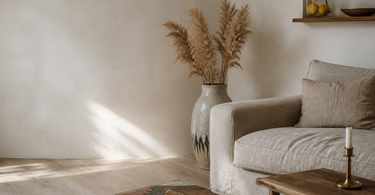
Minimalist interior design isn't about empty rooms — it's about conscious choices. Every object should serve a function or have a form that can stand alone. Clean lines, a restrained colour palette and high craftsmanship quality are the cornerstones. When you remove the superfluous, the remaining things gain far more impact — and the room gets room to breathe.
There's a difference between a room that's empty and a room that's been reduced to the essential. Minimalist interior design belongs to the second category. It's a discipline that requires you to ask sharp questions about every object you bring into your home: Does it have a function? Does it have a form that lasts? And can it stand alone without needing other things to defend its presence? When you start asking those questions, decorating shifts from a shopping exercise to something closer to editing work.
What is minimalist interior design?
Minimalist interior design is built on the principle that every single element in a room is chosen thoughtfully — and that nothing is superfluous. It's not a style defined by absence, but by precision. Furniture is simple in its design, yet sophisticated in its craftsmanship. Surfaces are uncluttered, not because there's nothing to display, but because what is displayed has been carefully chosen.
The style is visually characterised by clean lines, a muted base palette and a deliberate focus on the relationship between form and function. Decoration is sparse — but that makes each individual piece something closer to a small work of art. A ceramic dish, a single branch in a narrow vase, a candlestick in clear glass. It's not little. It's enough.
Minimalism emerged as an art movement in 1960s USA, but as an interior design style it truly took hold in Scandinavian home culture, where it resonated well with an existing design tradition of simplicity and functionality. Today it's more relevant than ever — not least as a counterweight to a consumption culture that constantly pushes you to add more.
How to choose the right pieces
In a minimalist room, poor purchases are impossible to hide. When you only have a few things on a shelf or table, each one is fully visible — and a thoughtful selection process isn't a luxury but a necessity.
A practical rule of thumb is to ask three questions about a potential new object:
- Does it give me real joy or calm — not just in the shop, but imagined in your home?
- Does it have a concrete function beyond the decorative?
- Is the form strong enough for the object to stand alone without support from its neighbours?
If you say yes to at least two of the three, the item has earned its place. It's not a system that eliminates all doubt, but it eliminates impulse. And that's exactly what minimalist interior design requires.
Tip: Try the "one in, one out" rule: every time something new arrives in your home, something existing should leave it. It keeps the number stable and forces you to prioritise actively instead of accumulating passively.
Storage is an underrated part of minimalist interior design. Visible storage only works if what's being stored is visually strong enough. Everything else belongs behind closed doors. Thoughtful storage is the foundation for clean surfaces — and clean surfaces are the foundation for the minimalist expression.
Vases as sculptural objects
In the minimalist home, a vase is rarely just a container. It's a sculptural object that defines a corner, a shelf or a table. A tall, organically shaped large vase on the floor can be the only decorative element in a room — and that's enough, if the form is strong enough.
The choice of material says a lot. Ceramics with visible traces of craftsmanship — irregularities in the glaze, asymmetry in the clay — bring warmth to rooms that might otherwise risk feeling clinical. Ceramic vases from European manufacturers typically vary in wall thickness between 4 and 8 mm depending on technique and firing temperature, and this very handmade variation is a quality in itself in a minimalist context.
Glass vases with clean lines and transparent elegance have a different quality: they change character with the light and with the seasons. Empty in winter, they're still a decorative element. A single dried branch in autumn changes the whole register of the room. It's exactly this kind of flexibility that minimalist interior design benefits from.
Wall vases as a space-saving solution
If you have limited horizontal space, wall vases are an elegant alternative. They add a botanical or sculptural element to a wall without taking up worktop space, and in a minimalist setting, they work as a replacement for picture frames and other wall decor.
Candles and candlesticks
Light isn't a detail in minimalist decor — it's one of the most important tools. Natural light is enhanced by clean surfaces and the absence of clutter. But artificial light, and candlelight in particular, solves a problem that many minimalist rooms struggle with: coldness.
A room with white walls, concrete-grey floors and a single piece of furniture can feel sterile if there are no warm light sources. Candles and candlesticks add the organic, flickering quality of light that a minimalist room needs without adding visual clutter.
Crystal candlesticks have a particular quality in this context: they break light into prisms and create reflections on walls and ceilings that give a room life and depth. A single crystal candlestick on a dining table is functional as a candlestick, sculptural as an object and dynamic as a light source — three functions in one.
Glass candlesticks with simple, geometric shapes are another solid choice. They don't hide, but they don't shout either. They're present in the way everything in a minimalist home should be: quiet and precise.
| Type | Material | Minimalist strength |
|---|---|---|
| Crystal candlestick | Lead crystal or optical crystal | Light refraction, subtle luxury, sculptural form |
| Glass candlestick | Mouth-blown or pressed glass | Transparency, geometry, translucence |
| Ceramic candlestick | Stoneware or earthenware | Handcrafted texture, matte surface, warmth |
Mirrors: space and reflection
Mirrors are one of the most effective tools in minimalist decor — because they add nothing, yet change everything. A large mirror doubles the visual size of a room, carries light from the window into dark corners, and works as a decorative element that constantly changes its content.
Round mirrors are especially popular in minimalist interiors, because they break the dominance of straight lines without adding chaos. A round mirror above a console or a hallway chest of drawers is a statement in itself — simple, yet visually strong.
Choose mirrors with thin, simple frames or no frame at all. Place them deliberately so they reflect something worth seeing twice: a window, a vase, a candlestick. It's not random decoration — it's curated space.
Can minimalist interior design have colour?
Yes — and the question reveals a common misconception. Minimalism is about reduction, not about fear of colour. The classic white-beige-grey palette is one approach, but it's not the only valid one.
A minimalist decor in warm terracotta tones, deep botanical greens or gentle dusty blue shades can work just as well — provided the colour discipline stays intact. That means: choose one or two colours beyond the neutrals, and use them consistently. A single coloured vase and a matching set of candles can be the only coloured elements in a room. That's precisely why they'll have real impact.
Colour in the minimalist room works best as an accent, not as a backdrop. That's the difference between a room that speaks and a room that shouts.
Quality over quantity
Minimalist interior design isn't a cheap style — it's an investment. And that logic makes sense: when you own fewer things, you can afford to choose the best. And the best lasts, both in durability and in aesthetic relevance over time.
Mouth-blown glass from European manufacturers typically takes 5-15 minutes per piece to produce and varies slightly from one piece to the next — that's precisely the variation that sets handmade apart from mass-produced. Ceramics fired at high temperatures (above 1200°C, the stoneware category) are generally denser, harder and more durable than low-temperature earthenware. That's the kind of fact that matters when you've got just one object on a shelf.
Invest in the things you see and use most. A solid candlestick on the dining table, a vase that suits your room, a mirror positioned at eye level. That's a home built up one good choice at a time.
Frequently asked questions
Is minimalist interior design the same as Scandinavian design?
They overlap, but they're not identical. Scandinavian design has a strong minimalist tradition — a focus on function, natural materials and clean lines — but it also allows more expressiveness than strict minimalism does. Minimalism is a philosophy; Scandinavian design is a geographical and cultural design tradition. Many Scandinavian products fit perfectly into a minimalist home without one category swallowing the other.
How do you keep a minimalist home tidy day to day?
Minimalism makes upkeep easier, because you own fewer things. Set fixed places for everything, and stick to them. Use the "one in, one out" rule actively — not just as a concept. Go through your things twice a year and ask yourself the same question you asked when buying them: does this still deserve its place?
Can you live a minimalist life with kids?
Yes, but it takes flexibility and zoning. Keep the shared spaces closer to the minimalist ideal, and give the children's rooms freedom to have their own expression. Choose robust materials in the shared areas — ceramic vases in stoneware and candlesticks in heavy glass withstand busy everyday life better than fragile trinkets.
Is minimalist interior design boring?
Quite the opposite — provided the pieces are well chosen. When every object is selected with care, a calm and a visual depth emerge that overfurnished rooms never achieve. It's about letting materials, shapes and proportions speak, rather than filling the room with noise. A well-placed object with a strong shape is anything but boring.
What does it cost to decorate minimalistically?
Minimalist interior design isn't necessarily expensive, but it shifts towards fewer and better things rather than lots of cheap ones. Your budget is determined by what you value — but expect to spend more per object than you would in a more eclectic style. In return, you buy less often. Over time, it's often better economy.
Which decorations are best suited to minimalist interior design?
Go for objects with a strong shape and a limited level of detail. Vases with a sculptural silhouette, candlesticks in clear or frosted glass, mirrors with slim frames and ceramics with an even glaze are all good starting points. Avoid decorations that need a "family" of other things to make sense — in a minimalist room, every piece should be able to stand on its own.
Summary
At its core, minimalist interior design is an editing exercise. You start with what you already have and remove what doesn't hold up — in function, in form, or in the feeling the object gives. What remains is your true home.
The most important principles are discipline in your selection, investment in quality, and awareness of how light, materials and proportions work together. A single ceramic vase, a crystal candlestick and a round mirror can define a room completely — if they're chosen right and placed thoughtfully. You don't need more than that. You just need the right thing.
Explore our range of decoration for the minimalist home — or find the right Vase, candlestick or mirror for your room.