
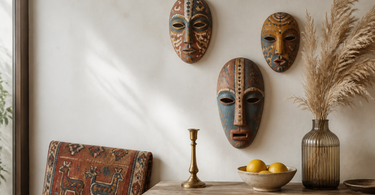
Decorative masks are one of the most effective ways to give a wall character and depth. They come in materials like wood, ceramic and papier-mâché — and are typically handmade, so no two are alike. A single mask works as a solitary statement; three or more create a gallery wall. You can also place them on shelves or chests of drawers if you'd rather avoid drilling into the wall.
A decorative mask does something to a wall that a picture rarely does: it has volume, shadow and a tactile quality that changes with the light in the room. It's wall decor with depth — quite literally. But there's a difference between hanging up a mask and hanging it up properly. Below, we go through materials, placement logic and combination options, so you avoid the classic pitfall: a single mask looking lonely in the middle of a white wall.
What are decorative masks?
Masks as wall decor have deep roots in many cultures — from African and Mexican craft traditions to South East Asian theatre culture. In modern home decor, they've been detached from their ritual or dramatic functions and are used primarily as sculptural elements with cultural resonance.
What sets masks apart from other forms of wall decor is the three-dimensional expression. Where a print or a poster is flat, a mask casts shadows and changes appearance depending on where the light in the room falls. This means they interact with the room in a way that shifts throughout the day.
In Scandinavian homes, they're typically used as a counterpoint to minimalism — an element that breaks the clean line and adds something unexpected. It works especially well in rooms that are otherwise restrained in expression.
Materials and craftsmanship
The most common materials for decorative masks are wood, ceramic and papier-mâché. Each material has its own look and its own production conditions.
Wood
Wooden masks are usually hand-carved, meaning that surface texture and proportions vary from piece to piece. Colouring is typically done with natural pigments or hand-painted acrylic. Weight depends on the type of wood — light tropical woods like balsa can weigh under 200 grams, while dense types like mahogany come in at three times that for a mask of the same size.
Ceramic
Ceramic masks are fired and glazed, and the surface can range from matte and rough to glossy and reflective. They're typically heavier than wood and require sturdy fixings. Ceramic has the advantage that the glaze allows for very precise colour rendering — from earthy umber tones to bright, graphic colours.
Papier-mâché
Papier-mâché is the most readily available material and is especially used in Mexican and South American craft traditions. It's light, relatively sturdy and can be shaped with great detail. Many papier-mâché masks are decorated with patterned textiles, mirror glass or natural materials.
Tip: Always check the back of the mask before mounting it. Most handmade masks have either a wire or a groove for hanging — but it's not always placed exactly in the centre. Measure the distance from the top to the hanging point, so you get it right on the first try.
Placement on the wall
The most important decision isn't which mask you choose, but where you hang it. Ceiling height, the line of your furniture and the distance to other elements all play a part.
Single mask as a solitary element
A single mask works best when it has something to play off — for example, above a sofa, a side table with candlesticks or above a chest of drawers in the hallway. The eye-level rule applies here: the centre of the mask should be placed roughly 145–155 cm from the floor, corresponding to average eye level when standing. If you sit down, the optimal placement shifts a bit lower — around 130 cm, if the mask is to be seen primarily from sofa level.
Masks on the staircase
A staircase is a natural gallery corridor, and here it makes sense to follow the line of the stairs with masks at increasing heights. Keep a consistent vertical distance — e.g. 20–25 cm between each hanging point — and vary size rather than position to create dynamism without chaos.
Gallery wall with masks
Three or more masks on the same wall work as a curated gallery — but require more planning than a single mask. Here are the principles that make it easiest:
- Odd numbers:Three, five or seven masks look more organic than two or four.
- Vary size, not style: Mix large and medium masks, but keep a common thread in the material or colour palette.
- Spacing: 10–15 cm between the masks gives breathing room without them visually falling apart.
- Try it on the floor first: Lay the masks out on the floor in the arrangement you're imagining, before you drill the first hole.
A classic gallery-wall principle is to have an anchor point — typically the largest mask — and build the others around it as satellites. This gives the eye a natural resting point and prevents the wall from looking scattered.
Combine with other decor
Masks don't have to stand alone. Combined with other wall-mounted elements, they can become part of an eclectic composition that looks curated rather than random.
Mirrors
A round or oval mirror next to a mask creates an interesting interplay of shapes — organic versus sculptural. Round mirrors work particularly well for this, because they don't compete for attention with the mask's facial form. The mirror reflects light into the room; the mask absorbs it. It's a good balance.
Posters and prints
Flat poster wall decor can act as background noise that lets the mask stand out. Use neutral tones in the prints if the mask is colourful — and vice versa. The point is that the three-dimensional element (the mask) will always dominate visually, so use the flat elements to frame it.
Hooks and hangers
In a hallway, a combination of masks and hooks for the hallway is a practical and aesthetic solution. The hooks provide functionality; the masks provide character. Make sure the two types of elements are spaced far enough apart that hoods and bags don't cover the masks.
Masks on shelves and chests of drawers
Not all masks need to go on the wall. A mask leaning against the wall on a shelf or a chest of drawers gives a more relaxed and flexible look — and is ideal if you're renting or simply don't want to drill.
The styling works best when the mask is combined with other objects at varying heights: a vase, a couple of candles and maybe a small figure. The key is to let the mask be the largest element, so the hierarchy in the arrangement is clear. Use a small wedge-shaped stopper (e.g. a folded cork) behind the mask to give it a slight forward angle — it looks more intentional than a mask pushed flat against the wall.
You could also consider combining masks with ornaments in the same tone or material to create a cohesive composition on the shelf without it looking overcrowded.
| Placement type | Best for | Things to watch out for |
|---|---|---|
| Single mask on the wall | Statement piece above sofa or bed | The mask needs to be large enough not to get lost |
| Gallery wall (3+) | Staircase, long hallway, large side wall | Plan the arrangement on the floor first |
| Shelf/chest of drawers | Tenants, flexible setups | Use a wedge so the mask angles forward |
| Mixed gallery wall | Eclectic look with mirrors, prints and hooks | Let the mask dominate — flat decor as backdrop |
Frequently asked questions
Which materials are most durable for decorative masks?
Wood and ceramic are the most durable materials for masks intended for permanent hanging. Papier-mâché is lighter and well-suited to changing arrangements, but more sensitive to moisture. Avoid hanging papier-mâché masks in bathrooms or kitchens, where humidity is high.
How many masks are needed for a gallery wall?
Three masks is the practical minimum for a gallery wall — it gives enough variation for the arrangement to read as a composition rather than a random cluster. Five to seven is ideal for larger wall spaces. Use an odd number for a more organic result, and vary the size rather than buying identical masks.
Can you mix masks with other types of wall decoration?
Yes — and it's actually recommended. Masks work well together with mirrors, posters and ceramic wall hangings. The key is to let the mask be the visual anchor point. Flat decoration like prints and posters works best as a background frame, while the mask draws the eye with its volume and depth.
What do I do if I don't want to drill holes for the masks?
Let the masks lean against the wall on a shelf or chest of drawers. This gives a relaxed, more still-life-like look. Use a small wedge-shaped stopper behind the mask so it angles slightly forward. Combine with vases, candlesticks and ornaments to turn the arrangement into a deliberate composition rather than a temporary solution.
Are decorative masks exclusively handmade?
Most decorative masks in ceramic, wood and papier-mâché are handmade or hand-painted, which means colour, details and proportions vary slightly from mask to mask. This is a quality rather than a flaw — two masks from the same series are never identical, and that's precisely what sets them apart from mass-produced wall decorations.
Which rooms do masks work best in?
Masks work in any room, but they particularly shine in living rooms, hallways and staircases — rooms with foot traffic, where you naturally move past and discover details. In the bedroom, a single mask above the headboard can create a focal point without feeling overwhelming. Avoid damp environments like poorly ventilated bathrooms, unless the mask is ceramic.
Summary
Decorative masks in wood, ceramic or papier-mâché are one of the most effective ways to add three-dimensional character to a wall. They're almost always handmade, and the variation from piece to piece is part of the aesthetic. One mask placed deliberately — at eye level, with space around it — works as a solitary statement. Three or more masks arranged with consistent spacing and varying sizes create a gallery effect. Combined with mirrors, posters or ceramic hangings, they can become the centrepiece of an eclectic wall composition. And if you'd rather not drill at all, a mask works just as well on a shelf, leaning against the wall with a vase beside it.
Explore our range of decorative masks — handmade in wood, ceramic and papier-mâché.