
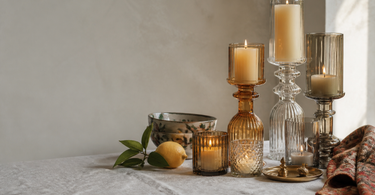
Glass candlesticks capture and spread light in a way no other material does — because glass allows light to pass through rather than absorbing it. You'll find them in variants such as mouth-blown, pressed, coloured and crystal, and they suit everything from the everyday table to the party tablecloth. Size, colour and glass type determine the look and function. Use an odd number of candlesticks, mix heights, and think about whether you want candles or LED lights.
Glass and light are an age-old combination that never fails. The flame behind a piece of glass is constantly changing — it reacts to every gust of air, and the light breaks differently depending on the glass thickness, colour and surface. It's this effect that has made glass candlesticks a permanent feature of home decor, from the crystal chandeliers of the Baroque era to today's Scandinavian shelves. This guide covers the most important types, sizes and styling tricks, so you can make a well-considered choice.
Types of glass candlesticks
Glass isn't one material with one look. The production method and the composition of the raw materials determine how the light behaves — and thereby the entire mood of the room.
Mouth-blown glass
Mouth-blown glass is made by a glassblower shaping molten glass with their lungs and specialist tools. The process leaves traces: small air bubbles, variations in glass thickness and slightly asymmetrical shapes. No two candlesticks are identical. That's exactly what makes mouth-blown candlesticks so appealing — they visibly carry the craftsmanship. Scandinavian glassworks have long traditions in mouth-blown glass, and the method is still used by a number of European producers.
Crystal
Crystal candlesticks differ from ordinary glass by having a higher content of lead dioxide or barium — typically 24% or more in classic lead crystal. This increases the refractive index and gives the characteristic play of light prisms. Crystal is heavier than ordinary glass and rings differently when you tap it lightly. It's a classic party candlestick, but many use crystal every day for the refined sheen it gives.
Coloured glass
Colour is added to the glass mass during production via metal oxides: cobalt oxide gives blue glass, iron oxide green, and gold gives ruby red. The result is that the light is filtered and coloured before it spreads out into the room. Amber and cognac-coloured glass are warm and inviting, while blue and green create a cooler, calmer mood. See, for example, coloured candlesticks in amber and green tones.
Pressed glass
Pressed glass is made by pressing molten glass into a mould under high pressure. The method allows for detailed reliefs and geometric patterns that are hard to achieve with blowing. Many of the popular retro designs from the 1950s and 1960s are exactly in pressed glass. They have a nostalgic charm and a budget-friendly profile — and they're easy to find at flea markets if you're into vintage.
Tip: Want to test whether a piece of glass is crystal? Gently tap the edge with a fingernail. Crystal gives a long, clear ring. Ordinary glass sounds flatter and more short-lived.
How to choose the right size
The size of the candlestick should be in proportion to the surface it's going to stand on, and the social context it's used in. Here are some practical rules of thumb:
| Placement | Recommended height | Number of candlesticks |
|---|---|---|
| Dining table (4-6 people) | 15–25 cm | 3–5 pcs. |
| Dining table (8-10 people) | 15–30 cm | 5–9 pcs |
| Windowsill / bookshelf | 10–35 cm | 1–5 pcs |
| Floor (by fireplace/corner) | 40–80 cm | 1–3 pcs |
| Party table | Mixed | Groups in odd numbers |
One important detail for the dining table: the candlesticks mustn't block eye contact between guests. Keep the top of the flame below eye level for seated adults — that's below approximately 50–55 cm from the table surface including the candle. If you have tall candlesticks, you can instead gather them in the middle as a sculptural group and let them speak for themselves without a candle lit.
On the floor, large glass candlesticks work best at natural anchor points: a fireplace, a corner or a doorway. They create dramatic depth when lit in the evening, but require space and a stable surface.
Coloured glass candlesticks in interior design
Coloured glass is one of the easiest ways to introduce a new colour into a room — without painting walls or changing furniture. The effect is subtle in daylight and dramatic with candlelight in the evening.
Warm palette: amber, cognac and golden yellow
These colours enhance the warm glow of candlelight and work well in rooms with wooden furniture, earthy tones and natural textiles. They connect visually with organic materials and create a cosy, welcoming atmosphere.
Cool palette: green, blue and grey
Cool glass colours suit white or light grey walls and rooms with a more minimalist look. A deep bottle-green candlestick adds a botanical touch, while cobalt blue glass draws the eye as an accent piece.
Playful palette: pink, purple and turquoise
These colours work as a contrast in neutral rooms and suit a more bohemian or eclectic look. Combined with ceramic candlesticks in matching shades, a cohesive look emerges without feeling monotonous.
A concrete styling tip: choose a coloured glass candlestick in a shade that already appears elsewhere in the room — in a rug, a cushion or a piece of art. It visually ties the room together without requiring many changes.
Styling with glass candlesticks
Glass candlesticks are unusually flexible. They're transparent and therefore don't visually take up space in the same way as solid metal or ceramic — which means you can use several of them without the table or shelf looking overcrowded.
Odd numbers and varied heights
Three or five candlesticks look more dynamic than two or four. It's a classic composition technique from fine art: odd numbers create movement, while even numbers give symmetry and stillness. Feel free to mix candlesticks of different heights — place the tallest at the back and the shorter ones in front, or let them stand in an irregular row.
Glass in front of mirrors
A pair of glass candlesticks in front of a mirror visually doubles the light and creates depth. The mirror reflects the flame and the glass's sheen, and the effect is especially striking in rooms with dimmed lighting.
Combine materials
Glass looks its best when combined with other materials. A ceramic candlestick next to a glass candlestick creates a material contrast that gives the collection depth and personality. Similarly, glass works well alongside brass, concrete or terracotta.
Seasonal use
Glass candlesticks aren't just for winter decoration. In summer, you can place a small bunch of wildflowers or a few branches in a tall, open glass candlestick instead of a candle — the effect is simple and elegant. In winter, you light a real candle and enjoy the flickering glow behind the glass.
Care and maintenance
Glass candlesticks require minimal care, but there are a few things worth knowing.
Removing wax residue
The quickest method: put the candlestick in the freezer for 1–2 hours. Wax contracts at low temperatures and loosens from the glass surface. You can then pick it off with your fingers or a soft plastic scraper. Avoid metal tools, which can scratch the glass.
Alternatively, you can pour a little warm (not boiling) water into the candlestick — the wax melts and floats to the surface, where you can remove it. Then wash with warm water and a mild washing-up liquid.
Crystal needs extra care
Crystal candlesticks should be polished with a soft, lint-free cloth after washing. Avoid the dishwasher — the high temperatures and harsh detergents can dull the surface over time and remove the characteristic shine. Wash by hand with lukewarm water and dry immediately.
Coloured glass
Coloured glass is generally robust, but direct sunlight over long periods can, in theory, fade intensely coloured glass. This is rarely an issue in Danish light conditions, but it's worth bearing in mind if you place candlesticks on a south- or west-facing windowsill.
LED lights or candles?
The short answer: both work, but they give a different effect.
LED taper candles have improved significantly in recent years. The best models have a flickering glow that surprisingly convincingly mimics a real candle. Choose LED candles with a colour temperature of 2200–2700 K — this corresponds to the warm, yellow glow of a wax candle. Cheaper LED candles often have a colour temperature of 3000–4000 K, which gives a cooler, whiter glow that doesn't harmonise with the warmth of glass candlesticks.
LED candles are a great choice if you have children or pets, or if the candlestick is somewhere you can't keep a direct eye on. They're also practical in unique candlesticks with narrow holders, where a dripping wax candle can create a mess.
What LED can't replace is the organic unpredictability of a real flame. A living candle behind a glass reacts to the air currents in the room — it bends, flickers and casts shadows that are impossible to replicate digitally. For dinner or special occasions, wax candles are still the most convincing choice.
Tip: Use LED candles in candlesticks that are hard to reach daily (tall shelves, alcoves), and save wax candles for the candlesticks within reach on the dining table or coffee table — where you sit and enjoy the effect up close.
Frequently asked questions
Which type of glass is best for candlesticks?
It depends on budget and style. Crystal gives the most shine and the most beautiful light prisms, but is the most expensive option. Mouth-blown glass has an organic character and is unique piece by piece. Coloured pressed glass is affordable and holds up well. For everyday use in busy rooms, thicker, pressed glass is the most durable choice.
How many glass candlesticks suit a dining table?
For 4–6 people, 3–5 candlesticks in varying heights is a good starting point. For a table seating 8–10, you can increase to 5–9 candlesticks. Remember to leave room for plates, glasses and dishes — the candlesticks shouldn't dominate the table functionally. A group in the middle with lower candlesticks towards the sides creates good balance.
Can all glass candlesticks be used outdoors?
Technically, you can use most glass candlesticks outdoors, but you should take wind and moisture into account. Enclosed lanterns protect the flame better than open candlesticks. Avoid leaving fine crystal candlesticks outside — temperature fluctuations and moisture can put strain on the glass over time, and crystal is more fragile than standard glass.
What's the difference between crystal and ordinary glass?
Crystal typically contains 24% or more lead oxide or barium, which increases the refractive index and gives a clear, prism-like play of light. Crystal is heavier, rings when tapped lightly and is harder to scratch than soft glass. Ordinary glass is lighter and cheaper to produce, but doesn't have the same optical properties.
Can glass candlesticks be combined with ceramic candlesticks?
Yes, and it's recommended. Glass and ceramic complement each other — the contrast in materials gives the collection visual depth. Keep a common thread through colour or height — for example, clear glass and ceramic in earthy tones. See ceramic candlesticks as a starting point for a mixed collection.
What does a good glass candlestick cost?
Prices vary a lot. Simple pressed-glass candlesticks can be found for 50–150 DKK. Mouth-blown or coloured designer candlesticks typically fall within 200–600 DKK. Crystal candlesticks in recycled crystal or handmade quality cost from around 300 DKK and upwards. The quality can be seen and felt — thickness, weight and the surface finish quickly reveal the price range.
Summary
Glass candlesticks are versatile décor that work in almost any room and any style. The choice of glass type — mouth-blown, crystal, coloured or pressed — determines the look and price point. The size is adapted to the surface and context: the dining table, windowsill, shelf or floor each has its own optimal proportions. Coloured candlesticks are an easy way to add colour, while clear glass and crystal work timelessly in ever-changing décor. Feel free to combine glass with ceramic candlesticks or other materials, use odd numbers and varied heights — and choose candles when you want the full effect behind the glass.
Explore our range of glass candlesticks — from coloured mouth-blown glass to classic crystal candlesticks.