
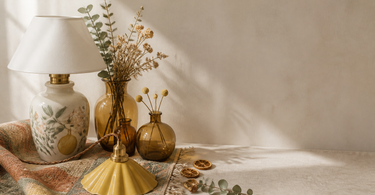
Lamps fall into three main categories: table lamps, pendants/ceiling lights and freestanding lamps such as mushroom lamps. You get the best lighting experience by combining several light sources at different heights — and never settling for a single ceiling fixture. Rechargeable table lamps offer flexibility; pendants over the dining table set the visual tone; mushroom lamps work as sculptural decoration that also lights up. Choose according to function and mood, not just style.
Light is the fourth dimension of a room. You can have the right piece of furniture, the perfect colour on the wall and a rug with exactly the texture you were looking for — but with poorly placed or one-sided lighting, the whole mood falls apart. Fortunately, lighting is one of the easiest parameters to adjust once you understand what the different lamp categories do to a room. This guide covers the three most important types and explains how to put them together.
Why light transforms a room
Our eyes perceive a room differently depending on where the light comes from and in which direction it spreads. A single ceiling fixture in the middle of the ceiling casts an even, shadowless light that's functional but rarely cosy — it's the type of lighting most often found in offices and supermarkets, and there's a reason so few people want to live in them.
In interior design, this is called layered lighting: a principle that combines three levels. Ambient light forms the base lighting and typically comes from the ceiling. Task lighting is aimed at specific activities — reading, cooking, working at a desk. Mood lighting is the third layer: candles, floor lamps, mushroom lamps and other sources that warm up the room and create contrast with the rest of the light.
Contrast is the key word. When light and shadow exist side by side, a room is perceived as more alive and three-dimensional. That's exactly what you achieve when you work with lamps from different categories rather than a single lighting system.
Light temperature — warm or cool?
The colour temperature of light is measured in kelvin (K). Below 3000K gives warm, yellowish light — ideal for the living room and bedroom. Between 3000–4000K the light is neutral and suits the kitchen and bathroom. Above 4000K the light is cool and daylight-like, best for workspaces and studios. For home lighting in living rooms and bedrooms, 2700K is the classic recommendation.
Mushroom lamps: sculpture and light source in one
Mushroom lamps are characterised by their organic, pilz-shaped silhouette: a round shade mounted on a slender base. The design emerged as a reference to natural forms and has its roots in the modernist design thinking of the 1960s and 70s, but has undergone a significant revival in recent years.
What sets the mushroom lamp apart from a conventional table lamp is the choice of material. The shade is typically cast in opal glass, matt plastic or fabric, which diffuses the light instead of sending it directly in one direction. The result is a soft, almost cloud-like light without harsh shadows — perfect for reading corners, bedside tables and side tables, where you want cosiness rather than task lighting.
Rechargeable mushroom lamps
A large proportion of mushroom lamps today — including popular models from AU MAISON — come in rechargeable versions. That means no cord, no socket, free placement. A fully charged lamp typically lasts 8–20 hours depending on the brightness setting, and many models can be dimmed steplessly. Handy on the terrace in summer, on that little side table corner with no socket nearby, or as a mobile dinner table arrangement.
If you want the mushroom lamp as a purely decorative statement in a small format, a small mushroom lamp in 16×ø13 cm can work as an accent piece on a shelf or windowsill.
Tip: Place a rechargeable mushroom lamp on the dining table during dinner instead of a candlestick. It gives the same intimate, warm mood, but with adjustable brightness and no dripping wax.
Table lamps: task lighting and mood lighting
Table lamps are the most versatile lamp category. They're portable (most simply have a plug), can be moved between rooms and placed exactly where extra light is needed. They cover everything from sharp, functional desk lighting to soft mood lighting on a bedside table.
Bedside lamps
A bedside lamp should ideally have a brightness adjustment, so you can dim it down to a minimal glow for evening reading without disturbing a sleeping partner. Choose a lamp that's at least 45–55 cm tall, so the light falls down onto the book and not directly into your eyes when you're lying down. The base should be heavy enough to stand stably when you're fumbling for it in the dark.
Desk lamps
For the desk, you need more directional light — ideally with a movable arm or adjustable neck. An adjustable desk lamp with 2700–3000K keeps the colour rendering close to natural light and reduces eye strain. Place the lamp to the left of the screen if you're right-handed (the other way round for left-handed people), to minimise reflections and shadows over the keyboard.
Lamp on the chest of drawers
A table lamp on the hallway console or living room chest of drawers works as a visual anchor point for a decorative arrangement. Combine it with a vase and a few other objects at varying heights to create a scenic "tableau". Here, the lamp's base and shade are part of the aesthetic — the choice of material should reflect the room's overall tone.
Pendants and ceiling lights: the room's anchor point
A pendant or ceiling lamp is the first element the eye registers when you step into a room. It sits at eye level, it's typically the room's largest single lamp, and it largely defines whether the room feels cohesive or random.
Pendant above the dining table
Above a dining table, the pendant is pretty much obligatory. The rule of thumb is that the bottom edge of the pendant should hang 70–80 cm above the tabletop. Hang it higher, and you lose the intimate zone; hang it lower, and people will hit it with their heads. For a long rectangular table of 180–200 cm, two pendants spaced 60–80 cm apart are a better solution than one large single one.
Ceiling lamps for the living room
In the living room, a ceiling lamp is rarely sufficient as the only light source — it primarily serves as general orientation lighting and visual interest. Choose one with a shade that sends the light downwards and sideways rather than straight down, to avoid glare. An opal diffuser or a fabric shade gives the softest result.
Size and proportions
A handy rule of thumb for pendant diameter: add up the room's length and width in metres and multiply by 25–30. A room of 4×5 metres therefore gives a recommended pendant diameter of 225–270 mm. For large open-plan rooms, you can go up to a diameter that corresponds to about 1/12 of the room's diagonal measurement.
How to combine light sources the right way
The key to good home lighting is layering. One light source — no matter how well designed — rarely gives you the result you're after. Three light sources at three levels give depth and control.
| Light source | Level | Function | Typical placement |
|---|---|---|---|
| Pendant / ceiling lamp | Top | Ambient light / orientation light | Middle of the room, above the table |
| Table lamp | Middle | Task light / accent | Bedside table, desk, chest of drawers |
| Mushroom lamp / floor lamp | Low | Ambient light / sculptural decoration | Side table, floor, dining table |
| Candles | Low | Warm, flickering ambient light | Everywhere — but especially on tables and shelves |
Feel free to combine your lamp setup with candles in candlesticks as the lowest and most intimate layer of light. Candles have a colour temperature of approx. 1800K — far warmer than even the warmest LED bulb — and provide an organic, flickering quality that no electric source can imitate.
A concrete everyday example: A living room works well with a pendant light for general lighting, a table lamp behind the sofa for reading light, and a mushroom lamp on the side table as ambient light, switched on instead of the pendant light when the evening film starts.
Light source and bulb: the technical basics
All lamp categories depend on which light source is fitted in them. Today, LED is the dominant choice, and rightly so — a standard LED bulb uses 8–10 watts to replace a 60-watt incandescent bulb and lasts 15,000–25,000 hours compared to the incandescent bulb's 1,000 hours.
Edison vs. opal glass
Edison bulbs with a visible filament-style wire (LED filament) give a warm, decorative look and suit lampshades with a visible bulb and open pendants. They typically have a lower brightness (lumen) and a colour rendering index (Ra) above 90, which makes colours in the room more accurate. Opal LED bulbs are more diffuse and better suited to lamps with a dense, closed shade.
Dimmability
If you buy a dimmable lamp, the bulb needs to match: not all LED bulbs are dimmable, and a non-dimmable LED on a dimmer can hum, flicker or fail prematurely. Always check that the bulb and dimmer are compatible — most manufacturers state this on the packaging.
Tip: If you're unsure of your lamp's socket type, E27 (the large screw base) and E14 (the small one) are the most common in Europe. GU10 is mainly used for spotlights. Take the old bulb with you to the shop, or measure the base diameter — E27 = 27 mm, E14 = 14 mm.
Frequently asked questions
How low should a pendant light hang above the dining table?
The rule of thumb is 70–80 cm from the tabletop to the underside of the lamp. If the pendant hangs higher, you lose the intimate lighting zone over the table. If it hangs lower, guests may be dazzled or bump into the lamp when they stand up. Adjust the ceiling bracket to exactly the right height before mounting the lamp permanently.
What's the difference between a mushroom lamp and an ordinary table lamp?
Mushroom lamps have a distinctive round, mushroom-shaped shade mounted directly on a slender base — often made of opal glass or a matte material that diffuses the light softly in all directions. A classic table lamp typically has a more traditional shade that primarily sends the light downwards. The mushroom lamp is more sculptural and works as a decorative object in its own right, even when switched off.
Are rechargeable lamps just as bright as corded lamps?
Most rechargeable lamps are designed for ambient lighting and have a lower brightness than fixed lamps — typically 50–200 lumens compared to a standard table lamp's 400–800 lumens. They're well suited as a tertiary light source (ambient light), but not as the sole light source for, say, reading. Battery life varies from 8 to over 20 hours depending on the setting and model.
Which colour temperature suits the living room and bedroom?
For the living room and bedroom, 2700K is recommended — this is the warm, yellowish light temperature reminiscent of old-fashioned incandescent bulbs, giving a calm, cosy atmosphere. For the kitchen and bathroom, you can go up to 3000–3500K for a more neutral, clear working light. Avoid cool daylight (over 4000K) in living spaces — it feels tiring over time.
How many pendant lights should I have over a long dining table?
Over a rectangular table of 180–220 cm, two pendant lights are recommended with 60–80 cm between them, centred over the table's midline. This gives more evenly distributed light than a single large pendant and is visually more balanced. Choose pendants from the same family or with the same material for a cohesive look, even if they're not identical.
Can I use a mushroom lamp outdoors?
Only if the lamp is rated IP44 or higher, which indicates that it's protected against splashing water. Most indoor mushroom lamps — including rechargeable versions — aren't designed for outdoor use in the rain. For the terrace: always check the IP rating, or place the lamp under cover, where it's protected from direct rainfall.
Summary
Good home lighting is about layers and contrast, not a single lamp. The combination of a pendant for the top light level, one or two table lamps in the middle layer and a mushroom lamp or candles as the lowest, warmest layer is the recipe for a room that works both functionally and atmospherically. Choose your light temperature with care — 2700K is the right choice for most living spaces — and make sure dimmable lamps are paired with compatible bulbs. These are the details that make a difference in everyday life.
Explore our range of lamps for the home — from pendants and ceiling lamps to rechargeable mushroom lamps.