
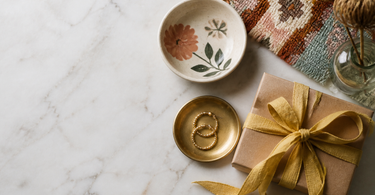
Jewellery as a gift can go wrong, but it doesn't have to. Earrings are the safest choice, because they don't require sizing. Rings require precise knowledge of the recipient's finger size. Necklaces in simple designs suit most people, while bracelets are flexible and easy to combine. Always choose timeless designs rather than trendy ones, so the gift lasts a long time.
Jewellery is one of the most classic gift categories, and one of those that most often ends up quietly in a bedside drawer. The problem is rarely the piece of jewellery itself, but the choice: size, style, material and when it's worn. This guide covers the four main categories, earrings, rings, necklaces and bracelets, and tells you exactly what you need to know about each type before you make a choice.
What can go wrong with jewellery as a gift?
Most mistakes with jewellery as a gift come down to one of three things: the wrong size, a misunderstood style, or a design that requires a specific wardrobe. A ring in the wrong size can't be worn. A necklace that's too short for someone with a high neckline never ends up around the neck. And statement earrings in a style that doesn't match the recipient's everyday look end up unused.
It doesn't mean you should choose the most boring alternative. It means you should choose the right alternative, and that starts with understanding which type of jewellery requires what.
Tip: If you're unsure about the recipient's style, look at what they already wear day to day. Metal finish (gold, silver, rose gold), size and complexity are the three most important things to look out for.
Earrings: the safest choice
Earrings are consistently the safest piece of jewellery to give as a gift. The reason is simple: they don't require a precise size. A pair of earrings with a diameter of 15-20 mm fits pretty much all ears, there's no ring size to get right, no chain length to match.
Which type of earring?
Earrings come in three basic shapes: hoops (circular ring), studs (sit directly against the ear) and drop earrings (hang down from the earlobe). Hoops and studs are the most versatile for everyday wear and can be worn with everything from jeans to a dress. Drop earrings are more of a statement and work best if you know the recipient's preferences.
Choose the metal finish carefully. Gold-coloured and silver-coloured are the two most neutral choices. Brass has made a comeback and works well for earthy, warm styles. Avoid mixing metals, unless you know the recipient mixes them deliberately.
Material and allergies
Nickel allergies are common, up to 15-20% of women are allergic to nickel according to the Danish Allergy Research Centre. Choose earrings in sterling silver (925), 14-carat gold, stainless steel or hypoallergenic brass to avoid problems. Avoid gold-plated earrings with an unknown base metal.
Rings: require more preparation
Rings are the hardest jewellery category when it comes to gifts. Finger thickness varies significantly, even on the same person the ring finger differs from one hand to the other, and a ring that's one size too small can't be put on.
Ring sizes in Denmark
In Denmark, rings are measured in millimetres (inner diameter). The most common sizes for women range between 16 and 18 mm, but there's a lot of variation. A ring in size 52 (inner circumference 52 mm = approx. 16.5 mm diameter) is average, but that's a rough estimate.
| Inner diameter | Inner circumference (mm) | EU size |
|---|---|---|
| 15.3 mm | 48 mm | 48 |
| 16,6 mm | 52 mm | 52 |
| 17,2 mm | 54 mm | 54 |
| 18,2 mm | 57 mm | 57 |
Adjustable rings as a solution
Adjustable rings with an open design (open band) can be tailored within a certain range, typically 2-4 sizes. They're not suitable for all finger types, but they eliminate the problem of precise ring sizing. If you're in doubt, an adjustable ring or a pair of earrings is almost always the better choice.
Necklaces: timeless and flexible
Necklaces are a good middle ground. They don't require sizing in the same way as rings, and a single design can be worn with most outfits. The key parameter is the chain length.
Chain lengths and placement
Necklaces are typically measured in inches or centimetres and determine where the chain sits on the body:
- 40 cm (16"): Sits close around the neck, choker-like. Not suitable for high necklines.
- 45 cm (18"): The most neutral length. Rests at the collarbone and suits most necklines.
- 50 cm (20"): Falls to the chest. Works well with V-necks and open shirts.
- 60 cm (24"): A long necklace, suitable for layering.
45 cm is the standard choice if you don't know the recipient's preference. It's the most versatile and least risky length.
Simple design over statement
A thin chain with a small pendant or a simple chain without a pendant is easier to work into an existing wardrobe than a chunky, decorative version. Statement necklaces are fantastic, but only if you know the recipient's style in detail.
Tip: A 45 cm necklace with a slim chain and small pendant can be worn day to day, to work and to parties. It's the type of gift that actually ends up around someone's neck.
Bracelets: easy to give
Bracelets are the next safest category after earrings. Most wrist sizes range between 15 and 18 cm in circumference, and many bracelets are either adjustable or made in a one-size range that covers this span.
The stacking culture
One of the big advantages of bracelets as a gift is that they can be combined with what the recipient already has. Stacking bracelets is an active part of many people's personal style, a new bracelet can easily join an existing stack without looking out of place.
Choose a bracelet that's neutral enough to work as part of a layered look, but characterful enough to stand alone. A simple twisted chain, a row of beads or a simple cuff are good starting points.
Wrist circumference and sizes
Bracelets with an inner circumference of 17-18 cm suit most people. Open-design cuffs (C-shaped) can be adjusted, making them the most gift-friendly option. Closed, elastic-based bracelets in stretch material are easy to put on and take off, but don't always keep their shape over time.
Also check out our full jewellery collection to find the combination that works best as a gift.
How to choose the right piece of jewellery
An easy decision-tree approach:
- Don't know the recipient's style or size? → Choose earrings in a timeless design.
- Do you know the recipient's metal preference and finger size? → Rings are a good choice.
- Do you want to give something that can be worn every day? → A necklace at 45 cm or an adjustable bracelet.
- Do you want to give something that can be combined with existing jewellery? → A bracelet for stacking.
Whatever you choose, it's always an advantage to know the recipient's metal-finish preference. Gold and silver are rarely mixed, and if the recipient consistently wears one, that's a clear signal.
If you can't quite find the right thing, a gift card is always an honest solution, it lets the recipient choose exactly the piece of jewellery that suits their collection and style.
Frequently asked questions
What's the safest piece of jewellery to give as a gift?
Earrings. They don't require a size and suit almost everyone. Choose a timeless design in a neutral metal, gold or silver, and make sure the material is hypoallergenic (sterling silver, 14 carat gold or stainless steel) to avoid nickel reactions.
How do I find the recipient's ring size without giving away that I'm buying a ring?
Borrow a ring they already wear on the relevant finger, and measure the inner diameter with a ruler. Alternatively, you can ask a close mutual friend or choose an adjustable ring in an open band design, which typically covers EU sizes 50-58.
Which necklace length suits most people?
45 cm is the most versatile necklace length. It sits at the collarbone and suits both high and low necklines. If in doubt, 45 cm is the standard choice, it's the length most necklaces are produced in by default.
Can you give a bracelet without knowing the wrist circumference?
Yes, in most cases. Adjustable bracelets and C-shaped cuffs cover a wide range. Elastic-based bracelets and chains with an extender chain also offer a degree of flexibility. Avoid rigid, closed metal bangles if you don't know the size.
What should I choose, gold or silver?
Look at what the recipient already wears. Most people stick to one finish consistently. Gold (including brass and rose gold) and silver (including stainless steel) are rarely mixed in a deliberate look. If in doubt, silver/stainless steel is generally the most neutral choice.
Is nickel a problem in jewellery?
Nickel allergy is one of the most common contact allergies: up to 15-20% of women react to nickel according to the Danish Allergy Knowledge Centre. Always choose jewellery labelled nickel-free, hypoallergenic or made from sterling silver, 14-carat gold or medical-grade steel (316L).
Summary
Jewellery as a gift requires a bit of groundwork, but not much. The most important rule of thumb is: the less you know about the recipient's size and style, the more flexible a type of jewellery you should choose. Earrings are the starting point, because they eliminate the sizing issue entirely. Bracelets are a strong alternative, especially adjustable versions. Necklaces in 45cm with a simple design is the most versatile choice in the necklace category. Rings are the most personal, and most risky, gift, but with the right preparation they're also the most memorable. Know your recipient, know the material, and choose timeless over trendy.
Read also
- How do you clean jewellery? A guide by material
- Necklace length: find the right length
- Bracelet size: how to find the right length
Explore our range of jewellery for gifts and everyday wear, from earrings and rings to necklaces and bracelets.