
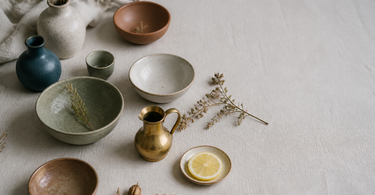
Ceramics are fired clay — one of humanity's oldest materials, with over 25,000 years of history. The term itself covers several subtypes: stoneware is fired at 1,200–1,300°C and is robust for everyday use, porcelain at up to 1,450°C and is finer and semi-translucent, while earthenware is fired at a lower temperature and is mostly used for decoration. The glaze determines both aesthetics and function — and whether you can put the piece in the dishwasher.
Ceramics are one of humanity's oldest materials. Over 25,000 years ago, our ancestors were already shaping clay with their hands and firing it over open flames. Today, ceramics still fill our homes — from the cups we drink our morning coffee from, to the vases holding dried flowers on the shelf. But what is ceramic actually made of, what sets stoneware apart from porcelain, and how do you keep your pieces in good condition? Here are the concrete answers.
What is ceramic made of?
Ceramics are made from clay — a natural material formed over millions of years as feldspar and other minerals break down in the earth's crust. The type of clay, its purity and its composition of quartz and mineral particles are decisive for the finished product's appearance and properties.
The production process typically follows four steps:
- Shaping — the clay is shaped on a potter's wheel, in a mould or entirely freehand.
- Drying — the piece is dried slowly to avoid cracks before it's ready for firing.
- First firing (bisque firing) — the clay is fired in a kiln and turned into a hard, porous base material.
- Glazing and second firing — a thin layer of glaze is applied and melts at high temperature into a glass-like surface, giving colour, shine and water resistance.
The glaze isn't just about aesthetics. It determines whether the surface is matte or glossy, whether the piece can withstand the dishwasher, and whether it's safe for contact with food. The glaze's colour and finish come from metal oxides — for example, cobalt gives blue tones, copper gives green — being added and reacting with the heat during firing.
Tip: The glaze's appearance changes markedly with the temperature during firing. Even experienced ceramicists can't predict the exact result — it's part of the material's character and one of the reasons no two handmade pieces look completely alike.
The types: stoneware, porcelain and earthenware
The terms are often used interchangeably, but there are real and measurable differences. Ceramic is the overarching term for all products made from fired clay. Stoneware, earthenware and porcelain are three subcategories, each with their own properties.
| Type | Firing temperature | Properties | Typical use |
|---|---|---|---|
| Stoneware | 1,200–1,300°C | Heavy, durable, rustic surface | Everyday tableware, cups, bowls |
| Porcelain | 1,300–1,450 °C | Light, thin, semi-translucent | Fine china, espresso cups |
| Earthenware | 900–1,100 °C | Porous, brittle, absorbs liquid | Decorative vases, plant pots |
Is stoneware the same as ceramics?
Yes and no. Stoneware is a type of ceramic — but not all ceramics are stoneware. Think of it as circles within a larger circle: stoneware, porcelain and earthenware are all ceramics, but ceramics isn't synonymous with any single one of them. When people use the word "ceramics" in everyday speech, they usually mean stoneware or earthenware, as these are the most common types found in private homes.
Porcelain gets its characteristic white, semi-translucent surface because it's made from kaolin — a particularly pure, white clay mineral — and fired at the highest temperature of the three types. It's precisely this combination that gives porcelain its fine, lighter feel compared to the heavier stoneware.
Hand-painted vs. mass-produced ceramics
One of the things that makes ceramics such a varied material is the difference between handmade and industrially produced pieces. Hand-painted ceramics carry the artist's brushstrokes directly on the surface — no two plates are ever quite alike, and the small variations in glaze, colour tones and pattern density aren't flaws, but hallmarks of genuine craftsmanship.
The process behind a hand-painted ceramic piece typically takes several days: shaping, drying, bisque firing, glazing, decorating and a further firing. Mass production can complete the same basic process in minutes using moulds and automated glaze application. The result is uniform and functional — but without the individual variations that make handmade ceramics recognisable.
European ceramic makers have kept the traditional handmade techniques alive. Many products from, for example, Spanish and Portuguese workshops are still hand-painted in series, with each decoration applied individually. It's this type of production that gives plates and bowls with citrus and sea motifs their lively, uneven brushwork.
Ceramics in the kitchen
The kitchen is ceramics' natural home. The practical and the decorative merge in this material — and stoneware is particularly well suited to everyday use, as it withstands rough handling without losing its looks.
Everyday stoneware tableware
Stoneware is the preferred material for ceramic cups, as it insulates well and keeps your drink warm longer than thin-walled porcelain cups. A typical stoneware cup weighs 300–450 grams and has a wall thickness of 5–8 mm, giving it that characteristic weight in the hand.
Ceramic plates in stoneware can handle daily use in the dishwasher when properly glazed. The flat and deep variants come in everything from simple, monochrome designs to patterns featuring animals, fruit and graphic motifs. The advantage ceramics have over, for example, plastic and melamine is that the surface doesn't get scratched by cutlery and doesn't release substances into the food.
Smaller kitchen items in ceramic
Small plates and bowls in stoneware are used for everything from breakfast and dips to storing salt and spices on the kitchen counter. Salt and pepper sets in glazed ceramic are one of the categories where the design varies the most — from classic cylinders to figures shaped like animals, fruit and vegetables.
Ceramic jugs work both as a serving item and as decoration on the table. A hand-painted stoneware jug with a lemon motif doesn't need to hold anything to do its aesthetic job — but it's functional enough for water, juices and cold drinks. Ceramic butter keepers are a French tradition that keeps butter soft at room temperature for up to 30 days without a fridge — it works by sealing the butter airtight with a layer of water in the base.
Ceramics as decoration
Ceramics don't just belong in the kitchen. In the living room, hallway and bedroom, it plays an important role as a three-dimensional decorative element — with a weight and depth that posters and flat pictures simply can't match.
Vases
Ceramic vasescomes in everything from minimalist cylinders to sculptural shapes with animal motifs and organic profiles. A single large vase with dried flowers can define an entire room. Glazed vases in deep colours — ochre, forest green, terracotta — are perfect for creating contrast against light walls, while unglazed vases in natural clay tones give a more subdued, minimalist expression.
Candlesticks and plant pot covers
Ceramic candlesticks give a warm, rustic look and come in a huge range of shapes — from simple, conical designs to figures of birds, hands and flowers. The material holds heat better than glass and gives a softer glow from the flame.
Ceramic plant pot covers are the most popular type for houseplants. They come in glazed colours, natural earth tones and with decorative patterns. A ceramic plant pot cover isn't watertight unless it's glazed all the way down on the inside — check this before placing a plant directly in it without a saucer.
Wall decor
A growing trend is using ceramics directly on the wall. Ceramic wall hangings and decorative plates arranged in groups create a sculptural effect. The three-dimensional look gives the wall depth and character — something that's hard to achieve with pictures alone. Handmade ceramic masks and figures work as artworks in their own right and can be mixed with posters and mirrors for a more layered look.
Care and maintenance
Ceramics are surprisingly durable, but a little attention extends their lifespan significantly.
Everyday washing
Glazed stoneware and porcelain can generally go in the dishwasher, but hand-painted decorations, gold rims and unglazed surfaces wear faster with machine washing. Rule of thumb: the more craftsmanship in the decoration, the more it needs handwashing. A minute under the tap is all the care most ceramic pieces need.
Avoid thermal shock
Ceramics — particularly earthenware and thinner porcelain — can crack if exposed to sudden temperature changes. Don't move a piece straight from the freezer into a hot oven. Let it come to room temperature first. Stoneware is more resistant to temperature swings, but the principle applies to all types of ceramics.
Storage and repair
Stack plates with a layer of fabric or kitchen roll between them to avoid scratching the glaze. Hang cups on ceramic hooks instead of stacking them — this protects the handles and gives a tidier overview in the kitchen. Small chips on the edge can be smoothed with fine sandpaper (grit 400–600). Larger breaks can be glued with porcelain adhesive, but the piece should then be used for decoration only — not for contact with food.
Frequently asked questions
Is ceramic non-toxic?
Modern ceramics from reputable manufacturers are made with food-safe glazes free from lead and cadmium. EU regulation sets requirements for how much lead and cadmium a glaze may release into food. Always buy from reliable sources — especially if the ceramics will be used for hot drinks or acidic food, which can increase leaching from poor-quality glazes.
Can ceramics be used in the oven?
Stoneware and ovenproof ceramics can be used in the oven, but not all types. Stoneware typically withstands oven temperatures up to 220–250°C, while earthenware and thin-walled ceramics can crack. Porcelain is generally oven-safe, but always check the manufacturer's instructions. Avoid direct contact with a hot hob or grill element.
What's the difference between glazed and unglazed ceramics?
Glazed ceramics have a protective layer of melted glass that makes the surface waterproof, easy to clean and more resistant to stains. Unglazed ceramics have a raw, natural surface that's porous and absorbs liquid. Unglazed ceramics are most often used decoratively — as sculptures, plant pot covers and vases for dried flowers.
Why is handmade ceramic more expensive than mass-produced?
Handmade ceramics require time, skill and individual attention at every single step. Shaping, drying, bisque firing, glazing, hand-painted decoration and a further firing typically take 3–7 days per piece. Mass production automates most of these steps. You're paying for a unique piece with visible craftsmanship and individual variations — not for a flawed product.
Can ceramics go in the dishwasher?
Most glazed stoneware and porcelain is dishwasher-safe. However, hand-painted decorations, gold edges and unglazed surfaces should be hand-washed — the dishwasher wears down these finishes over time. If in doubt, hand-washing is always the safe option and takes less than a minute.
What's the difference between stoneware and earthenware?
Stoneware is fired at 1,200–1,300°C and is dense, heavy and durable — perfect for everyday use in the kitchen. Earthenware is fired at a lower temperature (900–1,100°C) and is more porous and brittle. Earthenware isn't waterproof without glaze and is mainly used for decorative purposes like vases and plant pots rather than everyday tableware.
Summary
Ceramics is a material with an unbroken history spanning over 25,000 years — and it's still relevant today because no other material combines durability, mouldability and aesthetic variation in the same way. Stoneware is your best friend for everyday tableware, porcelain for the finer pieces, and earthenware for decorative purposes. Glaze is the key technical factor: it determines water resistance, oven safety and dishwasher suitability. Hand-painted ceramics carry visible traces of the production process — variations in brushstrokes and glaze distribution are marks of quality, not flaws. Take care of your pieces with hand-washing and careful storage, and they'll last for decades.
Explore our range of ceramic vases, plates and bowls and candle holders in glazed stoneware and hand-painted ceramics.
