
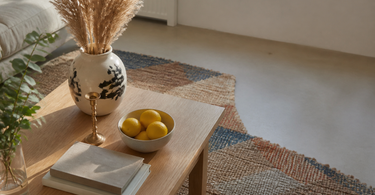
A well-styled coffee table builds on five elements: a tray or bowl as a visual frame, candles at different heights, something green or organic, one personal decorative object — and finally a composition in odd numbers with variation in materials and heights. Leave at least a third of the table surface free, and group the objects in clusters rather than spreading them out evenly.
The coffee table is the natural focal point of the living room — the piece your eye is drawn to the moment you step into the room. Yet many coffee tables end up in one of two extremes: either completely bare or buried under remote controls, magazines and half-empty coffee mugs. With five concrete steps, you can style your coffee table so it looks considered and inviting without seeming overdone. The guide applies regardless of the table's shape and size.
Step 1: Start with a tray or bowl
A tray or bowl works as the visual frame that gathers all your decorative objects in one place. It's the foundation you build the rest on. It's practical too: when the table is suddenly needed for food, games or puzzles, you simply lift the tray off.
Choose a material that contrasts with the table itself. A brass tray on a dark wooden table plays on the contrast between the organic and the metallic. A stoneware bowl on a marble table draws on the same logic — the matte, rough surface of the ceramic against the polished, cool surface of the marble. Shape matters too: round trays and bowls break up the line on a square table and vice versa, giving the composition more movement.
The size should be in proportion to the table. A tray that takes up more than half the table surface leaves little room for the rest. As a rule of thumb: the tray should take up about a third of the total table surface.
Tip: If you have a round coffee table under 60 cm in diameter, a single flat bowl can replace the tray and give a simpler look. Small trays and bowls in stoneware or ceramic work particularly well here.
Step 2: Add candles
Candles are a staple of Danish interior design for good reason: they change the mood of a room in seconds. On the coffee table, they add warmth and depth that no electric light source can quite replicate.
Choose two to three candlesticks at different heights. Variation in height is key — three candlesticks of the same size read as a mass, while one tall, one medium and one low candlestick create a composition with clear rhythm.
Materials and lighting effects
The material of the candlestick affects how the light behaves in the room. Crystal glass — both clear and coloured — reflects the flame and casts glimmers of light around the room. This gives a lively, almost shimmering look. Ceramic candlesticks absorb the light and give a warmer, more muted look that leans towards the organic.
You can also mix the two materials: a crystal candlestick next to a ceramic one creates an interesting dialogue between the clear and the matte — and supports the principle of material mixing, which we'll return to in step 5.
Step 3: Something green or living
An organic element — a branch, a dried flower, a couple of eucalyptus stems — brings life and freshness to the table. It doesn't need to be dramatic. A single branch in a small ceramic vase carries much more visual weight than you'd expect, because the organic shape breaks up all the geometric forms around it.
Dried flowers and branches have the practical advantage of lasting for months without water. Pampas grass, lagurus and gynerium are popular choices that all work in both minimalist and more filled compositions. If you prefer fresh flowers, a single stem in water stays nice for a week and is easy to replace.
The alternative to vases is a small potted plant in a decorative plant pot cover. A small succulent or a tiny monstera sprout doesn't take up much space, but clearly signals that the table has been deliberately styled rather than just tidied up.
For the vase itself: choose a small vase in ceramic or glass. A vase under 15 cm is usually enough on a coffee table, as it shouldn't compete with the height of the candlesticks or block the view across the table.
Step 4: A decorative object
Here's your chance to say something about yourself. An ornament, a small sculpture, a decorative bowl or a bound book gives the table character beyond the purely aesthetic. It's the element guests typically ask about.
Choose something with a story or a shape that's a little different. Ceramic figures in animal forms, geometric ornaments in stoneware or hand-twisted glass figures are all examples of objects that can stand alone and hold attention. It doesn't need to be expensive — a find from a craft shop or a souvenir with a personal connection works just as well as a designer piece.
The size should be kept moderate. A decorative object on a coffee table should rarely exceed 15-20 cm in width — otherwise it risks dominating the whole composition rather than contributing to it. See our selection of ornaments for inspiration on what works at a coffee-table scale.
Step 5: Think in odd numbers and variation
The human eye prefers odd-numbered groupings. Three or five objects feel more natural and relaxed than two or four, because the brain can't divide them symmetrically and automatically looks for a centre instead.
Variation in height
A good rule of thumb is to think in three levels: low (bowl, book, plate), medium (vase, small potted plant) and high (candlestick). When all three levels are represented, the composition has depth and movement even when seen from the side.
Variation in materials
Mix materials deliberately to avoid monotony. Glass next to ceramic, brass next to wood, polished surface next to matte. The different surfaces catch and reflect light differently and give the table a composed, rich expression.
How many objects?
The number depends on the size of the table. A small round coffee table under 70 cm in diameter has room for three to four elements. A large rectangular table can carry five to seven. The most important thing is that at least a third of the table surface remains free — it's the "air" that makes the rest look intentional rather than cluttered.
| Table size | Recommended number of objects | Key element |
|---|---|---|
| Small round (<70 cm) | 3–4 | One anchor object + candle + greenery |
| Medium rectangular (70–110 cm) | 4–5 | Tray as frame + 3 elements inside |
| Large rectangular (>110 cm) | 5–7 | Two clusters spread along the length of the table |
Styling your coffee table by style
Minimalist
Stick to three objects: a candlestick, a small vase and a bowl. Choose a tight colour scheme — black, white and natural tones — and let the materials do the work. Glass, marble and light wood emphasise the minimalist aesthetic by shifting their expression depending on the light in the room.
Boho
Here there's room to play with colours, textures and slightly fuller compositions. Mix ceramics in warm earthy tones, dried flowers, brass bowls and candles. A small woven textile or a textured placemat under the tray adds extra layers and texture without costing much. See, for example, our colourful plates and bowls for this style.
Scandinavian
Scandinavian style sits somewhere between minimalist and boho. Think natural materials — wood, ceramics, glass — in a muted colour palette with a few accent colours. Candles are absolutely central here. A simple stoneware vase with a branch, a couple of candlesticks in varying heights and a handmade bowl give just the right look.
Frequently asked questions
What should you put on a coffee table?
The four basic elements are: a base (tray or dish), lit candles in candlesticks, something organic (a vase with greenery or a potted plant) and one decorative object with personality. These categories cover everything you need. Also make sure that at least a third of the table surface is left clear — it's the "breathing room" that stops the composition from looking cluttered.
Does the coffee table need to match the sofa?
No — contrast is usually more interesting than matching. A round shape breaks up a square sofa arrangement, and a table in a different material (for example marble with a fabric sofa) adds depth. The most important thing is that the table's height suits the sofa: it should be level with the seat or slightly lower, typically 40–45 cm.
How do you keep the coffee table tidy day to day?
A tray is the most effective solution. It gathers your decorative items together and makes it easy to push them aside when the table needs to be used. Have a fixed spot for remote controls — a small bowl or a box — and clear the table of cups and plates daily. A well-styled coffee table typically only takes two to three minutes to maintain.
Can you style a small coffee table?
Yes. A small round table under 70 cm works well with three items: a low bowl, a single candlestick and a mini vase with a branch. Avoid a tray on the smallest tables — it takes up too much space. Keep all elements under 20 cm in height, so the composition doesn't feel heavy in relation to the table.
What do you do if the coffee table is glass?
On a glass table, the table surface itself is part of the look. Choose items with interesting bases and silhouettes, as they're visible from all angles and from below. Avoid heavy trays that cover the surface completely. A light brass tray or a low ceramic bowl works best, and two to three items are enough to keep the table's transparency an active design element.
Which colours work best on a coffee table?
There's no universal rule, but a good guideline is to use one dominant neutral tone (natural, white, black) and one or two accent colours drawn from the rest of the room's palette. Three or more unrelated colours on a small table can quickly look chaotic. Material variation — glass, ceramics, brass — adds visual interest without requiring lots of colours.
Summary
A well-styled coffee table is more about structure than the number of items. Start with a tray or dish as your frame, add candles at varying heights, an organic element and one decorative object with personality — then bring them together in a composition with odd numbers and a deliberate mix of materials. Leave a third of the table surface clear. Those are the five steps, and they work whether the style is minimalist, Scandinavian or boho. The more consistent you are with your choice of materials and colours, the easier it is to achieve a look that appears well thought-out — and stays that way day to day.
Find trays, candlesticks, vases and ornaments for your coffee table in our range of decoration.