
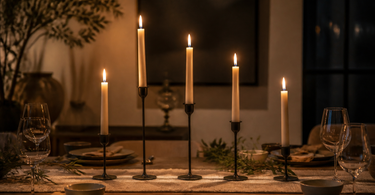
For everyday use, 1–3 candlesticks work well on the dining table. For dinner parties, 3–5 candlesticks in varying heights are recommended, and for a long table with 8 or more guests, 5–7 candlesticks work best. Choose candlesticks 25–40 cm in height, so the flames don't sit at eye level and disturb the conversation. Spread the candlesticks in an odd-numbered group along the table rather than a symmetrical line.
The question of how many candlesticks should stand on the dining table has a more precise answer than most people think. It's not just about personal taste — it's about the size of the table, the number of guests and the placement of the candles relative to eye level. This guide covers the concrete numbers and principles you need, whether it's a weeknight dinner or a larger gathering.
The rule of thumb for the number of candlesticks
Before you start setting out candlesticks, it's useful to know the basic rule: the number of candlesticks should increase proportionally with the length of the table and the number of seated guests. This ensures that the light is distributed evenly and doesn't clump at one end.
A simple setup looks like this:
- 2–4 people: 1–3 candlesticks
- 4–8 people: 3–5 candlesticks
- 8+ people (long table): 5–7 candlesticks
These numbers aren't arbitrary. With fewer than 1 candlestick per 1–1.5 running metres of table, dark zones appear, creating an uneven and unwelcoming atmosphere. With too many candlesticks, the table becomes cluttered and impractical — there's simply no room for the plates.
Odd numbers almost always work better than even numbers, because they create a more natural and dynamic composition. Three candlesticks, for example, look more lively than two, and five beats four hands down visually.
Tip: Use an odd number of candlesticks (3, 5 or 7) and mix two to three different heights. This gives more depth and movement to the table setting than a uniform row of identical candlesticks.
Everyday versus festive table setting
The daily dinner calls for different requirements than a dinner party, and your candlesticks should reflect that difference — both in number and arrangement.
For everyday use: 1–3 candlesticks
For the family's weeknight dinner, 1–3 candlesticks is enough. Here, the most important thing is that it's quick to set up and easy to remove again. A single candlestick with a tealight in the middle of the table can do the job alone. If you want a bit more, you can add two more of different heights and gather them in one group rather than spreading them across the table.
The advantage of the compact setup is that it doesn't take up space on a busy everyday table, where there also needs to be room for water carafes, sauce bowls and bread baskets.
For celebrations and gatherings: 3–5 candlesticks
For a dinner party of 4–8 guests, 3–5 candlesticks is the ideal amount. Here you have the opportunity to create a proper landscape of light along the axis of the table. Place the tallest candlestick in the middle and let the height gradually decrease towards the ends — a classic pyramid shape that draws the eye towards the centre of the table.
You can combine ceramic candlesticks with glass candlesticks to create layers and texture in the arrangement. Ceramic absorbs light and gives warmth, while glass reflects it and adds shine.
Long table with 8 or more guests
A long table has particular requirements, because the light needs to reach far and be distributed over a larger surface. For 8 or more guests, the recommendation is 5–7 candlesticks, placed at regular intervals along the table.
A practical approach is to divide the table into zones of about 60–80 cm and place a group of 1–2 candlesticks in each zone. This ensures that all guests have light within reach and aren't sitting in shadow.
For a long table, it's also acceptable to use two or three separate groups of candlesticks rather than one long unbroken line. These groups can visually anchor the table and create natural conversation islands.
For large gatherings, crystal candlesticks are a strong choice, because they spread the light widely and create many reflections from a single flame — in other words, you get more light from fewer candlesticks.
| Number of guests | Recommended number of candlesticks | Arrangement type |
|---|---|---|
| 2–4 (weekday) | 1–3 | Single group in the centre |
| 4–8 (dinner party) | 3–5 | Pyramid shape along the axis |
| 8+ (long table) | 5–7 | 2–3 groups evenly distributed |
Why height matters more than quantity
The number of candlesticks is one factor — the height matters at least as much. The rule is simple: the flames mustn't be at eye level when your guests are seated.
The average eye level for a seated adult is 110–120 cm above the floor, which corresponds to 55–70 cm above the tabletop. This means you should either stay under 40 cm — or go significantly higher than 70 cm, so the flame is above eye level. The latter solution, however, requires very tall candlesticks and is impractical for most homes.
The practical rule of thumb is therefore to choose candlesticks within the 25–40 cm height range. Within this range, the flame sits comfortably below eye level, and you avoid your guests having to look through or around the flames to see each other.
Candlesticks under 15 cm are too low for the dinner table — they get visually lost and contribute minimally to the lighting. Candlesticks over 50 cm are fine as standalone elements, but you need to be mindful that the flame doesn't end up exactly at eye level.
How to group your candlesticks
Placement isn't just about distance — it's about how the candlesticks work together as a group. There are three main approaches:
The linear arrangement
The candlesticks are placed in a line along the table's centre axis with 20–30 cm's spacing. Simple and classic, but it can become monotonous if all the candlesticks are the same height. Combine at least two heights to break up the line.
The cluster arrangement
2–5 candlesticks are gathered into one compact group, typically in the middle of the table. Works well for everyday use and for round or square tables, where there isn't one clear centre axis.
The distributed group
Two or three separate clusters spread along the table. Ideal for long tables. Provides light along the entire length of the table and creates natural focal points for your guests' attention.
Whichever method you choose, the candlesticks should always be kept within the table's central zone — at least 30 cm from the table's edge. This prevents candlesticks from tipping over and ensures your guests' elbow room isn't restricted.
Choosing materials for the dining table
The material of your candlesticks doesn't just affect the look — it also affects how the light behaves at the table.
Ceramic
Ceramic candlesticks absorb the light and give a matte, warm surface that supports the mood without distracting. They're heavy and stable — an advantage at dinners where glasses are raised and things get moved around. Ceramic is available in many colours and fits naturally into both rustic and minimalist table settings.
Glass
Glass reflects and refracts the light, so a single flame produces many spots of light on the tablecloth and on the walls of the room. This gives more light output per candlestick and can be used strategically when you want a lot of light from just a few candlesticks. Glass can feel cool, though, and it's recommended to combine it with warm materials such as ceramic or natural fibre.
Crystal
Crystal is the most light-effective material. The many facets refract and scatter the light in all directions, creating a richness in the room that no other material can match. Best used for festive occasions, when you want the maximum visual effect.
Frequently asked questions
How many candlesticks are appropriate for a table with 6 guests?
For 6 guests, 3–5 candlesticks are recommended. Three candlesticks is the minimum for the light to be distributed along the entire table surface. Five candlesticks give a richer arrangement, but require a table of at least 140 cm's length, so there's still room for tableware and glasses.
Should candlesticks be at eye level at the dinner table?
No. Flames at eye level — typically 55–70 cm above the tabletop — are distracting and can make it uncomfortable to maintain eye contact. Choose candlesticks in the 25–40 cm height range, so the flame sits well below your guests' eye level when they're seated.
Do the candlesticks need to match each other?
They don't need to match, but they should share a common element — this could be the same colour, the same material or the same overall style. For example, mix three ceramic candlesticks in different heights: the variation in height creates dynamism, while the shared material ensures cohesion.
Can candlesticks be used on a round table?
Yes. On round tables, a clustered arrangement works best: 1–3 candlesticks grouped in the centre. Avoid spreading the candlesticks out towards the edge, as they can quickly get too close to your guests' seats. A single candle in a striking candlestick is often the cleanest solution for a round dining table.
What is the recommended distance between candlesticks?
A distance of 20–30 cm between candlesticks is a good rule of thumb for most tables. This ensures the candlesticks visually belong together as a group, without the flames being so close together that they disturb each other's burning or create too much heat in one spot.
Can you mix different materials in one arrangement?
Yes, and it's actually recommended. A combination of, for example, ceramic and glass candlesticks gives both warmth and reflection in the same arrangement. Stick to two materials in one arrangement to avoid a cluttered look. Three or more materials require a very deliberate colour scheme to work.
Summary
The number of candlesticks on the dining table depends on three factors: the number of guests, the size of the table and the height of the chosen candlesticks. For everyday use, 1–3 candlesticks are enough. For a dinner party of 4–8 guests, 3–5 candlesticks is ideal. For a long table with 8 or more guests, 5–7 candlesticks divided into groups is recommended. Flames should never sit at eye level — stick to candlesticks of 25–40 cm in height. Use an odd number, combine two to three heights, and place them along the table's centre axis with at least 30 cm distance to the edge of the table. The variety of materials — ceramic, glass, crystal — is an effective tool for controlling the character and mood of the light.
Explore our range of candlesticks for the dining table — from simple everyday candlesticks to festive arrangements in glass and crystal.