
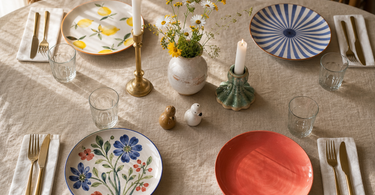
Table setting is built on three layers: the base (tablecloth or table runner), the middle (plate stack and cutlery) and the top (glasses, decoration, candles). You don't need every element every day — but the relationship between them creates the mood. For everyday: plate + glass + cutlery. For a party: add candlesticks, flowers and a runner. At Dims Studio, table setting is one of the brand's strongest areas — colourful ceramics, characterful glasses and playful salt and pepper sets.
A well-set table isn't a matter of fine taste — it's a simple structure you can scale up or down depending on the occasion. It's about three layers that each contribute to the mood. Learn the structure and you can set any table — from a quick weekday dinner to a confirmation.
The three layers of table setting
Think of table setting as architecture: a base, a middle and a top.
The base layer
What lies DIRECTLY on the table: a full tablecloth, a runner down the middle, or a bare table (perfect on beautiful wooden tables). The base layer defines the colour expression — a white tablecloth gives a formal frame; a colourful runner gives a playful mood.
The middle layer
The actual setting: plate, glass, cutlery, napkin. This is the functional part. Here you decide whether the setting is formal (each guest gets a matching set) or eclectic (each plate is its own story).
The top layer
The decorative element that "crowns" the table: candlesticks, flowers, fruit, small salt and pepper sets scattered around. This layer is where the mood comes from — warm light, beautiful flowers, characterful objects.
Everyday's simple setting
For everyday use, the rule is: under 5 minutes. Use what you have and keep it minimal.
- Base: Bare table or a simple runner
- Middle: Plates (preferably in colourful variants), cutlery on a napkin, glass for water
- Top: Maybe a small flower in a vase or a candlestick with a lit tealight
You don't need matching plates. Eclectic is beautiful — mix colours and patterns. It's part of Dims Studio's DNA: table setting should be characterful, not formal.
Tip: Keep 2-3 colourful plate sets ready in a visible cupboard. When you can see them, you use them more often. Hidden in a drawer = rarely used.
The party's full setting
For a party, you scale up all three layers.
- Base: Full tablecloth or a wide runner. Add placemats if you like, for extra dimension.
- Middle: Complete cutlery (fork-knife-spoon), 1-2 glasses per person (water + wine), folded cloth napkin in a decorative position on the plate, place cards if formal.
- Top: 3-5 candlesticks at different heights, fresh bouquet in the middle of the table, small salt and pepper sets scattered around, maybe characterful fun vases or egg cups as decoration for long tables.
Here's how you mix materials and colours
The eclectic setting is where Dims Studio shines. Rules to follow:
- 1 strong colour as an anchor: Choose one colour that repeats itself (e.g. pink in the plate edges, in the flowers and in a runner). It ties the setting together.
- Mix materials: Glass + ceramics + brass + linen. Materials create visual rhythm.
- Variation in height: Low dishes, medium-tall glasses, tall candlesticks. This creates visual architecture.
- 2-3 motifs max: Lemon + flowers + fish is too much. Choose two that harmonise (e.g. lemon + flowers).
- Characterful elements: Salt and pepper sets shaped like animals, a Testa di Moro vase, a butter cloche that spreads butter. These are conversation starters.
What do you need?
For a good everyday table setting for 4 people:
- 4 plates (ideally multicoloured)
- 4 sets of cutlery
- 4 water glasses
- 1 table runner or a light tablecloth
- 1 simple vase + a flower
- 2 candlesticks
- 1 salt and pepper set
For a party, expand with wine glasses, dessert cutlery, an extra tablecloth, more candlesticks and decorations.
Frequently asked questions
How big should the table be per guest?
Roughly 60-75 cm width per person along the long side. For a round dinner with 6 people: minimum table 1.40 m. For 8 people: 1.80 m. For a long table: the same applies. Remember to leave room for serving dishes in the middle — 30-40 cm width.
How many candlesticks should there be on the table?
For everyday use: 1-3 candlesticks, ideally in different heights. For a party: 3-5 if you have a long table; 2-3 for a round table. Avoid having candle flames at eye level — it's dazzling. Choose candlesticks 25-40 cm tall or tealight holders that sit low.
What type of glass for which drinks?
Wine glasses for wine (of course), but you don't need separate ones for red and white for everyday use. Champagne glasses for sparkling wine. Taller glasses for water. Smaller tumblers for schnapps. Choose fewer, but good-quality pieces rather than a large assortment.
Where should the cutlery go?
Classic: fork on the left, knife and spoon on the right. The knife's blade faces the plate. For everyday use: keep it simpler by placing the cutlery on a napkin next to the plate. For a party: follow the classic arrangement.
What's the difference between a tablecloth and a runner?
A tablecloth covers the whole table. A runner is a longer, narrow strip of fabric that runs down the middle of the table — typically 30-40 cm wide. Runners are often used in combination with placemats or directly on the table (without an underlying cloth). A runner is usually quicker than a full tablecloth.
Summary
Table setting doesn't need to be formal or complicated. Once you have the system of three layers in mind — base, middle and top — you can scale up or down depending on the occasion. For everyday use: minimal and quick. For a party: layer upon layer. What matters is that the table becomes part of the atmosphere — not just a surface on which food is served.
Explore our range of plates, candlesticks and salt and pepper sets — everything you need for both everyday life and celebrations.