
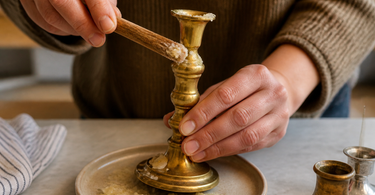
Always let the wax harden completely before you touch it — hot wax spreads and makes the damage worse. Once it's hard, you can carefully break it off with your fingers or a plastic spatula. On tablecloths, the iron-and-paper-towel method works well, on tables and worktops you scrape gently and use warm water, and on candlesticks you avoid using a knife against glazed surfaces.
Wax on a tablecloth, table or candlestick looks dramatic in the moment — but it's actually one of the easier problems to solve if you tackle it the right way. The most common mistake is panicking and trying to remove the wax while it's still liquid or half-soft. That makes things significantly worse. With the right order of steps and a few simple tools, you can get rid of all the wax in most cases without leaving a trace.
Always let the wax harden first
It sounds counterintuitive to wait when there's a splattered candle sitting on the table or tablecloth. But wax is a fatty substance that, in liquid form, sinks deeper into fibres and porous surfaces for every second it stays warm. When you let it harden, the penetration stops, and you end up with a firm, brittle lump sitting on top of the surface rather than inside it.
How long the wax takes to harden depends on the room temperature and the amount of wax. A small blob at room temperature (around 20°C) is hard within 5–10 minutes. A bigger pool can take 20–30 minutes. You can speed up the process by carefully placing an ice pack or a cold, damp cloth over the wax area — not ice directly, as condensation can create new stains.
Tip: Never use a hairdryer or hot water to "soften" the wax to make it easier to remove. Heat melts the wax and makes it spread over a larger area — instead of solving the problem, you double it in size.
Once the wax is completely hard and matte on the surface (shiny wax is still semi-solid), you can move on to the surface-specific method below.
Wax from tablecloths and fabric
Fabric and textiles are the surface where you have the most options — and where mistakes are easiest to make. Here's the recommended step-by-step approach:
Step 1: Break off and pick away the hardened wax
Use your fingers or the back of a plastic spoon to carefully break the wax loose from the fabric. Avoid sharp metal tools, which can cut the threads. You don't need to remove all of it — it's enough to loosen the big lumps.
Step 2: Iron and absorbent paper
Place 2–3 layers of paper towel or a piece of plain kitchen paper (not newspaper, as the ink can transfer) under the fabric and 1–2 layers on top of the wax stain. Set the iron to a low heat with no steam (around 80–100°C, wool setting). Iron with short, gentle movements over the paper. The wax melts and gets absorbed into the paper. Swap to clean paper as it becomes saturated — typically 3–5 changes for a normal stain.
Step 3: Degrease the remaining stain
Wax leaves a greasy trace even after the solid part is gone. A little washing-up liquid (1–2 drops in 1 dl of lukewarm water) dabbed on with a clean cloth removes the grease. Rinse thoroughly. Wash the tablecloth as normal afterwards.
White and light-coloured tablecloths handle this method well. Dark tablecloths risk a lighter mark from the heat — always test on a hidden corner first.
Wax from the table
Table surfaces vary enormously: lacquered wood, oiled wood, laminate, marble and glass all react differently to the tools you use. The general rule, though, stays the same: wait until the wax is hard, and never use a metal spatula on lacquered surfaces.
Lacquered and oiled wood
Use a plastic spatula or a credit card held at a low angle (around 15–20 degrees against the tabletop). Push the wax towards you in one steady motion. Remove the fragments with a soft cloth. Finish off with a damp cloth and warm water (40–50°C), and dry immediately afterwards. Any greasy residue on oiled wood can be removed with a little linseed-oil-based soap made for wood.
Marble and stone
Marble is porous and reacts to acids, so never use vinegar or lemon. A plastic spatula to remove the solid wax, followed by mild washing-up liquid and lukewarm water with a soft sponge, is the safe route. Dry immediately to avoid limescale rings.
Glass and laminate
Here you can allow yourself a bit more force with the plastic spatula. Glass can also tolerate a little heat: place a warm, damp cloth over the wax for 30 seconds, then push it off. Avoid steel wool scourers — they scratch.
Wax from the candlestick
Candlesticks collect wax on the inside, along the rim and around the base. The method depends entirely on the material — and this is where many people make the classic mistake of using a knife.
Glass and crystal candlesticks
On glass candlesticks and crystal candlesticks the easiest method is a cold water bath combined with the freezer: put the candlestick in the freezer for 30–60 minutes. The wax contracts at low temperatures and releases almost by itself from the glass surface. You can then simply press gently with a fingernail, and the mark will come away as one whole disc.
Alternatively, you can pour boiling water into an open-topped candlestick and let the wax float up and harden as a layer on the surface, which you can then lift off.
Ceramic candlesticks
Ceramic candlesticks with a glazed surface can't handle either a sharp metal knife against the glaze (risk of cracking the glaze) or heavy scraping. Use the freezer method here too, and clean off any remaining grease with lukewarm water and a soft sponge. Unglazed ceramic is more porous — here it's important to act quickly with the freezer method, before the wax gets a chance to soak in deeply.
Metal and iron candlesticks
Metal can handle more mechanical treatment. Use a plastic spatula for the bulk of it, followed by warm water (60–70°C) poured over it or a brief warming — but avoid sudden temperature changes on cast iron, as it can cause cracks.
You'll find a wide selection of candlesticks designed for easy cleaning and minimal wax spillage.
Material-specific guide
| Surface | Remove solid wax with | Clean grease residue with | Avoid |
|---|---|---|---|
| Tablecloth/fabric | Pick off + plastic scraper | Iron + paper, then washing-up liquid | Metal spatula, direct heat |
| Lacquered wood | Plastic scraper, low angle | Warm water + soft cloth | Metal knife, vinegar |
| Marble | Plastic scraper | Washing-up liquid + lukewarm water | Acid (vinegar, lemon) |
| Glass/crystal | Freezer 30–60 min | Boiling water poured over | Steel wool |
| Glazed ceramic | Freezer 30–60 min | Lukewarm water + soft sponge | Metal knife against the glaze |
| Unglazed ceramic | Freezer (quick!) | Washing-up liquid, gently | Soaking in water for too long |
| Metal | Plastic scraper + warm water | Washing-up liquid | Sudden temperature changes (cast iron) |
Prevent stains from candle wax
It takes a bit of preparation, but you can reduce wax spillage significantly without changing the look at all.
Use the right size candle for the candlestick
A candle that sits loosely in a candlestick easily falls over and drips everywhere. A candle that's too tight pushes down and tilts to the side. The manufacturer's stated diameter isn't decorative information — it's a functional measurement.
Put something underneath
A saucer, a plate or a piece of baking paper under the candlestick catches drips before they reach the tablecloth. It takes two seconds to set up and saves you the ironing process afterwards.
Choose high-quality candles
Cheap candles with a low wax content or lots of additives burn unevenly and drip more. Candles with a consistent composition burn more cleanly and leave minimal trickling. Look out for a clean, white or natural-coloured flame as a sign of good combustion.
Position candles away from draughts
Draughts from windows, ventilation systems or traffic passing the table make the flame flicker, burn unevenly and drip. A steady flame gives a calmer burn and less mess.
If you choose a ceramic candlestick with a deep cup, you automatically have a natural barrier against drips — many ceramic designs are built with exactly this in mind.
Frequently asked questions
Can I use vinegar to remove wax?
Vinegar doesn't dissolve wax, as wax is a fatty substance and vinegar is water-based and acidic. On marble and stone, vinegar will even etch the surface. Instead, use washing-up liquid (which is formulated to emulsify fat) combined with warm water for the greasy residue.
How long should the candlestick sit in the freezer?
30–60 minutes is usually enough for the wax to contract sufficiently. In a freezer at –18°C, this usually happens within 30 minutes. If the layer is thick (over 5mm), it can take up to 90 minutes. Don't take the candlestick out too early — incomplete cooling only gives a partial effect.
Can wax stains on fabric come out in the washing machine?
A direct machine wash without pre-treatment usually sets the wax stain permanently — the heat in the machine wash melts the wax, which is then absorbed back into the fibres. Always do the iron-and-paper method and remove the greasy residue with washing-up liquid before the tablecloth goes in the machine. After that, it can be washed normally.
What do I do if there's coloured wax on a light-coloured tablecloth?
The dye in coloured wax can leave a bleached mark in addition to the grease stain. Remove the wax as normal. If there's a colour residue, gall soap or an enzyme-based pre-treatment can help before washing. Always test on an unseen spot. Certain strong colours (red, black) may require professional cleaning.
Is it dangerous to use boiling water in a cold crystal candlestick?
Yes, the temperature difference can in theory cause cracks in thin glass and crystal — this is called thermal shock. Always let the candlestick reach room temperature (15–20 minutes) before pouring boiling water into it. Alternatively, use the freezer method, which is the gentlest solution for glass and crystal types.
Can I prevent the wax from sticking to the candlestick?
Yes — rub the inside base with a thin film of cooking oil or Vaseline before placing the candle in it. The wax sticks far less to a greasy surface, and cleaning afterwards is significantly easier. It affects neither the candle's burning properties nor the candlestick's appearance.
Summary
Wax is easier to remove than most people think — provided you follow one basic rule: let it solidify completely before you touch it. From there, the method depends on the surface: tablecloths are treated with an iron and absorbent paper, table surfaces are gently scraped with a plastic tool and finished off with warm water, and candlesticks — whether glass, crystal or ceramic — benefit most from the freezer method. Avoid metal knives on glazed and porous surfaces, avoid acid on stone, and never pre-warm the wax in an attempt to make it easier to remove.
Explore our range of candlesticks in glass, ceramic and crystal — designed for beautiful use and easy maintenance.