
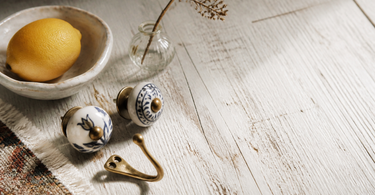
Hooks and knobs are two of the cheapest and quickest ways to lift a room. A set of new brass knobs updates an entire kitchen without any renovation. Fun animal hooks in the hallway work as wall decoration. Ceramic knobs give a handcrafted touch. Most replacements take under 10 minutes and only require a screwdriver — but you need to know your screw hole diameter and screw length before you order.
There's something liberating about the fact that one of the most impactful design decisions you can make in your home costs under 100 kroner and takes ten minutes. New knobs on an old chest of drawers can transform the whole look of the piece. A well-chosen hook in the hallway gives your guests something to appreciate right at the door. Hooks and knobs are functional, they're visible in everyday life, and they're surprisingly easy to swap out — whether you want a cooler, more minimalist look or something playful and personal.
Types of hooks and knobs
The market is far more varied than most people imagine. Here are the main categories — and what sets them apart.
Brass
Brass hooks and knobs are a classic choice with a warm, golden glow. Brass is an alloy of copper and zinc, and it naturally develops a patina over time — the colour becomes deeper and more nuanced as the surface oxidises. Polished brass suits modern and art deco-inspired interiors. Brushed or antique brass has a calmer, more rustic look that works well in a countryside or bohemian home. Brass is durable and withstands daily use for many years, even in slightly damp environments.
Ceramic
Ceramic knobs come in a huge range of colours, patterns and shapes — from simple white round knobs to hand-painted designs with floral motifs or geometric patterns. Ceramic has a good weight to it, giving a solid feel in the hand, and the handcrafted touch is clear, especially in hand-shaped or hand-painted versions. However, ceramic knobs are more vulnerable to knocks than metal — they can crack or chip if dropped on a hard floor.
Animal-shaped knobs and hooks
Knobs with animal motifs are a popular category — for the children's room, but very much also for adult rooms. Many European design brands produce handmade animal knobs in wood and metal that work like small sculptures on the front of a drawer or cupboard. An elephant, a lion or a bird gives the piece of furniture a character that no standard handle can match.
Flower and nature motifs
Hooks and knobs with leaves, flowers and organic shapes suit a bohemian or romantic interior well. The ginkgo leaf is a popular motif — the recognisable, fan-shaped leaf is decorative in its own right and works in many styles from art nouveau to modern Scandinavian. Roses and olive branches are other recurring motifs in this category.
Minimalist and geometric
Clean lines, black or white colours and geometric shapes characterise minimalist knobs. They work in a Scandinavian home where you want a discreet but well-thought-out look. Knobs for doors and drawers in a simple round or hexagonal shape are still among the most sought-after — not because they're boring, but because they put the furniture's lines in focus rather than the handle.
Brass knobs for kitchen and furniture
One of the most widespread upgrade projects in Danish homes right now is swapping standard handles for brass knobs for kitchen cupboard doors. Many kitchens come with industrial handles in brushed steel — functional, but without personality. A switch to brass changes the overall look and costs a fraction of what a new kitchen would cost.
Before you order, you need to know two measurements:
- Screw length: Most standard kitchen doors use M4 screws. The knob should suit the thickness of the door, typically 16-19 mm. Many knobs come with screws in standard lengths, but measure up before you order.
- Hole diameter: Most knobs use a single hole with a diameter of 4-5 mm. Drawer handles use two holes with a fixed centre distance instead — typically 96 mm or 128 mm. If you're switching from a handle to a knob, you'll need to fill one hole and possibly drill a new one.
Tip: Feel free to mix brass knobs with drawer handles in the same room. For example, put knobs on doors and handles on drawers — it creates a varied yet cohesive look. Make sure to stick to the same finish (polished or brushed) to avoid a messy result.
Hooks as wall decoration in the hallway
Hooks for the hallway are much more than just a place to hang your jacket. The right hooks work as wall decoration and give the hallway character, even though it's one of the rooms that typically gets the least design attention.
A simple yet effective trick is to mount a row of five different brass animal hooks on a white wall — it creates a gallery-like look without a single picture. Alternatively, one large, decorative hook can work as a statement piece in its own right.
Mounting height
| Use | Recommended height from floor |
|---|---|
| Jackets and bags (adults) | approx. 150 cm |
| Children's hooks | approx. 90–100 cm |
| Decorative hooks / wall art | approx. 160 cm (eye level) |
| Towels in the bathroom | approx. 130–140 cm |
Always remember to screw directly into the wall's timber stud or use the correct rawl plugs for your wall material. A hook holding a heavy winter coat can exert considerable pull, and a poorly mounted hook can take paint and plaster with it when it gives way.
Animal knobs for the children's room
The children's room is the obvious place to play around with knobs. Handmade animal knobs — elephants, lions, birds, pandas — make it fun for children to open drawers and cupboards. The best versions are made from solid wood or cast metal with hand-painted details and are sturdy enough to withstand daily use by little hands.
A popular trick is to put a different animal knob on each drawer of a chest of drawers. The child quickly learns that the lion sits on the drawer with jumpers and the elephant on the drawer with socks — it gives the piece of furniture personality and actually works as a practical system.
Doing Goods' animal knobs are a great example of this category. The Dutch design brand works with craftspeople and produces knobs that work as decorative figures in their own right. Many of them belong to the same aesthetic universe as Doing Goods' hooks, so you can create a cohesive look across furniture and walls.
How to change knobs yourself
Changing knobs is one of the easiest DIY jobs there is. You'll need a screwdriver — and that's pretty much it.
Step 1: Remove the old knobs
Unscrew the old knob by turning it anti-clockwise. Some knobs have the screw on the back of the door — hold the knob steady with one hand and unscrew with the other. Keep the old screws if the new knobs don't come with their own.
Step 2: Check hole size and screw length
Measure the diameter of the existing screw hole (typically 4–5 mm for knobs). Also measure the thickness of the door and check whether the new knob's screw is the right length. Most kitchen door knobs are designed for doors that are 16–19 mm thick.
Step 3: Fit the new knobs
Push the screw through the hole from the back and tighten the knob. Make sure the knob sits firmly — but avoid overtightening. Ceramic knobs are especially prone to cracking at the base where the screw sits if overtightened. Repeat for all doors and drawers.
Hooks for the bathroom
In the bathroom, hooks are essential for towels and dressing gowns, but the damp environment places demands on the materials. Brass, stainless steel and lacquered metal are good choices — they withstand condensation and cleaning products without corroding. Avoid unprotected iron, which starts to rust even with light moisture.
Coloured hooks in a water-resistant finish can give the bathroom a personal touch without requiring a major renovation. A single hook in a colour that contrasts with the tiles can be enough to markedly change the look of the room.
What's the difference between a hook and a knob?
The terms are often used interchangeably, but there's a functional difference. A hook is designed for hanging things on — it's mounted on a wall or door and has a protruding part you can hang a jacket, towel or bag on. A knob is a handle for a piece of furniture — it sits on the front of a drawer, door or cabinet and is used to open and close it.
In practice, the line is blurry. A large, decorative knob can be mounted on a wall and used as a hook. A hook can be screwed onto the front of a cabinet as a handle. The function depends on how you use it — not on what the manufacturer's label says.
Frequently asked questions
What screw size do most knobs use?
Most knobs use an M4 screw (4 mm in diameter). The screw length typically ranges from 25 mm to 40 mm depending on the thickness of the door. Standard kitchen doors are 16–19 mm thick. Always measure the door before ordering, and check whether the knob comes with screws — most do, but not all.
Can you fit a hook in a brick wall?
Yes, but you'll need the correct wall plugs for masonry — not the plastic plugs meant for plasterboard. Drill a hole with a hammer drill of the correct diameter (typically 6–8 mm), insert the plug, and screw the hook in place. A coat hook should be able to hold at least 10–15 kg, so be careful with the installation.
What's the advantage of brass knobs over plastic or zinc?
Brass is heavier than plastic and zinc, giving a more solid feel in the hand. It develops a natural patina and expands minimally with temperature changes. Zinc alloy (zamak), used in cheaper knobs, is more fragile and can crack on impact. Brass typically lasts 10–20 years with daily use, while cheap zinc knobs can start to look worn after 2–3 years.
Can you change the knobs on IKEA furniture?
Yes — the vast majority of IKEA furniture with knobs and handles uses standard hole spacing and M4 screws. On chest-of-drawer ranges like MALM and HEMNES, the hole diameter is typically 5 mm. You can replace the knobs with almost any standard knob on the market, as long as you use screws of the correct length for the door thickness.
How high should a hook be placed in the hallway?
Hooks for adults' jackets and bags should be placed about 150 cm from the floor. Hooks for children should be placed about 90–100 cm from the floor so they can reach them themselves. Purely decorative hooks can be placed at eye level, about 160 cm, to create the best visual impression on the wall.
What's the centre-to-centre distance on drawer handles?
The two most common standard measurements for centre-to-centre distance on drawer handles are 96 mm and 128 mm. Always measure the distance between the existing holes before ordering new handles. If you're switching from a handle to a knob (one hole), you'll need to fill one of the holes with wood filler or spackle, sand it smooth and drill a new hole centred on the door.
Summary
Knobs and knockers are one of those places in home decor where the effort is minimal and the effect is disproportionately big. A set of new brass knobs updates a whole kitchen. A well-composed row of hooks gives the hallway character. Animal knobs on the kids' chest of drawers give the furniture a personality no standard handle can match. The choice of material — brass, ceramic, lacquered metal — matters for durability and upkeep, but the basic swap is a job you can sort yourself in under half an hour with a screwdriver. Start with one piece of furniture or one room, and see if it doesn't make you want to carry on.
Explore our range of hooks and knobs — from ceramic to brass, minimalist to playful animal motifs.