
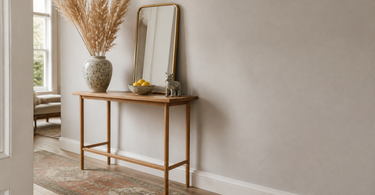
The hallway is a home's first and last room — but all too often the least thought-through. A well-functioning hallway balances practical storage (hooks, shoe racks, baskets) with elements that open the space up visually (mirrors, light, a rug). You don't need much space: three to four well-considered choices set the tone for the whole home. Warm light at 2700–3000 K, a mirror that reflects daylight, and hooks suited to the household are the best starting point.
The hallway is the first room you and your guests step into — and the last one you see when you leave the house. Yet it often ends up as a passageway with a pile of shoes and jackets thrown down in a hurry. That's a shame, because the hallway really does set the tone for the rest of the home. With four to five well-considered elements, you can transform even the smallest hallway into something that actually works — both aesthetically and practically.
Hooks and hanging — more than just a peg
Hooks are the hallway's most-used element. Every time someone comes home, they're the first thing hands reach for — so they need to sit right, look good and hold up to daily use.
Material and placement
Brass hooks give a warm, almost timeless look and develop a beautiful patina over time. Ceramic hooks add texture and colour, and are especially popular combined with limewashed walls or light wood. Wooden hooks are sturdy and easy to combine with Scandinavian décor. Whatever the material, hooks should be mounted at a height that works for the household — typically 160–175 cm for adults, 90–110 cm for children.
See hooks for the hallway in ceramic, brass and wood — including handmade designs with animal motifs from European manufacturers.
Number of hooks
A rule of thumb: one hook per person in the household plus two extra for guests. For a family of four, six to eight hooks is a realistic minimum. Mount them in an even row with 15–20 cm between each, so there's room for a thick winter coat without it feeling cramped.
If you want a bit more character, you can mix hooks and knobs in different sizes — a double hook for heavy outerwear and single hooks for bags and scarves.
Tip: Mount the hooks in two rows — a high row for outerwear and a lower one for bags and keys. This doubles the capacity without using more wall space, and gives a more organised look than one long row of mixed items.
Mirrors in the hallway — function and sense of space
A mirror in the hallway solves two problems at once: you can check your outfit before heading out the door, and the mirror reflects light and gives a visual sense of more space.
Size and shape
In a narrow hallway, a large, vertical mirror — or a proper floor mirror — works best. It visually doubles the depth of the room and draws daylight into the hallway. A round mirror above a console is a classic composition that's hard to get wrong: the circle breaks up the room's right angles and creates balance.
Oval mirrors are a middle-ground option — they have the same soft shape, but take up more vertical space than a round mirror and work well above a narrow table or shelf. See our range of mirrors suited to hallway spaces in various sizes.
Frame and material
Frames in rattan or bamboo give the entryway an organic, warm feel. Brass frames pair well with matching hooks and fittings. Mirrors without a frame — or with a very slim steel edge — feel more neutral and suit a minimalist décor.
| Mirror type | Best for | Consideration |
|---|---|---|
| Large floor mirror | Narrow entryway with little daylight | Requires wall space in height |
| Round mirror | Above a console or shelf | Limited reflective area |
| Oval mirror | Medium-sized entryway, classic style | Takes up more vertical than horizontal space |
| Frameless mirror | Minimalist décor | Risk of a cold feel |
Storage that works
An entryway without storage quickly becomes a chaos of shoes, keys and bags. The trick is to combine open and closed storage, so the most-used items are easily accessible while the rest is tucked away.
Shoe rack and baskets
A shoe rack is one of the most underrated pieces of furniture in the entryway. It keeps the floor tidy and gathers the family's footwear in one place. Woven baskets in seagrass or jute are ideal for gloves, hats and umbrellas — they're durable, easy to clean and look neat even when full.
Natural materials like seagrass and jute are also robust enough for the entryway's daily wear and tear. Look for storage baskets and boxes in natural materials that suit anything from boho to Scandinavian minimalism.
Console and shelf
A slim console table with a basket underneath replaces a large hallway cabinet and frees up more floor space. Choose a model with slender legs — light can pass beneath the piece, and the room feels more open. On top of the console, you can place a small tray for keys and post, and perhaps a table lamp.
Lighting and atmosphere
The entryway is often one of the darkest rooms in the home, as it rarely has windows on the sides. This means artificial light makes a huge difference — both functionally and for atmosphere.
Colour temperature and lux
Choose warm white lighting in the range of 2700–3000 K. This creates a cosy welcome and avoids the clinical feel that cooler light (above 4000 K) can create. In an entryway of 4–6 m², 200–300 lux is sufficient for good functional lighting.
A decorative pendant or wall lamp from the lamp collection can lift the room significantly. If you have a narrow hallway without ceiling lights, a table lamp on the console is a great addition — it gives a soft, indirect glow that sets the tone for the rest of your home.
Secondary lighting
A wall lamp beside the mirror — what's known as flanking light — gives an even light on the face and avoids harsh shadows when you check your appearance. It's a detail usually only seen in clothing shops and hotels, but it works just as well in a private home.
Rugs and doormats
A rug by the entrance does three things: it catches dirt and sand from outside, it creates a visual transition between outdoors and indoors, and it adds texture and character to the hallway.
Choose a rug in a hard-wearing quality — the hallway is one of the most heavily trafficked zones in your home. Jute and coir are classic choices that are easy to clean and age nicely. A patterned rug in darker colours is practical, as it hides stains and wear far better than a light, plain-coloured rug.
The size matters: the rug should cover the area people naturally step onto when they open the door — typically 60×90 cm as a minimum for a standard door. In a wider hallway, a rug of 80×120 cm or larger can give a more generous and welcoming feel.
Tip: Put a non-slip underlay beneath the rug in the hallway. This is a safety detail that applies whether the floor is parquet, tiles or vinyl — and it extends the rug's lifespan, since it doesn't rub against the flooring.
Colours and materials
The hallway should harmonise with the rest of your home — it's not an isolated room, but an extension of what awaits inside. Even so, it can have a distinct character that sharpens the transition from outdoors to indoors.
Neutral bases and colourful accents
White, sand and warm grey on walls and ceilings reflect light and give a calm starting point. From here, you can add colour through hooks, rugs or wall decor — elements that are easy to swap out if you want to change the look.
Natural materials like wood, rattan and brass are timeless and work with many styles — from classic Nordic to more Southern European and eclectic decor. They develop a lovely patina with age, and in the hallway — which is exposed to a lot of wear — that's an advantage.
Practical surfaces
The hallway is a high-traffic room: it's exposed to rain, snow, dirt and warm hands. Choose surfaces that can withstand wiping down. Lacquered wood, ceramics and brass are far easier to maintain than porous materials. Short-pile rugs are easier to hoover than shaggy types.
Small hallway? Here's how to prioritise
In a small hallway, it's about choosing three to four elements and making the most of them, rather than trying to cram everything in. Prioritise in this order:
- Hooks for coats — mounted on the wall, so they free up floor space
- A mirror — ideally one that covers a whole wall in height, for the visual spatial effect
- One storage solution — a slim shoe rack, a basket, or a console with a basket underneath
- Lighting — even a single wall lamp makes the hallway more inviting
Use the wall space actively. One or two pictures, a small shelf console or a ceramic wall hanging adds personality without using floor space. Avoid lots of small objects on the floor — they create visual clutter and make the room look smaller.
Frequently asked questions
How many hooks should there be in a hallway?
Aim for one hook per person in the household plus two extra for guests. For a family of four, six to eight hooks is a good starting point. If you want things organised, you can dedicate specific hooks to specific people and hang them at a fixed height that suits the users.
What's the best lighting for a hallway?
Warm white lighting at 2700–3000 K gives the most welcoming greeting. Combine an overall light source (pendant or ceiling lamp) with a secondary source — table lamp, wall lamp or plant lamp — to create depth and avoid harsh shadows in the room.
What should be in a small hallway?
Focus on three elements: wall-mounted hooks for coats, a mirror that visually opens up the space, and one compact storage solution for shoes or keys. A slim console with a basket underneath replaces a large hallway cabinet and frees up floor space. Avoid lots of small items on the floor.
How do you make a hallway feel bigger?
A large mirror is the most effective trick — it visually doubles the depth of the room. Light wall colours and warm lighting help. Keep the floor clear by mounting storage on the wall, and choose furniture with slim legs so light can pass underneath. Avoid visual clutter from lots of small items.
Which rug is best for a hallway?
Choose a rug in a durable quality with a short pile — it's easier to clean than a long pile. Dark colours and patterns hide dirt better than light, plain rugs. Jute and coir are classic materials that withstand daily wear. Remember a non-slip underlay regardless of floor type.
Can you hang pictures or decorations in the hallway?
Yes — wall decoration is an effective way to add personality to the hallway without using floor space. A single picture above the console, a ceramic wall hanging or a small grouping of posters works well. Stick to two to three elements so the wall doesn't feel overcrowded in a narrow room.
Summary
A well-thought-out hallway isn't about filling the room with furniture and details — it's about choosing the right elements and placing them correctly. Start with hooks at the right height and number, add a mirror that reflects light, and solve storage with one good solution rather than several half-hearted ones. Lighting at 2700–3000 K and a durable rug will take you a long way. In a small hallway, the wall space is your best friend: use it for hooks, a mirror and a bit of decoration, and let the floor stay free. The result is a hallway that works — and sets the right tone for the rest of the home.
Explore our range of hooks for the hallway — or find inspiration in our range of mirrors and storage solutions for the hallway.