
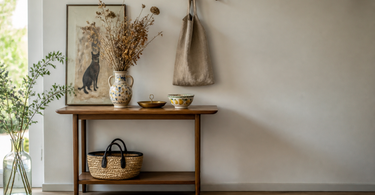
The hallway is your home's business card — the first thing guests see, and the last thing you see yourself before heading out the door. With just a few well-chosen elements, you can turn the passageway into an experience in itself: hooks that are decorative even when empty, a mirror that opens up the space, a rug that defines the zone, and a bit of wall decoration that says something about you. It doesn't require much space or a big budget.
Statistically, the hallway is the room that gets the least decorating attention — and it shows. Most people spend under three seconds in it before hurrying on. But those three seconds count. This is where you form your first (and most lasting) impression of a home. With a well-placed mirror, a couple of hooks with character and a splash of colour on the floor, you can transform a neutral passageway into a place you actually look forward to coming home to.
Hooks: practical and decorative in one
The typical row of hooks from the hardware store solves the logistics but adds nothing. A hook doesn't just have to be something to hang things on — it can also be a sculptural element that makes the wall interesting, even when there isn't a single coat hanging on it.
Animal-shaped hooks for the hallway in brass or ceramic are an obvious alternative. A parrot, an elephant or a crocodile in cast brass costs almost the same as an anonymous steel hook, but gives the wall a completely different identity. Ceramic hooks typically come in hand-painted versions, where no two pieces are identical — a natural result of the manual glazing.
Placement and setup
Avoid the horizontal line. Three hooks at exactly the same height with exactly the same spacing looks like a project from an IKEA instruction video. Instead, try placing them at varying heights: one low for children's bags, one at eye level for coats, one a bit higher for hats and scarves. It gives a more organic look and is actually more functional too.
Brass hooks suit a classic or industrially inspired hallway well. Ceramic hooks are ideal for a playful, colourful interior — and they come in a wealth of shapes, from geometric to figurative.
Tip: Mix materials deliberately. A single brass hook between two ceramic hooks creates a break that looks intentional rather than accidental. Stick to two materials max, so it doesn't end up looking cluttered.
The mirror: the hallway's most important element
If you only add one piece of furniture to the hallway, make it a mirror. The function is obvious — the last check before you leave home — but the spatial effect is just as important. In a narrow hallway, a mirror reflects the light and visually doubles the depth the room is perceived to have. A 60×90 cm mirror can make a 2 m² hallway feel twice as big.
Shape and frame
The shape communicates something. A round mirror brings calm and softness — it breaks up the straight angles in the architecture and acts as a visual breather. An oval mirror signals a more classic elegance. A rectangular mirror with a thick, textured frame in wood or metal becomes an architectural statement.
Choose a frame that has something to say: hammered brass, lacquered rattan, cast concrete or hand-painted wood. A mirror with a strong frame works as wall decoration, even when no one is using it. Take a look at our range of mirrors to find the shape that suits your hallway.
Hanging
The centre of the mirror should typically hang at eye level — around 155–165 cm from the floor for most adults. In a low hallway, you can hang it a little lower and angle it slightly forward, so it reflects both face and outerwear at once.
| Mirror shape | Expression | Suits |
|---|---|---|
| Round | Soft, calm | Minimalist or Scandinavian hallway |
| Oval | Classic, elegant | Traditional or bohemian interior |
| Rectangular | Structured, architectural | Industrial or modern hallway |
| Irregular | Playful, artistic | Colourful or eclectic interior |
Rug by the door
A doormat is essential, but it's rarely interesting. The clever trick is to lay a smaller rug just inside — either on top of the mat or right after it. A 60×90 cm rug is enough to mark a zone and adds colour and texture to a space that's otherwise typically quite neutral.
The rug in the hallway does something important architecturally: it defines the hallway as separate from the next room. Without that boundary, the spaces flow together and the hallway disappears as its own zone. With a rug on the floor, you get a room within the room — and it costs roughly the same as a mediocre bunch of flowers.
Choose a colourful rug in a wool blend or cotton weave. Wool rugs have the advantage of being naturally dirt-repellent — the scale structure of wool fibres means dirt doesn't penetrate the fibre the way it does with synthetic materials. A floor rug in hand-woven cotton is easier to clean and holds up better in a hallway with lots of traffic.
The wall: personality without taking up floor space
The hallway is rarely large. That's exactly why the wall is your primary canvas — it takes up no floor space, but can carry an enormous amount of personality.
Poster and pictures
A single poster in a simple frame is the quickest way to say something about yourself. Choose the motif over the style: a botanical print, an abstract graphic work, or an illustration that makes you happy every time you see it. One poster in a good frame always beats five squeezed-in prints in cheap frames.
Wall decorations and masks
If you're after something more three-dimensional, wall decorations in the form of ceramic wall hangings, decorative masks or a wall hangingobvious choices. They create texture and shadow on the wall, and they move from pure decoration towards something resembling curated art — without you needing to call it that.
Ceramic wall hangings are typically produced in hand-thrown earthenware or stoneware and glazed individually, giving each piece a unique surface. Many European ceramic makers offer sets of three to seven pieces in varying sizes that can be arranged freely on the wall.
The shelf or chest of drawers
If you have a narrow shelf or a low chest of drawers in the hallway, you have the perfect scene for a small, curated display. It doesn't need to be many things — in fact, fewer is better.
A small vase with a single branch or a fresh flower, a jar for keys and loose change, and a single porcelain figurine is enough. It's this type of detail that gives a home a sense of being lived-in and thought-through — not just furnished.
Keep function in mind: the hallway is a room in use. A bowl for keys isn't just decorative — it solves a real problem. Choose decorations that can handle being touched, moved and lived with.
Tip: Use the "rule of three": display things in groups of three at varying heights. A tall vase, a medium-sized jar and a low, flat object create a natural balance that the eye perceives as pleasing.
Frequently asked questions
What's the most important piece of furniture in a hallway?
A mirror is the element that gives the most back per square metre. It serves a practical function, reflects light and makes the room appear visually bigger. In a very small hallway, where you can only choose one element, the mirror is the right choice. The centre should hang roughly 155-165 cm from the floor.
What size rug suits a hallway?
A rug of 60×90 cm is the minimum to make a visual difference in an average hallway. If you have more space, you can go up to 80×120 cm. The most important thing is that the rug defines the hallway as its own zone rather than disappearing into the room behind it.
Can you mix hooks in different materials?
Yes — it can actually look more thought-through than a uniform set. Mix two materials, for example brass and ceramic, and stick to that. Three or more materials on one wall risks looking random rather than deliberately curated.
What can you do with a very narrow hallway?
In a narrow hallway, the wall is your best friend. Use it vertically: hooks at varying heights, a mirror, a single piece of wall decoration. Avoid large furniture on the floor. A rug in a narrow, elongated shape (e.g. 50×80 cm) works better than a wide, square rug.
What's the difference between a round and an oval mirror?
A round mirror gives a soft, neutral look that suits most styles. An oval mirror signals more classic elegance and has a slightly directional shape that visually lengthens the room. Both shapes break up the architecture and create more dynamism than a rectangular mirror.
How many decorations are appropriate in a hallway?
The hallway is a room in constant use, so keep it simple. Three items on a shelf or chest of drawers is typically enough: varying heights, one functional (e.g. a bowl for keys), and one or two purely decorative. More than that can quickly feel cluttered in a small, busy room.
Summary
A good hallway isn't about filling the space, but about choosing the right elements. A mirror opens up the room and is essential in narrow hallways. Hooks with character make the wall interesting, whether or not anything's hanging on them. A rug defines the hallway as its own zone and adds colour. Wall decoration — a poster, a wall hanging or a tapestry — adds personality without using floor space. And a small, curated display on a shelf or chest of drawers gives the home a sense of being thought-through all the way to the front door.
Explore our selection of hooks for the hallway — or see the full range of wall decorations and mirrors.