
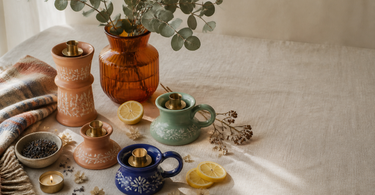
Candlesticks in glass, ceramic and crystal offer three completely different looks — from the soft play of colour in glass to the sculptural character of ceramic. You can style them on the dining table, in the window or on the chest of drawers by varying heights and materials within the same colour palette. Remove wax with warm water or a spell in the freezer. Glass candlesticks can usually go in the dishwasher; ceramic is best dried by hand.
A couple of lit candles can transform a room in under two minutes — but the candlestick itself doesn't need to wait for darkness to make a difference. Colourful, shapely candlesticks work as decoration all day long, whether they're sitting in the window catching the afternoon light or taking pride of place on the dining table as a sculptural centrepiece. This guide covers the three most-used materials, gives concrete tips for styling in your home, and explains how to keep your candlesticks in good shape for years to come.
Three materials, three looks
Choosing the material is the first — and most important — decision when you're looking for a new candlestick. Glass, ceramic and crystal each have their own physical properties, which directly affect what happens when the candle is lit. None of the three is the "most correct" choice; they simply suit different rooms, moods and styles.
| Material | Light effect | Look | Care |
|---|---|---|---|
| Glass | Soft, coloured glow | Light and atmospheric | Often dishwasher-safe |
| Ceramic | Diffuse, warm | Sculptural, handmade | Hand washing recommended |
| Crystal | Sharp reflections | Elegant, festive | Hand washing recommended |
Glass: light play and colours
Glass candlesticks make the most of the material's transparency in a way the two other materials can't: the burning candle sends light out through the glass, casting a soft, coloured glow on the table and the wall behind it. The effect varies with glass thickness and colour saturation — thick, dark glass gives a more subdued glow, while thin, brightly coloured glass casts more dramatic patches of colour.
Coloured glass is also decorative in daylight. Placed in a window, it catches the sunlight and projects colours onto the floor, like a little private stained-glass window. It's no coincidence that coloured glass in the windowsill is one of the most widespread forms of decoration in Scandinavian homes.
Tip: Place 3-5 glass candlesticks of varying height and colour close together in the window. Daylight blends the colours naturally, and in the evening the candles create a warm, cohesive glow — without you having to coordinate them down to the last detail.
As for cleaning, many glass candlesticks can go in the dishwasher — always check the manufacturer's recommendation, as painted or hand-blown glass may have surface treatments that aren't suitable for dishwasher use.
Ceramic: sculptural character
Ceramic candlesticks works differently from glass: the material is opaque, so the light doesn't pass through but gathers at the top by the flame and casts a soft, warm shadow downwards. This gives a more intimate and down-to-earth expression.
Handmade vs. cast ceramics
Hand-painted ceramic candlesticks are never 100% identical — the sweep of the brushstroke, a slight variation in paint thickness or an unevenness in the shape are signs that a human hand has been involved in the production. Cast ceramics are more uniform and typically cheaper, but lose some of the character that many people seek from ceramics rather than plastic or mass-produced porcelain.
The shape ranges widely: classic pillar shapes in various heights, geometric figures, organic sculptural forms and more playful versions such as animals or abstractions. Unique candlesticks in ceramic are often produced in limited series by European ceramic makers, which makes them hard to find again once sold out.
Combine heights
Ceramic candlesticks work best in groups with varying heights. A rule of thumb is to have at least two different heights — preferably three — within the same group. Try, for instance, 8 cm, 12 cm and 18 cm side by side. The colours don't need to match exactly; the tone matters more than the precise shade.
Crystal: reflections and elegance
Crystal candlesticks are in a class of their own. The material — either genuine lead crystal or crystal glass with a high refractive index — splits the light into spectrum colours as the flame burns. The effect is dramatically different from glass: instead of one combined coloured glow, you get hundreds of small, dancing reflections of light on the ceiling, walls and tabletop.
Crystal feels festive and suits situations where the table is set for several guests. But it works just as well in everyday life — a single crystal candlestick on a white table or a dark shelf is a strong graphic element that doesn't need other accessories to stand out.
Crystal candlesticks should be washed by hand in lukewarm water with a mild washing-up liquid to preserve the shine and avoid discolouration. Always dry thoroughly with a soft cloth to prevent limescale marks.
How to style with candlesticks
Candlesticks are one of the easiest tools for giving a room new life, because they can be moved and recombined without you having to rearrange the furniture. Here are four concrete placements with practical guidelines:
The dining table
Place 3-5 candlesticks in the middle of the table at varying heights. Feel free to mix materials — for example, a couple of glass candlesticks next to a ceramic one — but stay within the same colour palette. Warm terracotta next to a deep blue glass candlestick can look chaotic; swap the blue for a dusty green, and it typically works far better, because the colours are more "earthy" and complement each other.
The window
A row of coloured glass candlesticks in the window is a classic in Nordic interior design — and for good reason. Daylight activates the colours without you having to light a single candle, and in the evening the candles add a warm glow that's visible from both outside and inside at once.
The chest of drawers
A single, striking candlestick can stand alone as a sculptural eye-catcher on a chest of drawers or hallway shelf. Feel free to pair it with a vase or a mirror behind it, so the light reflections are enhanced and add depth to the arrangement.
The living room as a whole
Rather than gathering all the candlesticks in one place, it creates more room atmosphere to distribute them: coffee table, bookshelf and side table. When eight flames burn in a room spread across four surfaces, a warmth is created that one central group can never match. Feel free to combine the candlesticks with candles in lovely colours — votive candles, pillar candles and block candles cast different amounts of light and add variation.
Cleaning and maintenance
Wax is easy to remove if you know what you're doing. Two methods work well:
- Hot water: Pour boiling water over the wax residue and let it sit for 30 seconds. The wax softens and can be scraped off with a soft plastic spatula or your fingernails.
- The freezer: Put the candlestick in the freezer for 2-3 hours. The wax contracts and can be tipped off in one piece without leaving marks.
When it comes to daily cleaning:
- Glass: Usually dishwasher-safe at a low temperature (45-55°C). Hand-painted glass should, however, always be washed by hand.
- Ceramic: Best wiped with a damp cloth. Avoid soaking, as unglazed ceramic can absorb water and discolour.
- Crystal: Hand wash with lukewarm water. Dry immediately with a soft cloth to avoid limescale marks and discolouration from washing-up liquid.
Tip: Always use a candle with the correct diameter for the candlestick — a loose-fitting candle can tip over and pose a fire hazard, while a too-tight candle risks cracking a delicate glass holder. Most candlesticks are designed for either ø 2.2 cm (pillar candles) or ø 1 cm (taper candles).
Frequently asked questions
Which candlestick suits everyday use?
Ceramic and glass candlesticks are sturdy enough for daily use. Ceramic is heavy and stable, so it rarely tips over. Glass requires a little more care but is easy to clean. Crystal works fine for everyday use too, but requires careful cleaning to keep its shine.
What's the right candle size for a candlestick?
Most candlesticks are designed for one of two standard diameters: ø 2.2 cm for pillar candles and ø 1 cm for taper candles. Always check the manufacturer's measurements before buying. A loose-fitting candle poses a fire hazard; a too-tight candle can, in the worst case, crack a glass holder.
How do I remove wax from a candlestick?
The freezer method works best on most materials: put the candlestick in the freezer for 2-3 hours, after which the wax contracts and can be loosened in one piece. Alternatively, you can pour boiling water over it and scrape the wax off with a soft plastic spatula once it's softened.
Can I mix different materials and colours in the same display?
Yes — it's actually often more visually interesting than matching perfectly. The key is to stay within one colour family (for example, all warm earth tones or all cool pastels) and vary the heights. Feel free to mix glass and ceramic in the same group; it adds textural contrast without looking messy.
How many candlesticks do you need on a dining table?
3-5 candlesticks is a good starting point for a standard-sized table (approx. 180-220 cm). Place them in a lower group in the middle of the table so they don't block eye contact across the table. Vary the heights to avoid a flat, monotonous display.
Are colourful candlesticks hard to work into an existing décor?
No, quite the opposite. Colourful candlesticks work as a great "testing tool", because they're inexpensive and easy to swap out. Start with one strong colour that's already present in the room — a cushion, a rug or a painting — and choose a candlestick in the same tone. This creates cohesion without requiring a whole redecoration.
Summary
Glass, ceramic and crystal each do their own job. Glass creates coloured plays of light and looks beautiful in daylight; ceramic offers sculptural character and a handmade look that's unique from piece to piece; crystal gives sharp reflections and a festive elegance that works both for everyday and celebrations. Whatever the material, the principle is the same: vary the heights, stick to one colour palette, and spread the candlesticks around the room instead of grouping them in one spot. Cleaning is simple — the freezer method and hot water sort out most of it, and a soft cloth keeps the crystal shiny. That's all it takes to get the most out of colourful candlesticks in your home.
Explore our range of candlesticks in glass, ceramic and crystal — or find candles in matching colours for the perfect display.