
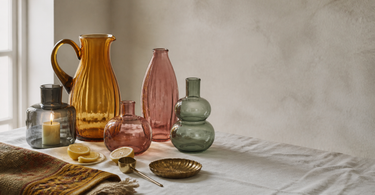
Glass is one of the most light-sensitive materials in the home — it changes with the day's light and shifts character from morning to evening. Mouth-blown glass differs from pressed glass in its natural variations in thickness and shape. Coloured glass in green, amber or blue is growing rapidly in popularity as a decorative element. Drinking glasses, jugs and candlesticks in glass are not just functional — they are sculptural objects that deserve to be chosen with care.
No other material in the home reacts to light quite like glass. A glass vase that is barely visible in the morning can become the most eye-catching object in the room when the afternoon sun hits it at an angle. It's precisely this quality — glass's ability to catch, refract and pass on light — that gives glass objects a truly special place in interiors. From simple drinking glasses to sculptural jugs and lively candlesticks, glass art covers a broad spectrum that reaches far beyond the purely decorative.
Mouth-blown glass vs. pressed glass
The difference between mouth-blown and pressed glass is both visible and noticeable when you hold a piece in your hand. Mouth-blown glass is shaped by a glassmaker blowing air through a metal pipe and turning the piece in molten glass at temperatures above 1,000°C. The process leaves small variations in thickness, natural bubbles and slightly asymmetrical shapes — it's precisely these so-called "flaws" that make each piece unique and impossible to copy by machine.
Pressed glass, on the other hand, is produced by pouring molten glass into a mould and pressing it into place. The result is symmetrical, uniform and typically cheaper to make. The expression is tighter and more predictable — which can be an advantage if you want a clean, geometric aesthetic.
When do you choose what?
Mouth-blown glass works well when you're after a handcrafted feel and accept that two pieces from the same series will never be identical. Pressed glass is a solid choice for large sets, where uniformity matters more than individuality. For decorative single pieces — a vase, a candlestick, a special jug — mouth-blown is almost always the more interesting option. The price difference is real: mouth-blown glass from European manufacturers typically costs 2-4 times more than equivalent pressed glass, but lasts better over time if treated correctly.
Glass candlesticks: light and reflections
A glass candlestick is one of the most effective ways to work with light in a room. The glass does double duty: it holds the light, and it amplifies it. Crystal glass with fine cuts scatters candlelight into prisms, creating moving reflections on walls and ceiling. See crystal candlesticks if you want the maximum play of light. Coloured glass, on the other hand, casts a tinted glow into the room — an amber candlestick warms the room up, a blue one cools it down.
Glass candlesticks in mouth-blown glass have a slight asymmetry that gives them an organic character. Light a pillar candle inside, and the irregular glass wall breaks the light in a way no machine-made piece can replicate. The colour also looks different in artificial light than in daylight — it's one of glass's many qualities as a decorative material.
Tip: Place three glass candlesticks of different heights and the same colour tone together — it gives more visual impact than spreading them out. Feel free to vary between clear and coloured glass to get both reflections and coloured light in one arrangement.
You can also use coloured candlesticks in amber, green or blue as purely decorative objects — even without flame, they work as sculptural elements on a shelf or table. The interplay between the glass's colour and the surrounding lighting is enough in itself.
Glass jugs: functional sculpture
A glass jug is one of the most underrated pieces in a home. It's used daily for water, juice or cocktails, but it can just as easily be left out as decoration between meals. A jug isn't just storage — it's a sculpture with a function.
Jugs in opal glass have a soft, milky-white surface that gives a calm Nordic look. They're particularly effective on a laid table, where they don't compete with the food for attention. See jugs in glass and ceramic for an overview of different materials and sizes. Crystal jugs are more festive and suit occasions where you want something that sparkles. A jug in coloured glass — smoked, green or deep blue — can, on the other hand, tie an entire table setting together colour-wise.
Large vs. small jugs
Size matters — not just in terms of capacity, but visually too. A large jug dominates the table and acts as a natural centrepiece. Small jugs are more flexible and can be used for portioned water, squash for children, or as a mini vase for fresh flowers. Many glass designs are created to handle both tasks elegantly.
Coloured glass and opal glass as decoration
Coloured glass has seen a marked comeback in recent years. Where interior design was long dominated by neutral, clear glass, coloured glass vases, bowls and candlesticks are now one of the fastest-growing segments within home décor. Green, amber and blue are the most sought-after shades, but pink, purple and yellow are also cropping up with increasing frequency.
What's interesting about coloured glass is precisely its changeability. A blue glass vase looks completely different in natural daylight in the morning than under a warm table lamp in the evening. The colour intensifies, fades or shifts undertone depending on the light source and angle. This creates a dynamic that solid, opaque materials simply can't match.
What is opal glass?
Opal glass — also called opaque glass — is a type of glass with a milky, semi-translucent appearance. It's made by adding substances such as bone ash, fluorspar or tin oxide during melting. These additives create microscopic particles within the glass mass, which scatter the light instead of letting it pass straight through. The result is a warm, muted glow rather than the sharp transparency clear glass gives. Opal glass is used in everything from vases and bowls to lamps and jugs, and it's popular in Scandinavian interior design precisely because it's calm and understated without being dull.
If you want to add colour to a space without it feeling overwhelming, coloured glass is a good strategy. It's a material that carries colour lightly and can be moved and combined in a different way than, say, painted walls or coloured textiles.
Drinking glasses with style
Glass art isn't just about decoration — the glasses you drink from are just as important to the overall experience. Shape affects function: a cocktail glass with a well-thought-out shape elevates the experience (at least psychologically), and wine glasses in thin crystal let the wine's colour and clarity come into their own in a way thick glass simply can't. A beautiful champagne glass with a long stem and narrow bowl keeps the bubbles going for longer and makes the celebration that little bit more festive.
Hand-blown drinking glasses have the small imperfections in the form of micro bubbles and slightly varying thickness that set them apart from mass-produced glasses. No two glasses from the same series are ever identical — that's a quality, not a flaw.
Mix and match
A growing trend is to mix drinking glasses in different colours and shapes on the same table. This requires a bit of awareness of colour tones — stick within the same temperature (warm or cool shades) or choose one recurring colour in varying intensities. The result is a table setting with personality that doesn't look like it was bought all at once from a single shop.
Need a sturdy solution for the terrace or garden parties? Acrylic glass is a practical alternative that looks like glass but can survive a fall without shattering. It's not hand-blown, but then again, that's not the point.
Caring for mouth-blown and crystal glass
Hand-blown glass and crystal glass aren't fragile, but they are sensitive. Proper care significantly extends their lifespan and keeps the glass clear and beautiful.
| Situation | Recommendation |
|---|---|
| Washing | Always hand wash — the dishwasher makes the glass matte and brittle over time |
| Cleaning product | Mild washing-up liquid, lukewarm water, a soft sponge — no scouring pads |
| Drying | Dry with a soft microfibre cloth or linen to avoid water marks |
| Temperature | Avoid thermal shock — never pour boiling water into a cold glass |
| Storage | Give glass items space in the cupboard — they mustn't press or knock against each other |
Crystal glass typically contains lead or zinc (lead-free clear crystal), which gives it its characteristic ring and light refraction. It's precisely these substances that also make the glass more sensitive to chemical cleaning agents and heat. Treat it as you would a fine piece of porcelain — with respect and simple means.
Frequently asked questions
Is mouth-blown glass dishwasher safe?
No. The dishwasher's combination of high heat and chemical cleaning agents breaks down the glass surface over time, making it matte, discoloured and brittle. Hand washing in lukewarm water with mild washing-up liquid is always the right solution for mouth-blown and crystal glass.
Can I use a glass vase as a candlestick?
Yes, many glass vases are well suited to tealights or pillar candles. Check that the glass thickness is sufficient — especially with slender, thin vases, the heat from the candle can cause thermal stress. Never place a candle directly against a narrow glass wall without air in between.
What's the difference between opal glass and frosted glass?
Opal glass is opaque or semi-transparent as a natural part of the glass's composition — it's created from within during the melting process. Frosted glass is clear glass that has subsequently been sandblasted or acid-treated on the surface to give a matte, cloudy effect. They look similar but are made in fundamentally different ways.
Which glass colours are most popular in home décor?
Amber, olive green and dusty blue are the most sought-after shades at the moment, as they suit both Nordic and southern European-inspired interiors. Pink and smoky grey glass are also growing in popularity as more subdued alternatives to the stronger colours.
How do I avoid water marks on glass vases and drinking glasses?
Always dry the glass immediately after washing with a clean, soft cloth — ideally microfibre or linen. Don't let it air dry, as the limescale content in the water leaves white marks that are difficult to remove afterwards. Limescale remover can be used in an emergency, but avoid it on very thin glass.
Can coloured glass fade over time?
It depends on how the colour has been added. Solid-coloured glass, where the pigment is part of the glass mass, is stable and won't fade. Glass with a coloured coating on the surface, on the other hand, can fade over time, especially with repeated hand washing. Always check the product description to see which colouring technique has been used.
Summary
Glass art in the home covers a spectrum from the purely functional to the distinctly sculptural. Mouth-blown glass is characterised by its natural variations and handcrafted character — qualities that make each piece unique and hard to replace with machine-made alternatives. Coloured glass in amber, green and blue is not a passing trend, but a rediscovery of a material with long traditions. Glass candlesticks, jugs and drinking glasses each offer ways to bring more light, colour and character into everyday life — and they demand no more than a soft cloth and a little care at the sink.
Explore our range of glass items for the home — from candlesticks and jugs for hand-blown quality drinking glasses.