
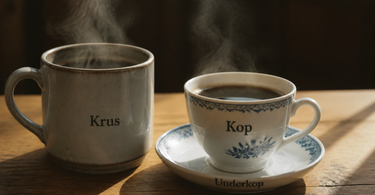
A mug is typically larger (250–500 ml), thicker and without a saucer — designed for everyday use at the desk or on the sofa. A cup is smaller (80–200 ml), thinner and traditionally served with a saucer for more formal occasions. The material determines both weight and heat conduction: stoneware holds the heat, porcelain is lighter and more elegant, and ceramic sits somewhere in between.
Mug or cup? It sounds like a trivial detail, but the difference is more concrete than you might think. The size isn't random — it reflects which drink you're serving, in what quantity and in what setting. Once you understand the logic behind it, it becomes much easier to put together a set of tableware, set up a coffee bar at home, or simply buy the right piece for the right purpose. Here we go through the exact parameters.
What's the basic difference?
The definition isn't set in law, but there's a clear convention in the ceramics and porcelain industry:
- A mug is a free-standing vessel with a handle, typically without a saucer, with a volume of 250–500 ml and relatively thick walls.
- A cup is smaller, 80–200 ml, with thinner walls and is traditionally served with a saucer.
Both have a handle — that's not what sets them apart. What matters is volume, wall thickness and context. A mug signals informal, everyday use; a cup signals something more formal and controlled.
This distinction isn't a Danish quirk. In English, a similar distinction is made between "mug" and "cup", and the two words translate directly to krus and kop respectively. In Scandinavia, the line has historically been a bit more fluid, because everyday coffee culture is strong — many people drink their morning coffee from a mug, but serve afternoon coffee in cups for guests.
Tip: If you're unsure what you need, start by defining the occasion: is it for your own everyday use, or is it for serving? Own everyday use = mug. Serving guests with a saucer = cup.
Size and volume
Volume is the easiest and most objective way to tell them apart. Here's an overview of the typical size ranges:
| Type | Typical volume | Height | Diameter |
|---|---|---|---|
| Espresso cup | 60–90 ml | 4–5 cm | 5–6 cm |
| Coffee cup | 100–150 ml | 6–7 cm | 7–8 cm |
| Tea/cappuccino cup | 150–200 ml | 7–8 cm | 8–10 cm |
| Standard mug | 250–350 ml | 9–11 cm | 8–9 cm |
| Large mug / jumbo | 400–500 ml | 11–13 cm | 9–11 cm |
Note that a "latte" cup today often approaches a mug in volume (350–400 ml), but can still be served with a saucer. Here the boundary is more fluid, and it's primarily the shape — wider, more open — that sets it apart from a classic mug.
Our range of cups covers the whole spectrum from espresso size to generous tea cups, so you can find exactly the volume you need.
Materials and weight
The material has a direct impact on three things: weight, heat conduction and durability. The three most common materials for both cups and mugs are stoneware, porcelain and ceramic.
Stoneware
Stoneware is fired at 1200–1300°C and is dense, heavy and very durable. It has low heat conduction, which means the drink stays warm longer — and the outside doesn't immediately become uncomfortably hot. A stoneware mug typically weighs 300–500 g. It's by far the most widespread material for everyday mugs.
Porcelain
Porcelain is fired at up to 1400°C and contains kaolin, which gives it the characteristic white, semi-translucent surface. Walls can be made thinner, and the weight is lower — a 150 ml porcelain cup can weigh as little as 80–120 g. Porcelain is the classic material for formal cups and tableware. Bloomingville cups are mainly in porcelain and stoneware and clearly illustrate this distinction across their collections.
Ceramic
Ceramic is a broad category, but in everyday language it's most often used about handmade or semi-handmade earthenware with an organic, irregular surface. The firing temperature is lower (1000–1100°C), and the material is more porous. Ceramic mugs typically have a rustic aesthetic and weigh 250–400 g. RICE cups are a great example of how ceramic is used to create a colourful, everyday-friendly look.
Melamine and other plastic materials
For children and outdoor use, mugs and cups are available in melamine and other plastic materials. They're almost unbreakable, but can't withstand a dishwasher at high temperatures and aren't suitable for the microwave.
Use and occasion
Choosing a mug or cup isn't just about aesthetics — it's about function in the specific situation.
Everyday use
For morning coffee at your desk, tea on the sofa or a long work session, a mug is the practical choice. The size (typically 300–400 ml) means fewer refills, and the thick walls keep the temperature for 20–30 minutes. You don't need a saucer, and the mug is generally more robust against knocks and drops.
Serving guests
When you serve coffee for guests, a cup with a saucer signals attentiveness and consideration. The saucer acts as a resting place for the spoon and catches drips. In formal settings — brunch, afternoon coffee, meetings — the cup is the norm.
Barista drinks
Espresso is always served in an espresso cup (60–90 ml) — the volume is necessary to preserve the crema and the correct espresso ratio. Cappuccino is traditionally served in a 150–180 ml cup, latte in a 300–400 ml glass or cup. Here the shape isn't just aesthetics: it affects how the foam distributes and the drink cools.
Explore our full range of cups for all types of serving — from espresso to latte.
The saucer — when and why?
Historically, the saucer isn't a decorative detail — it's functional. In 17th- and 18th-century Europe, when tea and coffee were expensive luxury goods, the drink was poured into the small saucer to cool it down faster and drunk from there. This explains why older cups have such a small volume: people drank in portions poured into the saucer.
Today the saucer is mainly used for three things:
- Holding the spoon — so you don't have to put it on the table or plate.
- Catching drips — particularly relevant for espresso and mocha.
- Signalling service — a saucer marks that someone has made an effort.
A mug is served without a saucer, and there's no social rule that changes that. If you put a mug on a saucer, it looks distinctly odd — the proportions simply don't match.
Tip:If you're buying cups with saucers, check that they're sold as a set — or that the saucer matches in diameter. A 150ml cup typically needs a saucer with a diameter of 14–15cm to look proportionate.
How to choose the right one
Here's a short decision guide based on the concrete parameters:
Choose a mug if:
- You want 300ml or more in one pour.
- It's for everyday, informal use.
- You prefer to keep your drink warm for longer (thick walls).
- You don't want to use a saucer.
Choose a cup if:
- You serve espresso, filter or mocha coffee in the classic size (100–150ml).
- You're serving guests and want a more coordinated presentation with a saucer.
- You prefer something lighter and thinner — for example, in porcelain.
- Aesthetics in the tableware set are a high priority.
Bloomingville cups typically combines Nordic design with practical volume — many of the models fall into the 200–250ml class, a compromise between a cup and a mug. It's a popular choice for those who want a bit more volume than a classic cup, but still prefer the slim profile.
At RICE you'll find cups with more expressive colours and patterns — typically in ceramic and in sizes suited to tea and filter coffee.