
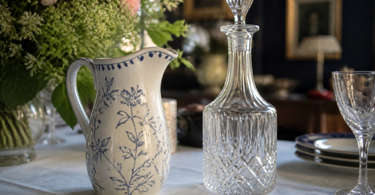
A jug has a handle and a spout, is designed for pouring and is used for everyday drinks such as water, milk or juice. A carafe typically has no handle, has a narrow neck and a wide base, and is mainly used for wine or as a table decoration on festive occasions. Material, shape and usage scenarios set the two types apart from each other – even though in practice they overlap.
Jug or carafe? Many people use the words interchangeably, but there are actually a number of concrete differences between the two – in shape, function and when you bring them out. Once you understand the differences, it's easier to choose the right one for the table, whether you're setting the table for an everyday dinner with the family or putting a bottle of red wine aside to decant before a dinner with guests.
Basic definitions
Let's start with the basics. The two words cover two distinct product types, even though they're both about storing and pouring liquid.
What is a jug?
A jug is a container with a handle and a spout. The handle gives you a firm grip, and the spout guides the flow of liquid precisely into the glass or cup. The jug is the everyday workhorse: you use it for water on the dinner table, for milk at breakfast, or for squash and juice. The shape varies a lot – from tall, narrow models to low and curved ones – but the handle and spout are almost always present.
You'll find jugs in many sizes and materials, from ceramic and porcelain to glass and stoneware. What they have in common is that they're built for easy, practical pouring.
What is a carafe?
A carafe is typically a glass-bottle-like container with a wide base and narrow neck – and usually without a handle. It's designed to present the contents, not necessarily to pour quickly and precisely. The carafe's wide base increases the surface area of the wine, allowing it to aerate (decant) effectively. It's used at the table as a visual and functional element when serving wine, water or other drinks on special occasions.
Shape and function
The shape of a jug and a carafe isn't random – it reflects the intended use.
The anatomy of the jug
A jug's handle sits fixed on the side and is proportioned so an adult hand can get a secure grip. The spout is shaped so the liquid flows in a controlled stream without dripping. Many jugs also have a lid that keeps the contents warm (coffee jugs) or cool. The base is wide and stable, so the jug doesn't tip over when placed on a table with children or in a busy household.
If you're looking for something minimal for the breakfast table, milk jugs are a perfect example of the jug shape's logic in miniature: handle, spout, stable base – everything essential, nothing superfluous.
The anatomy of the carafe
The carafe's characteristic shape – wide at the base, narrow at the neck – isn't just aesthetic. The wide base gives maximum contact area between the wine and the air, which speeds up the decanting process. The narrow neck slows down the oxygen supply when the wine isn't actively being poured, and helps preserve the aromas. Carafes for water or juice often follow a more cylindrical shape, but keep the elegant silhouette and the absence of a handle.
Tip: If you want to use a carafe for red wine, pour the wine into the carafe at least 30 minutes before serving – ideally 1-2 hours for full-bodied wines like Cabernet Sauvignon or Barolo. The wider the base, the faster the wine decants.
Materials and production
The choice of material also typically sets the two product types apart, although of course there's overlap.
Jugs: ceramic, porcelain and stoneware
Jugs are most often made from ceramic, stoneware or porcelain. These materials retain heat, are durable and can withstand daily use. Glazed surfaces are easy to clean and don't absorb odours or stains. Ceramic jugs are handmade in many cases, which gives variations in shape and glaze from piece to piece. Stoneware is heavier than porcelain, but in return more resistant to knocks.
A special category is lemon jugs, which are equipped with a juicer at the top, so you can squeeze citrus straight into the jug. Here, the shape and material are optimised for one specific task.
Carafes: glass and crystal
Carafes are almost always made from clear glass or crystal. This is deliberate: you need to be able to see the colour and clarity of what you're serving – particularly important with wine. The thickness of the glass varies from thin, mouth-blown crystal, which weighs very little, to thicker machine-blown glass, which is more robust. Crystal carafes refract light differently to ordinary glass and give a more "sparkling" look on the table.
Overlap: glass jugs
Glass is also used for jugs – especially for cold drinks such as ice-cold water, juice or lemonade. Glass jugs combine the jug's functionality (handle, spout) with the carafe's visual transparency. They're popular for the summer table, where you want to see the fresh ingredients in the liquid.
When do you use which?
The most practical way to understand the difference is to look at the concrete situations where the two types of products make sense.
The jug for everyday use
The jug belongs in everyday life. It's used for:
- Water on the dinner table – easy to grab and pour without spilling
- Milk for coffee and tea – the small milk jug is a classic café-table piece
- Juice and cordial for breakfast – big enough for the family, but easy to handle
- Coffee and tea – insulated pots keep the temperature up
The handle is key. It allows for secure handling, even when the jug is full and heavy. That's exactly why small jugs for milk or cream always have a handle – even in mini format, it's crucial for precise pouring.
The carafe for something special
The carafe comes out when the table needs setting for something a bit more than the everyday:
- Wine at dinner – decanting improves the taste and presentation
- Cold water at a festive table – looks smarter than a plastic bottle
- Homemade lemonade or sangria – fruit and herbs are visible in clear glass
- Whisky or cognac – decanting carafes are used for strong spirits
Jug vs. carafe – overview
| Feature | Jug | Carafe |
|---|---|---|
| Handle | Yes, almost always | Rarely |
| Spout | Yes | Usually a wide opening, not a spout |
| Primary function | Pouring and serving | Decanting and presenting |
| Typical material | Ceramic, porcelain, stoneware, glass | Glass, crystal |
| Usage scenario | Everyday | Parties, dinners, special occasions |
| Visibility of contents | Only with glass jugs | Always (clear glass) |
| Decanting effect | Minimal | High (wide base) |
How to choose the right one
When you're choosing between a jug and a carafe, it's about mapping out your actual needs rather than letting aesthetics alone guide you.
Ask the right questions
Start by considering:
- Will it be used daily or only on special occasions?
- Is precise pouring important – for example, for a child or a narrow cup?
- Do you want to decant wine, or is it mainly water and juice?
- Does it need to withstand the dishwasher and daily handling?
If your answer is "daily use" and "precise pouring", a jug is the right choice. If your answer is "wine at dinner" and "table setting that impresses", a carafe is more obvious.
Size and capacity
Jugs typically come from 0.3 litres (milk jugs) up to 2 litres (large water jugs). Wine carafes often start at 0.75 litres, equivalent to one bottle of wine, and go up to 1.5 litres for double magnums. For table settings for 4-6 people, a 1-litre water carafe is suitable.
Tip: If you need both, a glass jug with a handle and wide opening can work as a compromise. It's easy to pour from like a jug and looks elegant enough to sit on a dinner table.
Cleaning and maintenance
The carafe's narrow neck is its Achilles' heel when it comes to cleaning. You can't get a sponge down to the bottom, so you're reliant on a long carafe brush, cleaning beads or a dishwasher (if the model allows it). Jugs – especially ceramic ones – are far easier to clean with a dishcloth. Always check whether the product is dishwasher-safe before you buy.
Frequently asked questions
Can a carafe replace a jug for water?
Yes, a carafe can easily be used for water – and it often looks lovely on the table. The downside is the lack of a handle, which makes precise pouring a bit harder, especially if the carafe's neck is narrow. For everyday use, a jug is more practical; for the dinner table, a carafe works fine for water.
What is a milk jug, and how does it differ from an ordinary jug?
A milk jug is a small jug – typically 0.1 to 0.3 litres – with a handle and narrow spout, designed for adding milk or cream to coffee and tea. It follows the jug's basic principle of handle and spout, but is optimised for precise dosing in small amounts rather than serving large quantities of liquid.
What does it mean to decant wine?
Decanting means pouring wine from the bottle into a carafe, so the wine comes into contact with air. This opens up the aromas and softens the taste experience. Young, powerful red wines in particular, and older wines with sediment, benefit from decanting. The process typically takes 30 minutes to 2 hours depending on the type of wine.
Are there jugs without a handle?
Yes, they exist, but they're less common. Jugs without a handle are poured by tilting the entire container, which requires a good grip on the body – and makes precise pouring harder. Many such models sit in the grey area between jug and carafe and are often marketed as both.
What is a lemon jug?
A lemon jug is a jug with a built-in juicer on top. You cut a lemon or lime in half and press it directly down into the jug. The juice runs through a sieve that holds back the seeds. It's a practical solution for lemonade, cocktails or flavoured water without the need for extra equipment.
Which material is best for a jug?
It depends on the use. Ceramic and stoneware hold heat well and are durable for daily use, but are opaque. Glass is hygienic, easy to clean and shows the contents, but is more fragile. Porcelain is light and elegant, but requires more care. For everyday use, stoneware and ceramic are usually the sturdiest choice.
Summary
The difference between a jug and a carafe is fundamentally a question of shape, function and context. The jug has a handle and spout, is made for daily and practical pouring, and comes in materials such as ceramic, porcelain and stoneware. The carafe's wide base and narrow neck are optimised for decanting and aesthetic presentation – typically in clear glass. The two product types overlap in borderline cases such as glass jugs and water carafes, but the starting point is clear: the jug is the everyday tool, the carafe is for the table setting. Once you know your actual needs – daily use versus special occasions, milk versus wine – it's easy to choose the right one.
Explore our range of jugs for everyday use or find your next small jug for the coffee and tea table.