
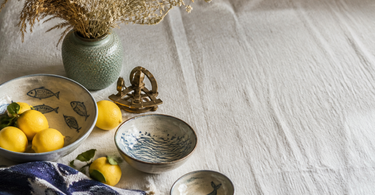
Fish and shellfish as a decorative theme are one of the most striking movements in modern home decor. The organic, asymmetrical shapes from the world of the sea — fish-shaped jugs, shell-shaped bowls, seafood platters — act as a contrast to decades of strict minimalism. You get the best use out of them as accent pieces in natural colours: blue, sand, white and green. One or two statement pieces are plenty to establish the mood without overdoing the theme.
The sea has inspired artists, architects and designers for centuries — and now the organic forms from the world of the ocean have truly made their way into the living room, kitchen and hallway. Fish-shaped jugs, seafood platters and shell-shaped bowls are turning up on dining tables and shelves everywhere. It's no coincidence: the shape of a fish or a scallop has been biologically perfected over millions of years, which makes it visually interesting in a way that's hard to replicate with straight lines and square corners. Here's an overview of what's driving the trend, what types of products are out there, and how to work with them in your home.
Why maritime aesthetics in home decor?
The maritime trend hasn't emerged from a vacuum. It should be understood as a reaction to the strict, monochrome minimalism that dominated interior design for much of the 2010s. Where minimalist design prioritises order and uniformity, maritime motifs pull in the opposite direction: asymmetry, texture, biological complexity.
There are three driving forces behind the trend:
- A longing for nature. A growing interest in biophilic design — that is, decor that draws references from nature — has made the shapes of the sea appealing. Mussels, fish and seaweed are organic forms that feel calming and grounding in the same way as plants and stones.
- The complexity of the shapes. A carp fin has between 15 and 20 individual rays. An oyster has concentric rings with millimetre variation. These details give the eye something to rest on and discover — something a smooth rectangular vase rarely offers.
- Humour and surprise. There's something understatedly playful about serving salad in a shell-shaped bowl or putting a fish jug on the table. It breaks the solemnity in home decor and sparks conversation.
The result is an aesthetic that can be both refined and down-to-earth depending on which materials and colours you choose.
The key product categories
Fish jugs and fish-shaped vases
Fish jugs are one of the most recognisable expressions of the trend. They're typically cast in stoneware or ceramic and modelled with details such as individual scales, defined fins and an open mouth that acts as a spout. The height typically varies between 18 and 30 cm, and the capacity is usually 0.5–1.2 litres — fully functional for serving water, juice or dressing.
Fish-shaped vases follow the same design language but are closed at the top and intended for flowers or as pure sculpture. Both types can be used as a statement piece on a shelf, as part of a curated table setting or alone on a side table.
Seafood platters and shell-shaped bowls
Seafood platters and bowls with a shell shape take their starting point from oysters, scallops and mussels. The shape is characterised by the radial ribbed structure that gathers towards a central point, and the wavy edges that follow nature's own pattern rather than the round rhythm of a potter's wheel.
These pieces can be used for:
- Serving tapas, sushi or starters
- A jewellery bowl by the bed or in the hallway
- A salt bowl or sauce bowl on the table
- A purely decorative element on a shelf
Most are produced in sizes from approx. 10 cm (a single handful) to 30+ cm (suitable for large servings).
Fish and seafood motifs on plates
Plates with fish and seafood motifs are a third category. Here, the shape of the plate is typically round and conventional, but the decoration — printed, painted or embossed in the glaze — depicts fish, prawns, crabs or octopuses. They work well as part of a dinner service for special meals or as decorative wall plates.
Salt and pepper sets
Many manufacturers make maritime salt and pepper sets, where the pots are shaped like fish or shellfish. They're typically 6–10 cm tall and made from ceramic with glazed surfaces. A good example of how even a small accessory can carry the theme through without overdoing it.
Tip: Use maritime elements across categories rather than gathering everything into one category. A fish-shaped jug, a couple of seafood platters and a fish salt-and-pepper set create a more nuanced mood than eight plates with the same motif. The variation in shape and function keeps the look alive.
How to style with maritime elements
One statement piece as an anchor point
The most effective starting point is to choose one dominant piece — typically a fish-shaped jug in a striking size or a large seafood platter — and build the rest of the table setting or shelf arrangement around it. This creates hierarchy and stops the maritime elements from competing with one another.
The colour palette: sea and coast
Stick to a palette of ocean blue, green, sand, terracotta and white. Maritime decorations in these colours naturally relate to one another, even when the shapes vary. Avoid bold primary colours unless the piece is specifically designed in a pop-art tradition — it can work, but requires more control over the rest of the room.
Mix with natural materials
Ceramic fish and seafood pieces work well alongside wood, linen, raw stone and wicker. The natural texture of the materials reinforces the organic reference without requiring extra maritime motifs. A sand-coloured wool throw or unglazed stoneware dishes create a calm backdrop against which the maritime accents can stand out.
Placement in the home
Maritime elements aren't just for the kitchen or bathroom. They work surprisingly well in the living room as shelf decoration and in the hallway as a welcoming detail. Ceramic ornaments in fish and seafood shapes can easily live on a bookshelf alongside plants and neutral candlesticks — it's the combination that tells the story.
In the kitchen, fish platters have an obvious place: use them for serving tapas, as a bowl for olives or for presenting cheeses. The decorative function and the practical function merge, and that's exactly the kind of dual functionality that gives an object a long-lasting place in the home.
Avoid overexposure
The biggest pitfall is going all-in on one theme to the point where the room loses nuance. Two to three maritime pieces in a room is usually plenty. If you want more, spread them across rooms rather than gathering them in one corner. And avoid combining maritime elements with other distinct nature motifs in the same setting — fish and lion motifs in animal-inspired vases can coexist in a home, but they should have their own room or shelf.
Materials and finish
Stoneware and ceramics
The majority of maritime decorative products are made from stoneware or regular ceramic. Stoneware is fired at high temperatures — typically 1200–1300 °C — and is denser and more durable than low-fired ceramic. This means stoneware jugs and platters withstand daily use and hand washing without losing their glaze. Many pieces from European ceramic manufacturers are produced in Portugal, Spain or the Netherlands, where there are strong ceramic craft traditions.
Glaze and surface
The glaze on maritime ceramic products varies from clear and glossy (which highlights the underlying colour and details) to matte and drippy (which gives a more rustic, handmade look). Reactive glazes, where the colour varies depending on temperature and firing conditions, are particularly popular in the maritime category — they create a natural variation in blue and green tones reminiscent of water in different light.
Care and maintenance
Most glazed stoneware pieces can be hand washed with mild washing-up liquid and warm water. Many are also dishwasher-safe, but repeated machine washing can affect the glaze's shine over time. Always check the manufacturer's instructions for the specific piece. Avoid sudden temperature changes — for example, moving a cold jug straight onto a hot hob — as this can create micro-cracks in the glaze over time.
Frequently asked questions
Are maritime decor elements only for the summer house?
Not at all. Fish and shellfish motifs work all year round and suit a city flat just as well as a summer house. The key is to use them as accent pieces rather than building a full-on sea theme throughout. A single fish platter or a mussel-shaped bowl on a shelf tells the story without turning the room into a souvenir shop.
Can a fish jug be used for serving?
Yes. Most fish jugs are fully functional and designed for pouring. They're suited to water, juice, dressings and cold sauces. However, always check whether the glaze is food-safe — this should be stated in the product description. Stoneware finished with a lead-free glaze is the standard among all serious European manufacturers.
How do I keep my ceramic fish pieces looking nice?
Hand washing with a mild washing-up liquid is the safe option for all ceramic pieces. Many are dishwasher-safe, but repeated machine washing can make a glossy glaze go matte over time. Avoid sudden temperature changes, and don't stack them if they have protruding details like fins or tails — these can easily chip off.
Do maritime products suit a modern, minimalist interior?
Yes — in fact, the contrast is a strength. A single fish-motif piece in an organic shape breaks up the tight minimalist look and adds character without making the room feel cluttered. Choose pieces in neutral colours or ocean blue to keep them within the minimalist colour scheme, and let the shape do the work.
Can I mix fish and shellfish motifs with other nature motifs?
Yes, but thoughtfully. Fish and shellfish combine naturally with other sea-related motifs like seaweed or stones. They can also coexist with plant motifs and citrus and fruit shapes in the same home — but give each theme its own space or shelf so they don't compete visually.
What size fish jug is right for everyday use?
A jug of 0.8–1.2 litres corresponds to 4–6 glasses and is practical for the table. Jugs under 0.5 litres are best as purely decorative pieces or for serving dressings and sauces. Larger jugs of 1.5 litres and up work well as a water jug for larger groups and as a visually dominant piece on the table.
Summary
Fish and shellfish as a decoration theme are, at their core, about biological form — the complexity and asymmetry that arise in nature over time, which the eye finds more interesting than the perfect circle or the straight line. You don't need to go all-in: a single fish jug on the kitchen counter, a shellfish platter on the shelf and a set of fish-motif plates for special dinners is plenty to give your home a clear, coherent nod to the world of the sea. Use natural materials as a backdrop, keep the colour palette in the sea's own tones, and let the complexity of the shapes do the rest of the work.
Explore our range of fish and shellfish bowls and platters — as well as fish jugs for the table.