
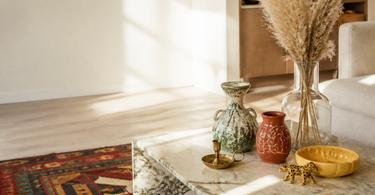
You don't need paint, a saw or special skills to create impactful home projects. Four of the easiest: swap out furniture knobs (5 minutes, big difference), create a hook gallery on the wall, style a shelf with mixed heights and materials, or hang a rug as wall art. All four projects use accessories you already know — just in new contexts.
DIY decorating isn't about building furniture from scratch. It's about using what you already have — or can easily get hold of — in ways that aren't obvious at first glance. A screwdriver, a few command strips and a thoughtfully chosen selection of accessories can transform a room significantly without requiring any special craft skills. Here are four projects with concrete instructions that work even if you've never drilled a hole in a wall.
Swap the knobs on your furniture
It's quite possibly the fastest home project there is: unscrew the old knobs, screw on the new ones. Time per knob: about 30 seconds. A whole chest of drawers with six drawers: under five minutes. Yet the effect is disproportionately big, because knobs are the first thing you touch on a piece of furniture — they set the tone for the whole piece's look.
What to check before you buy
Most furniture knobs and drawer handles use a standard M4 screw (4 mm diameter). Measure your existing screw or hole diameter before buying new ones. If the piece has handles with two screw points, you'll also need to measure the centre distance — that is, the distance between the two holes, typically 32, 64 or 96 mm.
Knobs for kitchen cabinet doors come in ceramic, brass and coloured metal. Brass knobs develop a patina over time and take on a warmer look, while ceramic knobs keep their colour stable. If you want a consistent look across rooms, you can choose the same line for both your kitchen and chests of drawers.
Tip: If the old hole is M4 and you buy a knob with an M4 screw, it'll fit straight away. If you buy drawer handles with two screw points for a piece of furniture with only one hole, you'll need to drill one extra hole — use a pencil to mark it precisely and a 4 mm wood bit.
Style and combinations
You don't need to match all your knobs identically. A mix of brass and ceramic on the same piece of furniture can look deliberate and cohesive if you keep either the shape or the colour consistent throughout. Try, for example, round knobs in two different materials rather than two wildly different shapes.
Hook gallery on the wall
A single hook in the hallway is functional. Four to six hooks grouped together is art — and still functional. The principle is the same as a photo collage wall: you arrange objects with different shapes, but within a shared framework, so they read as one composition rather than a random jumble.
Plan the placement in advance
Lay the hooks out on the floor in the arrangement you're picturing before you drill. Photograph the layout with your phone, and use the picture as a reference when marking the holes. Typically, an irregular, organic arrangement works better than a strict horizontal or vertical line — vary the spacing between hooks from 5 to 15 cm.
Hooks for the hallway come in a huge range of shapes: leaves, animals, geometric figures, hands. For a gallery arrangement, you'll typically mix two to three different designs rather than using six identical ones. Keep either the material (e.g. all in brass) or the colour (e.g. all in one colour) consistent to visually tie the group together.
Practical and stylish at the same time
A hook gallery can absolutely be put to use. Hang hats, bags, cloths or jewellery on it — the objects hanging there become part of the composition. Choose hooks with enough weight capacity for what you plan to hang: a simple ceramic hook typically holds 1-2 kg, while a cast-iron or brass hook with two screw points can easily bear 5+ kg.
Shelf styling with mixed materials
A shelf with one material and uniform heights looks dull. A shelf with two to three materials and varied heights looks curated. The principle is called the "trinity": for each arrangement, you use three elements of different heights that together form a visual triangle. It's not a strict rule, but a good starting point.
Materials that work well together
Ceramic and glass complement each other because they share a craft heritage, but have opposite opacity — the ceramic is solid and matte, the glass is transparent and reflective. Add an organic element (a plant, a piece of fruit, a piece of coral) as the third material, and the shelf gains depth.
Concrete combinations that work:
- A tall ceramic vase(30+ cm) + a low wide bowl + a single candle
- Three candlesticks at different heights + a small figure
- A jug + two books + a small potted plant in a planter
Empty space is also an element
The most common styling mistake with shelves is filling them too much. Empty space — negative space — gives the eye somewhere to rest and highlights the objects you actually want to show off. Remove a third of what you've put up, and see if it looks better. It almost always does.
| Element | Height | Function in the arrangement |
|---|---|---|
| Large vase or jug | 25–40 cm | Anchor point, draws the eye |
| Medium-sized object | 12–20 cm | Connects tall and low |
| Small figure or candlestick | 5–12 cm | Detail, adds charm |
| Empty space | – | Air, gives the arrangement calm |
Rug as wall art
A rug on the floor dampens sound and defines zones. The same rug on the wall does all of that — minus the floor function — plus it becomes a visual element in the room. Rugs with figurative motifs (animals, faces, geometric patterns) work particularly well as wall art, because they're already composed with a central motif, just like a painting.
Two hanging methods
Command strips: Extra-large Velcro-based command strips (3M Command strips, Large or XL) can hold rugs weighing up to 2-3 kg. Rugs made of cotton or wool blend measuring 90×60 cm typically weigh 800–1200 g, which is within the limit. Reckon on 4–6 strips spread along the top edge.
Rod and string: A wooden rod (a simple round rod from the hardware shop, approx. 2.5 cm in diameter) pulled through a seam along the top edge of the rug — or attached with binder clips and pegs — and hung from string on a single hook. A more durable solution for heavier rugs, giving a deliberate, "gallery-like" look.
Wall rugs are designed specifically for hanging and often have a loop or reinforced top edge that makes it easier. Animal rugswith tigers, leopards or other animals works as strong, autonomous images and doesn't need much else on the wall to work.
Tip: Hang the rug at eye level — the centre of the motif approx. 150–160 cm from the floor. It's the same rule as for paintings and works for the same reason: it matches your natural viewing angle when standing in the room.
Choosing materials and tools
None of the four projects requires a particularly well-equipped workshop, but a few basic things make them easier:
- Spirit level (app or physical): A crooked row of knobs or a wonky hook gallery is hard to overlook afterwards. Most smartphones have a spirit level in the compass app or in a free app.
- Pencil: Always mark holes with a pencil before you drill or hammer in nails. Pencil can be erased; holes can't be invisibly filled.
- Electric screwdriver: Not strictly necessary, but saves time and fingers when replacing knobs in larger quantities.
- Wall plugs (rawplugs): For hooks in plasterboard walls — always use a plug, never screw directly into plasterboard.
You'll find accessories for all four projects — knobs, hooks, vases, candlesticks and rugs — together in our decoration range.
Frequently asked questions
Which screw size fits most furniture knobs?
The vast majority of furniture knobs use an M4 screw (4 mm diameter). Always check your existing knob's screw or hole diameter before buying. Drawer handles with two screw points typically have a centre measurement of 32, 64 or 96 mm — measure this on the furniture before ordering.
Can you hang a rug without making holes in the wall?
Yes. Command strips in Large or XL size carry up to approx. 3 kg and leave no holes. They suit light and medium-weight rugs (under approx. 2 kg). Heavier rugs, however, require a wall hook for sufficient load-bearing capacity over time.
How many hooks suit a gallery arrangement?
Four to six hooks is a good starting point. Fewer than four can look sparse; more than eight starts to look cluttered unless you have a very large wall. Mix two to three different models for variation, but keep either the material or the colour constant so the group hangs together visually.
What's the easiest way to get started with shelf styling?
Start by removing everything from the shelf. Lay all the objects on the floor, and choose three to five of them. Arrange them with varied heights and leave at least a third of the shelf's surface free. Add more gradually — it's always easier to add than to edit once things are in place.
Can ceramic knobs withstand daily use in a kitchen?
Yes. Glazed ceramic is robust and resistant to moisture and grease vapour, which are the primary stresses in a kitchen. Avoid striking the knob directly with hard objects — ceramic is strong under pressure but can chip under sharp point impact.
Can you mix different knobs on the same piece of furniture?
Yes, and it can look deliberate rather than inconsistent. Keep either the material or the shape consistent throughout. For example: round knobs in both ceramic and brass work cohesively because the shape stays constant. Two very different shapes in the same material can also work — but require a keener eye for detail.
Summary
The four projects here — knob replacement, hook gallery, shelf styling and rug art — share a common principle: they take accessories you might already know and use them in a new context or combination. None of it requires special craft skills, expensive equipment or irreversible changes. Replacing knobs takes five minutes; a hook gallery takes half an hour. Shelf styling and hanging rugs are even quicker to change again if you change your mind. That makes them the lowest-risk decorating projects you can start with — and often the ones with the most visible effect.
Explore our range of hooks and knobs, wall rugs and candlesticks for your next DIY project.