
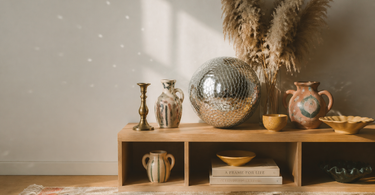
Disco balls are far more than party accessories. Mounted in a window, above a dining table or in the nursery, they work as permanent light objects that cast moving reflections around the room all day long. They come in many sizes and can be freely mixed — one large one as a statement and a few small ones as texture. The effect is greatest where natural light hits the surface directly.
A disco ball measuring 20 centimetres is covered in hundreds of square mirror tiles that together break up and cast light in all directions. It's not a new invention — disco balls first appeared in dance halls back in the 1920s — but they've been rediscovered as a serious interior element. Not because they're discreet, but precisely because they're not. Hung in the right spot, they deliver something no lamp, mirror or candlestick can: moving, organic light that changes with the sun.
What actually happens with the light?
The effect of a disco ball is all about physics. Each of the small mirror tiles sits at a slight angle relative to its neighbouring tiles, because the ball is round. This means they reflect light in marginally different directions. When a light source — the sun, a lamp, a candle — hits the ball, the light is caught and cast out as individual points of light that move as the ball's position in the room shifts, or as the light outside changes.
In the morning, when the sun is low, the light reflections are sharp and concentrated. In the middle of the day, with the sun higher, they spread more widely across walls and ceiling. In the evening, with artificial lighting, a softer, more diffuse sparkle effect appears. You effectively get three different expressions of the same object within a single day.
The bigger the ball, the bigger the individual mirror tiles, and the bigger the light reflections. A 30 cm ball casts visible spots of light 5-10 cm in diameter. A 10 cm ball casts many small, sharp points. Neither is wrong — it's simply a different type of texture in the room.
Tip: Hang disco balls in a window facing south or west for maximum daylight effect. A south-facing window gives direct sun for most of the day, and therefore the most and sharpest reflections. North-facing rooms can still work, but the effect is much softer.
Where you hang it makes all the difference
Placement is the most important variable. A disco ball hanging dark and still in a corner doesn't do much on its own. Hung correctly, it works as an active part of the room's lighting.
The window sill
The classic solution. Hang the ball directly in the window sill — ideally on a string or a thin brass hook — so it hangs freely and can turn easily. Even a small gust from an open window sets it going. In a south- or west-facing window, it casts reflections into the whole room in the afternoon.
Above the dining table
A disco ball in the ceiling above the dining table works as an alternative or complement to a pendant or ceiling light. A large ball — typically 25-40 cm — as the sole fixture makes a clear visual statement. It also reflects the table setting itself from below and adds a decorative dimension to candlesticks and glasses on the table.
The nursery
The nursery is an obvious location, especially because moving light sparks curiosity. Hang up a smaller ball on a string and let natural daylight do the work. Avoid placing it directly above the bed or play area, where sharp reflections can feel disruptive during playtime.
The bathroom
Rarely thought of, but effective. A bathroom with a ceiling light and white tiles is perfect for spreading reflections from a small disco ball. Keep in mind that the ball is close to a source of moisture — check the material description, as some surfaces can go matte over time in high humidity.
Size and composition
Disco balls typically come in sizes from around 8 cm in diameter up to 40 cm or more. The choice of size isn't just a question of ceiling height — it's about which light effect you're after, and whether the ball should work as a solitary eye-catcher or as part of a composition.
| Size | Placement | Light effect |
|---|---|---|
| 8–12 cm | Window sill, shelf, tabletop placement | Many small, sharp flecks of light |
| 15–20 cm | Window hanging, children's room | Good balance — visible but not dominant reflections |
| 25–40 cm | Ceiling in the living room or above the dining table | Large, dramatic points of light — requires space |
Mix sizes for the best visual effect. A classic composition is one large ball (30+ cm) hung centrally in the room and two to three smaller ones (10–15 cm) in the window sill or in a cluster. This creates depth and gives the eye something to move between. Avoid hanging lots of balls in the same size — it looks more like storage than a considered choice.
If you want a more cohesive look, you can combine the disco balls with other reflective decorative elements — glass figures, mirrors or glass candlesticks — that catch and pass on the light from the ball.
Disco balls aren't just for New Year's Eve
There's a fixed mental association: disco balls belong with champagne and New Year's Eve. That association is understandable, but it limits their use unnecessarily. A disco ball in a window is a lighting tool, not a party decoration — and they're designed to hang permanently.
In summer, with long daylight hours and a low angle to the morning sun, they deliver some of the year's most dramatic reflections. In winter, with short, low sun, the effect is more intense and concentrated in the hours the sun hits it. In reality, it's the seasonal light that sets the agenda — the ball simply reacts to what's there.
Combined with candles on a table below, you get an extra dimension in the evening. The flickering flame is restless and casts shifting reflections from the ball's surface that artificial lighting can't reproduce in the same way.
What do disco balls go with?
Disco balls work best in rooms that already have a certain character — not necessarily lots of things, but clear choices. They're easy to overuse in a room that's already visually busy. In a more subdued room with few, well-considered elements, the ball draws all the attention and delivers the effect it's designed for.
Style-wise, they're surprisingly flexible. They work in Scandinavian-minimalist rooms because they add movement and warmth to the white. They work in colourful, eclectic rooms because they reflect and amplify the colours around them. A disco ball hung close to a colourful rug will reflect the rug's colours back into the room.
What does require some thought, however, is combining them with patterns. A room with lots of patterns — rugs, cushions, wallpaper — can quickly feel restless with a large disco ball, because there's now additional movement in the light plane. Try setting up a small ball temporarily before hanging anything permanently.
For the hallway, disco balls are an underrated solution. The hallway is typically a narrow room with one window, and a ball hung here casts reflections down the hallway — and it's the first thing guests see. It works well combined with hallway hooks, which give the room character beyond the functional.
If you're considering a more cohesive decorative setup, wall decor combined with a disco ball can create a room that responds to light from several angles at once.
Frequently asked questions
Can disco balls be used in any room?
Yes, but they work best in rooms with access to natural light. The more direct sun, the stronger the light effect. In dark rooms, artificial lighting can activate them, but the effect is softer and more diffuse. Bathrooms work fine, but check the material's suitability for humid environments.
What size disco ball should I choose?
Start by considering the size of the room and the ceiling height. A ball of 15–20 cm is versatile and suits most rooms. Over 25 cm requires good ceiling height and a room with space for the large reflections to spread out. For window sills, 8–15 cm is typically the right size.
How do I hang up a disco ball?
Most disco balls come with an eyelet ring at the top for a hook or string. For the ceiling, use a standard ceiling hook — the same type used for hanging flower baskets. Make sure the ball can hang freely and spin, as rotation significantly enhances the light effect.
Are disco balls only for New Year's Eve and parties?
No. Disco balls work as permanent decor elements all year round. In fact, it's often in the everyday morning sun that the effect is at its best — not at a party with flickering spotlights. Think of them as active light objects rather than party props.
Can I mix disco balls with other decorative elements?
Yes. They pair well with other reflective or luminous elements like glass vases, mirrors and candles. Take care in rooms with lots of patterns and textures — the extra movement in the light plane can make the look feel too busy there. Test with a small ball before investing in a large one.
What are disco balls made of?
The core is typically styrofoam or lightweight metal, covered with hundreds of tiny mirror tiles in glass or plastic. Glass versions are heavier and cast sharper reflections. Plastic tiles are lighter and more durable, but the reflection is slightly softer. Check the product description for the specific material.
Summary
A disco ball is essentially an optical instrument. It takes the light already in the room and redistributes it — in motion, in patterns, depending on the time of day and season. Not many other decor elements do that. Place it where natural light can hit it, choose the size based on the look you want, and feel free to mix sizes to create depth. They're permanent decor objects that require zero maintenance and deliver different light every day of the year.
Explore our range of disco balls — in several sizes for the home, window sill and ceiling.