
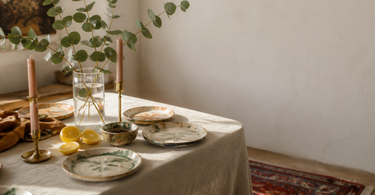
A well-functioning dining room is about layers: the right tableware, candlesticks at varying heights, a rug big enough that the chairs still rest on it, and wall decoration at seated eye level. You don't need to match everything — mix ceramics and glass, odd numbers of candlesticks and textures for a table with character. The small details like salt and pepper sets and fabric napkins are cheap upgrades with a big visual impact.
The dining room is the room in the home where everyday routines and festive moments meet at the same table. It's not primarily the dining table or chairs that set the mood — it's the layers of details: the light from the candlesticks, the texture of the plate, the sound a fabric napkin makes when it's folded. With the right choices, a Tuesday evening with pasta and a glass of water can feel just as considered as a dinner party for eight guests. Here's what actually makes a difference in your dining room.
Tableware and plates — mix with care
The era when all tableware matched exactly in colour, pattern and edge thickness is over. Nowadays, a mix works far better — not because rules have been abolished, but because contrast brings the table to life. The principle is simple: choose a colour palette and stick within it, while varying material and shape.
How to build a place setting with layers
Start with a plain dinner plate as your base — ideally in a neutral tone like raw white, cream or dusty blue. Add a patterned side plate on top and place a small bowl alongside for bread or an amuse-bouche. This gives you three levels within the same setting without needing a matching set.
Stoneware and glazed ceramics are two materials that withstand everyday use and still look festive. Stoneware is heavy and robust — it can handle the dishwasher, microwave and the inevitable fork scraping across the surface. Glazed ceramics have a sheen that catches candlelight beautifully. Combine the two to get both weight and shine on the table.
Supplement with platters and bowls for shared dishes in the middle of the table. A large, flat platter for the salad or cheese is far more inviting than a plastic container straight from the fridge — and it's exactly the kind of detail guests notice, even if they can't always put it into words.
Tip: If you stick to three colours in your palette (for example terracotta, white and dark green), you can mix styles and materials freely without it looking messy. One colour "anchor" per place setting is enough to create cohesion.
Candlesticks as the table's focal point
Nothing transforms a table faster than candlelight. Candlesticks set the mood, visually bring the table together and signal that some effort has gone in — whether it's a weeknight or a dinner party.
Number and arrangement
Three to five candlesticks is a good starting point for a table for four to six people. Odd numbers look more dynamic than even ones — the brain perceives a group of three as more balanced and natural than a group of two or four. Vary the heights: one tall candlestick (30-40 cm), two mid-level (15-20 cm) and one low (under 10 cm) gives depth without blocking eye contact across the table.
Materials and combinations
Brass, ceramic and glass are all suitable materials for the dining room. A ceramic candlestick next to one in clear or coloured glass creates contrast without chaos. Brass develops a patina over time and adds a warm, organic quality that suits many table settings.
As for the candles themselves: white, cream and honey-yellow tones work for the vast majority of table settings. Want a splash of colour? You can be a bit bolder with coloured candles — but make sure they match at least one other element on the table, such as a plate or a napkin, so it looks intentional.
| Material | Mood | Care | Suits |
|---|---|---|---|
| Brass | Warm, classic | Polish as needed | Rustic and modern |
| Ceramic | Soft, handmade | Largely maintenance-free | Boho, scandi, colourful |
| Glass | Light, airy | Easy to clean | Minimalist, festive |
| Crystal | Glam, reflective | Hand wash recommended | Festive and dramatic |
Jugs and glasses — form meets function
A jug on the table isn't just about having water or wine within reach — it's a sculptural detail in the table setting. A ceramic jug for everyday use and one in clear or coloured glass for festive occasions is a good rule of thumb. Glass reflects the light from the candles and adds a dimension that ceramic can't.
Drinking glasses and wine glasses in mouth-blown glass have an organic irregularity that makes each piece unique — no bubbles sit the same, no thickness is identical. It's the kind of quality that's visible in the light. If you want to add a splash of colour to the table without changing the whole setup, a single reddish or greenish glass mixed in among neutral glasses can do just that.
The small details that count
Salt and pepper with character
A salt and pepper set is perhaps the most underrated detail on the dining table. It's one of the few elements that's actually used at every single meal — and yet it often ends up in the "whatever we happen to have" category. A set with personality can start a conversation and reflect the character of your home. From classic designs in marble to more unexpected figures — the choice is yours.
Vases and flowers
For everyday use: a small vase with three or four stems from the garden or a single leafy branch is enough to bring the table to life. For a party, you can scale up with a larger arrangement, but avoid strongly scented flowers at the table — they compete with the food. Dried branches and eucalyptus are long-lasting, scent-free alternatives.
Egg cups as a breakfast detail
Breakfast in the dining room deserves the same attention as dinner. A set of ceramic egg cups is a small detail that lifts the everyday soft-boiled egg into something you actually appreciate. Ceramic keeps the heat better than plastic and looks endlessly better on the table.
Table settings from everyday to celebration
A well-laid table is a layered exercise — it's about layers and textures working together. Start from the bottom and build upwards.
The base: tablecloth or placemats
A coarse linen tablecloth as a base gives a warm, textured foundation. Alternatively, individual placemats in linen or cotton can give a more casual look that still feels considered. Fabric napkins are the investment that pays off — they can be reused hundreds of times and lift the table's look noticeably compared with paper.
Everyday vs. for a party
- Everyday: candlesticks, salt and pepper, a small vase — the table is inviting without needing tidying before dinner
- Party: add a water jug, wine glasses, fabric napkins folded or rolled with a napkin ring, and place cards for larger gatherings if needed
The principle is the same in both cases: the table should invite you to sit down. It's fine for it to look arranged — but not like a shop window you're afraid to touch.
Floor and walls — the bigger picture
Rug under the dining table
A rug under the dining table solves two problems at once: it visually ties the room together and dampens the sound of chairs being pulled back and forth. The sizing rule is practical: the rug should extend at least 60-80 cm beyond the table on all sides, so the chairs still rest on it when pulled out. A chair half-balancing on the rug's edge is never comfortable.
Flatwoven rugs are the most practical choice under the dining table — they're easier to vacuum and withstand crumbs and light moisture better than tall, soft rugs. Jute is another good choice: natural, durable and easy to clean with a damp cloth if something spills.
Wall decoration at sitting height
Wall decoration in the dining room should hang at eye level — but calculated from a seated position, not standing. After all, it's while seated that you and your guests experience the room during a meal. A large art print, a collection of ceramic plates on the wall or a mirror reflecting the table and the light from the candlesticks can all transform the room's proportions.
A mirror is especially useful in a small dining room: it doubles the light and gives a sense of more space. Choose one with an interesting frame — it's visible from all sides of the table.
Choosing a dining table
A round table for up to six people encourages conversation, because everyone sits at the same distance from each other. Rectangular tables are more flexible for larger gatherings and allow for adding extension leaves. Solid wood and oak develop a beautiful patina over the years and withstand everyday use — scratches and marks become part of the story rather than damage.
Frequently asked questions
Should tableware match?
No. Mixing tableware gives the table personality and character. The most important thing is to stick to an overall colour palette — for example, earth tones or blue and white tones — so the variation looks intentional rather than random. One or two "anchor colours" are enough to tie it all together.
How many candlesticks should be on the table?
Three to five is a good starting point for a table for four to six people. An odd number looks more dynamic and natural than an even number. Vary the heights to create depth — the tallest piece shouldn't block eye contact across the table.
How big should the rug under the dining table be?
As a rule of thumb, the rug should extend 60-80 cm out on all sides of the table. That ensures the chairs still rest on the rug when pulled out — a chair balancing partly on the edge is unstable and looks off in the room.
What's the best lighting for the dining room?
A pendant light above the dining table as the primary lighting, combined with candles on the table, creates the best atmosphere. The pendant should hang 70-80 cm above the table surface. A dimmer on the ceiling light lets you adjust between everyday light and dinner-party mood without changing bulbs.
What should permanently be on the dining table?
For everyday use: candlesticks, salt and pepper, and a small vase or decoration. That keeps the table inviting and lively without requiring tidying before every meal. Avoid keeping post, keys and other non-table items on the dining table — it's the fastest way to undermine the room's atmosphere.
How do you choose the right material for tableware?
Stoneware is sturdy, dishwasher-safe and has a handmade look — great for everyday use. Glazed ceramics are lighter and glossier and work well for festive occasions. Porcelain is the thinnest and lightest, giving a more formal impression. Many people choose to have two sets and mix them depending on the occasion.
Summary
Dining room decor is, at its core, about layering: the right rug under the table, tableware mixed deliberately within a colour palette, candlesticks of varying heights, and wall decor designed for seated eye level. None of these require changing everything at once — a new jug, a couple of ceramic candlesticks or a few fabric napkins are enough starting points. When each element is chosen with a bit of thought, they add up to a room that feels considered both for everyday meals and for celebrations.
Explore our range of candlesticks for the dining table, plates in ceramic and stoneware and platters and bowls for sharing dishes — and build the table setting that turns every meal into an experience.