
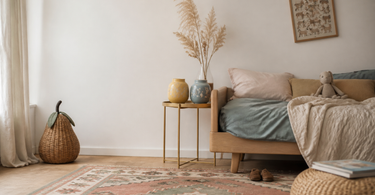
The children's room is the space where you can experiment most with colours and shapes. Start with the floor — an animal-shaped rug in wool and cotton sets the tone. Build on it with wall decorations, hooks and small details on the shelf. Choose durable materials from the start: a good rug, a quality lamp and ceramic hooks last for many years and still suit the room once the child has grown up.
The children's room is the only room in the home where the colour scheme is almost unlimited. Yet many end up looking the same: pale blue or pink, neutral furniture and a single poster. That's a shame, because a well-designed children's room can both stimulate the imagination and last a decade — if you choose right from the start. Here's a practical rundown of the key elements, from floor to shelf.
Start with the floor
The floor is the first place the child spends time — literally. Before the furniture moves in and the walls are painted, you should have a rug in place. It defines the room's zone, dampens sound and adds warmth underfoot, especially on cold tiles or wooden flooring.
Animal-shaped rugs as play rugs
Animal-shaped rugs are especially popular for children's rooms, and for good reason. A rug shaped like a tiger, polar bear or crocodile works as both a toy and a piece of furniture — the child plays on it, not just around it. Most in this category are handmade from a combination of wool and cotton, giving them a natural durability. Wool is naturally dirt- and moisture-resistant, making it better suited to a room with heavy use than many synthetic alternatives.
For the slightly calmer room — or as a complement to an animal rug — colourful floor rugs work well. They add colour without stealing all the attention, and they're easier to combine with furniture that changes over time.
Tip: Measure the room and the furniture placement before you order. A rug measuring 120 × 80 cm disappears under a bed — for a children's room of 10–12 m², you'll typically benefit from at least 160 × 120 cm as a centre rug, or a larger animal rug as the primary surface.
The wall as an active surface
Walls in the children's room don't have to stay bare or make do with a single poster. Treat them as an active part of the decor — there's room for both the decorative and the functional.
Wall decorations and posters
Posters with animal or nature motifs are a simple place to start. They're easy to swap out as the child's interests change, and they can be grouped gallery-wall style for more visual weight. You can also combine posters with wall hangings in soft colours — a wall hanging adds texture and dampens sound in a room that can otherwise become echo-heavy with hard surfaces.
Functional hooks
Animal-shaped hooks are one of the smartest touches in a children's room. They solve a practical problem — somewhere to hang bags, jackets and costumes — but do it with character. A hook shaped like an animal's head breaks with the anonymous and gives the child ownership of their space. Choose hooks in sturdy materials like resin or ceramic, which withstand repeated use without giving way.
| Type of wall decoration | Primary function | Suits |
|---|---|---|
| Posters | Decorative | All ages, easy to swap |
| Wall hangings | Decorative + acoustic | Larger children's rooms with hard surfaces |
| Animal-shaped hooks | Functional + decorative | Entrance zone in the room, close to the door |
| Ceramic wall hangings | Decorative | Shelves and above the desk |
Shelf and desk
It's in the details that a room shifts from neat to personal. A shelf with three or four well-thought-out objects beats any shelf filled with a random stack of toys.
Decorative objects with function
A small animal-shaped vase with a single dried flower, a money box in colourful ceramic or a porcelain figurine adds character to a shelving unit. Ceramic objects have the advantage of being durable and not fading over time the way plastic does — colours in glazed ceramic keep their intensity for years.
The desk
A pencil holder shaped like an animal is a small, inexpensive touch that visually lifts the desk and keeps felt-tips and pencils in order at the same time. It's the kind of detail your child actually uses — and notices.
Also consider a small colourful vase in ceramic on the desk or windowsill. Even without flowers, it acts as a splash of colour and gives the room a more pulled-together feel.
Lighting for the children's room
Lighting is one of the most underrated factors in a child's room. Most people stop at a single ceiling light — which is a shame, because layered lighting makes a real difference to the room's atmosphere, especially in the evening.
Mushroom lamps as a night light
Mushroom lamps are popular for children's rooms for good reason. The distinctive mushroom shape, which became widely popular in home decor in the 2010s, gives a soft, diffuse light without harsh shadows — ideal as a night light or cosy lighting. They come in a wide range of colours, so you can match them to the rest of the room's palette.
Place a mushroom lamp on the bedside table or a low shelf within your child's reach. Many models have a dimmer, which is handy for the transition from playing to sleeping.
In addition to the mushroom lamp, you could consider a table lamp for the desk with adjustable directional light — important for the eyes once homework reading begins.
Think long-term from day one
The most expensive mistake in children's room design isn't buying expensive things — it's buying short-term and repeating the purchase every other year. A handmade rug in natural materials, a set of ceramic hooks and a good lamp cost more than the plastic equivalents, but last ten times as long and still fit when the child is a teenager and the room's function has changed.
What lasts, and what wears out?
- Wool and cotton rugs — natural resistance to wear and dirt. Can be cleaned and keep their shape and colour for many years.
- Ceramic hooks — withstand repeated daily use. Glazed surface is easy to wipe clean.
- Ceramic figures and vases — colours in glazed ceramic don't fade. Unlike plastic, which yellows and becomes brittle.
- Lamps with replaceable bulbs — invest in the design itself, change the bulb as needed.
A good starting point is to choose a fixed colour palette for the room — two to three colours as a recurring thread — and stick to it when buying new things. This means elements from different times can coexist without the room losing its coherence.
Frequently asked questions
What rug size suits an average children's room?
For a room of 10–12 m², a rug of at least 160 × 120 cm works well as a central play rug. An animal-shaped rug follows its own form and doesn't need to fit standard measurements — assess it based on the available floor space and furniture placement.
Are handmade wool and cotton rugs healthy for a children's room?
Yes. Wool is naturally resistant to dust mites and moisture, and cotton is allergy-friendly. Avoid rugs with chemical flame treatment, and air the rug thoroughly before using it. Clean according to the manufacturer's instructions — typically vacuum cleaning and spot cleaning with mild soap.
When is a child old enough for ceramic figures on a shelf?
Ceramic objects on open shelves are best suited when the child is around 3–4 years old and understands that certain things aren't toys. Place them on shelves out of the child's reach in the first years. From 5–6 years old, they can easily be placed lower as part of the child's own room.
Can mushroom lamps be used as the only lighting in the children's room?
No — a mushroom lamp is ideal as supplementary and mood lighting. For homework and general activity in the room, you need a primary light source, typically a ceiling light or pendant, combined with a directional desk lamp.
How do I coordinate colours in the children's room without it becoming chaotic?
Choose two to three base colours and stick to them across the rug, hooks and decorative objects. Let the furniture be neutral (white, natural colours) and bring in colour via textiles and ceramics. This makes it easier to swap out one element at a time without the whole palette falling apart.
What's the difference between a wall hanging and a wall décor piece for the children's room?
A wall hanging is typically woven in textile and is wide — it covers a larger area and functions as a visual anchor zone. A wall décor piece is often smaller and made of a harder material such as ceramic or rattan. The two types complement each other: the wall hanging as background, the wall décor piece as accent.
Summary
A well-designed children's room doesn't have to cost a fortune or be reinvented every three years. Start with the floor and a rug in natural materials — it defines the room's zone and sets the tone. Build on it with functional wall décor like hooks, add personality via ceramic objects on the shelf, and finish with layered lighting. Choose durable materials such as glazed ceramic, wool and cotton from the start, and you avoid having to repurchase. The result is a room that actually reflects the child's personality — and lasts until the child has grown out of it.
Explore our range of animal-shaped rugs for the children's room — handmade in wool and cotton.