
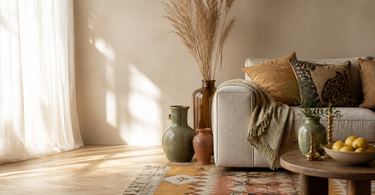


There’s nothing wrong with white walls—but there’s also no rule saying your home has to look like everyone else’s. Colorful interior design is about having the courage to bring personality into a room through colors that make you happy. It doesn’t require a complete renovation—often, it’s the small, well-chosen details that make the biggest difference.
Where do you start with color?
The easiest place to begin is with accessories and details. Instead of repainting the entire living room, you can add color through vases, cups, plates, and textiles. The advantage is that you can experiment without a major investment—and switch things up whenever you feel like something new.
Find your starting color. Look in your closet, at your favorite photos, or in nature. Which colors do you gravitate toward? Use that color as your anchor color and build from there. Maybe it’s a deep blue, a warm terracotta, or a fresh green—there are no wrong answers.
Colors in Ceramics and Tableware
Ceramics are one of the easiest ways to add color to your decor. Colorful vases on a shelf or windowsill instantly bring life to a neutral room. A collection of vases in related colors—for example, three shades of blue—creates a beautiful, cohesive effect.
Colorfulcups and plates turn every meal into a little celebration. Brands like Rice have made it their mission to bring color into everyday life with melamine tableware that’s kid-proof, dishwasher-safe, and built to withstand daily use. It’s colorful decor that actually gets used.
Colorful rugs: The face of the floor
A colorful rug can transform an entire room. It defines a zone, adds warmth, and brings color to the largest surface in the room after the walls and ceiling. A rug with a bold pattern can serve as the starting point for the entire room’s color scheme.
Doing Goods creates rugs shaped like animals and featuring colorful designs that are conversation starters in their own right. Bongusta offers soft, colorful rugs and bath mats that turn even the smallest bathroom into a colorful retreat.
Colored candleholders and accents
Colored candleholders are an easy way to add pops of color throughout the home. A group of candle holders in different colors and heights on a side table creates a dynamic, lively display. When the candles are lit, the colors take on an extra dimension from the warm glow.
Colored hooks and knobs are an overlooked trick. They’re inexpensive, easy to install, and instantly add character to an entryway or bathroom. Choose a color that speaks to you and use it as a unifying theme throughout the room.
Which colors go well together?
Color theory may seem complicated, but in practice
,
it’s all about trusting your eye. Complementary colors — colors that are opposite Colors opposite each other on the color wheel, such as blue and orange, create energy and contrast. Analogous colors—adjacent colors like green, blue, and purple—create a more harmonious, calm feeling.A good rule of thumb is 60-30-10: 60% neutral base, 30% secondary color, and 10% accent color. But remember—rules are meant to be broken. If you love colors, use them. A home should reflect you, not a color scheme from a textbook.
Colorful entryway and colorful kitchen
The entryway is the first thing guests see. Colorful coat hooks, a vibrant vase on a shelf, or a patterned rug by the door immediately signal that someone with a bold sense of style lives here
. The kitchen is another obvious choice. Caja Company and Rice offer colorful kitchenware, storage, and accessories that make cooking more fun. Colored glasses, patterned plates, and a colorful pitcher on the table transform the kitchen from functional to festive.
FAQ on colorful interior design
Don’t you get tired of colors?
It depends on how you use them. By keeping large surfaces neutral and adding color through accessories and textiles, you can easily switch things up when you feel like a change. Start with smaller elements and add more as you find your style.
Can colorful decor work in small spaces?
Yes. Colors can actually make small spaces feel more interesting and dynamic. Choose one or two colors and use them consistently. A colorful rug and matching vases can give a small room plenty of personality.
How many colors are too many?
There’s no hard-and-fast rule, but three to four colors plus neutral tones is a good starting point. The key is to have a unifying theme—a color or color group that recurs throughout the room and ties everything together.
