
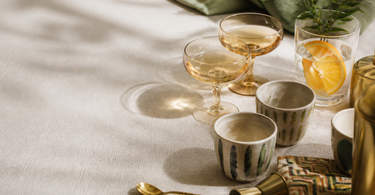
A functional home bar doesn't require twenty types of glassware. Three basic types cover most of it: coupe glasses for classic cocktails, highball and tumbler glasses for longdrinks and whisky, and wine glasses for everyday use and celebrations. Mouth-blown crystal glass is thinner and lighter than standard glass, refracts light differently and is more durable than you'd expect. Hand-washing preserves the shine, but most quality glasses can withstand a dishwasher on a gentle cycle.
There's a difference between drinking a negroni from a thick-bottomed school glass and from a well-balanced tumbler with a single large ice cube. Not because the drink is different, but because hand weight, shape and glass thickness genuinely affect the experience of what you're drinking. A well-stocked home bar therefore isn't only about what's in the bottles — the right glass selection makes a real difference, and you don't need to start with everything at once.
Which glasses should the home bar have?
Most people start too broadly and end up with a cupboard full of glasses they rarely use. A more practical approach is to build up your home bar in layers: start with three core categories, and expand as you discover which drinks you actually make.
The three basic types that cover the vast majority of situations are:
- Coupe glasses / cocktail glasses — for classic and modern cocktails
- Highball and tumbler glasses — for longdrinks and short drinks with ice
- Wine glasses — for everyday wine and more festive occasions
A set of four of each type is a solid starting point for most households.
Coupe glasses and cocktail glasses
The coupe glass is the home bar's most versatile cocktail glass. Its rounded, wide bowl suits martinis, daiquiris, espresso martinis, sidecars and a long list of other classic drinks served "up" — meaning without ice in the glass. The volume of a standard coupe glass is typically between 150 and 200 ml, which suits most classic recipes.
The classic martini glass with its pointed V-shape is more specialised. It looks distinctive, but it's also less stable and spills more easily. For most home bars, the coupe glass is the more practical choice — it can do the same and more.
Tip: Put coupe glasses and cocktail glasses in the freezer for 10-15 minutes before serving. A cold glass keeps the drink cold significantly longer — and gives a professional touch without extra effort.
Start with four cocktail glasses in a style whose hand weight and shape you like. This covers most gatherings and social occasions without filling an entire cupboard.
Highball and tumbler glasses
Highball glasses are tall, slender glasses with a capacity typically of 300-400 ml. They're used for longdrinks with a high ratio of mixer to spirit: gin and tonic, mojito, Tom Collins, dark 'n' stormy and similar drinks that need plenty of ice and room for it.
Tumbler glasses — also called old fashioned glasses or rocks glasses — are lower and wider. Capacity is normally 250-350 ml. They're designed for short drinks with ice: negroni, old fashioned, whisky on the rocks or whisky with a single large ice cube (a so-called "rock"). The wide glass gives room for exactly that.
Both glass types are so fundamental to the home bar that it's hard to do without them. Have both, and you can make the vast majority of drinks people actually ask for.
Wine glasses and champagne glasses
Wine glasses
A good wine glassgives real a real difference to the wine experience. The shape of the bowl determines how the aroma is concentrated and released, and the size determines how much the wine can be aerated. Generally, red wine thrives in a larger, more open bowl, while white wine and rosé do well in a slightly narrower shape.
Mouth-blown wine glasses are typically thinner in the glass and lighter than machine-made alternatives — this gives a more delicate drinking experience. The weight distribution between bowl and stem is more balanced, and preferably with a stem that's comfortable to hold.
Champagne glasses
Champagne glasses come primarily in two shapes. The flute glass — tall and narrow — keeps the bubbles active longer, because the surface area is small. The coupe glass — wide and shallow — releases the aroma faster and gives a more aromatic experience, but the bubbles disappear more quickly. Both shapes are legitimate choices; it depends on what you prioritise.
In recent years, a third type has also come into use: a tulip-shaped champagne glass that combines the flute's bubble-retaining properties with the coupe's aromatic opening. It has become popular with many wine enthusiasts.
See e.g. Anna Von Lipa champagne glass as an example of handmade alternatives in coloured crystal that can easily hold their own on the party table.
Mouth-blown crystal: what sets it apart from ordinary glass?
Crystal glass and ordinary glass are both primarily made from silicon dioxide (quartz), but the composition and production method differ markedly. Crystal glass contains additives — historically lead, today typically barium or zinc — which give the material a higher refractive index. This means that light refracts differently in the glass and creates the characteristic shine.
Mouth-blown crystal is also thinner in the wall than moulded glass. A typical mouth-blown crystal glass can have a wall thickness of under 2 mm, compared to 3-5 mm for machine-made glasses. This gives a lighter, more delicate feel in the hand and against the lips.
A concrete example is Anna Von Lipa, a Danish glass brand that produces mouth-blown lead-free crystal in a wide palette of colours — from classic clear to deep shades of green, blue, amber and pink. Each glass is unique, because the process takes place by hand. The glasses are surprisingly durable despite the thin wall and can withstand dishwashers on a gentle programme, although hand washing extends the shine.
Coloured crystal also opens up another way of thinking about table setting: instead of matching sets, you can deliberately mix colours and create a more personal and festive expression. Many people start with one set and gradually expand over time.
| Property | Standard glass | Mouth-blown crystal |
|---|---|---|
| Wall thickness | 3–5 mm | Under 2 mm |
| Refraction | Standard | High, with shine |
| Weight | Heavier | Lighter |
| Uniqueness | Uniform | Each glass varies |
| Dishwasher | Yes | Yes (gentle programme) |
| Price per piece | From approx. DKK 50 | From approx. DKK 250 |
Equipment and accessories for the home bar
Once you've got the glass type sorted, the next step is to put together the basic bar equipment. Glasses are the foundation, but the right tools are what separates a well-stocked home bar from an improvised setup.
The basic bartender kit
- Shaker — for drinks that need shaking (sours, daiquiris, espresso martinis). A three-piece cobbler shaker is the easiest to start with.
- Bar spoon — for drinks that need stirring, not shaking (martini, negroni, manhattan). Stirred drinks are clearer and have a silkier texture than shaken ones.
- Jigger — a double measuring cup, typically 2 cl / 4 cl or 3 cl / 6 cl. Precision is underrated in cocktails.
- Muddler — for mashing fresh fruit, herbs and sugar directly in the glass (mojito, smash).
- Strainer — for straining out ice cubes when pouring from shaker to glass.
If you're storing wine during dinner, a wine cooler keeps the bottle cold and looks smart on the table, rather than tucking it away in an ice bag. It's a small detail with a big visual effect.
Storing cocktail glasses
Cocktail glasses should stand upright in a cupboard to avoid scratches along the rim. Avoid stacking them — the thin rims on coupe glasses and crystal glasses can crack under the weight. Storing them with the stem facing upwards (hanging in a glass rack) minimises the risk of dust in the bowl, but requires a rack sized to fit the thickness of the stem.
Price guide for glassware and barware
The price of glasses varies enormously depending on material, production method and brand. Here's an overview of what you can expect to pay:
| Segment | Price per piece | Typical type |
|---|---|---|
| Basic | Under DKK 100 | Machine-made highball and tumbler glasses |
| Mid-range | DKK 100–250 | Quality cocktail glasses and wine glasses |
| Premium | 250–500 DKK | Mouth-blown crystal, exclusive coupe glasses |
| Cocktail equipment | 200–600 DKK (set) | Shakers, bar spoons, jiggers |
A set of four Anna Von Lipa wine glasses in mouth-blown crystal typically costs 1,000-1,500 DKK depending on colour and model — that works out to 250-375 DKK per glass, which is a fair price for handmade crystal with a long lifespan.
If you'd like to start in the more accessible segment, there's solid quality to be found in &Klevering glasses, which offer characterful glass designs at a more affordable price.
Frequently asked questions
Can mouth-blown glasses go in the dishwasher?
Most mouth-blown glasses, including Anna Von Lipa, can withstand the dishwasher on a gentle programme at low temperature. To preserve the shine and avoid limescale marks, hand washing with lukewarm water is recommended. Never use strong descaling or bleaching agents, as this attacks the surface and can make the glass cloudy over time.
How many cocktail glasses do I need?
Four to six coupe glasses and four to six highball glasses cover the vast majority of social occasions. This gives you a buffer for guests and any breakages. Expand with speciality glasses like margarita or hurricane glasses as you discover which drinks you make most often.
What's the difference between crystal and ordinary glass?
Crystal glass is thinner, lighter and refracts light differently than standard glass. This gives a clearer ring when you clink glasses, and a more delicate feel against the lips. Modern crystal glass is lead-free and made with additives such as barium or zinc, which are safe for daily use.
Can I mix different glass colours on the table?
Yes. Mixed glass colours create a personal and festive table, provided there's an inner logic — for example, the same shape in different colours, or the same colour in different shapes. Many people deliberately buy one glass at a time and build up a varied collection over time rather than having a complete matching set.
What's the difference between a flute glass and a coupe glass for champagne?
The flute glass — tall and narrow — keeps the bubbles going longer, because the surface area is small. The coupe glass — wide and low — releases the aromas faster and gives a more fragrant experience, but the bubbles disappear more quickly. Many wine enthusiasts today prefer a tulip-shaped in-between glass that combines both qualities.
What do I need besides glasses for the home bar?
The basic bartender's kit consists of a shaker, a bar spoon, a jigger and a strainer. With these four tools, you can make the vast majority of classic cocktails. In addition, a muddler is useful for mojitos and fruit-based drinks, and a wine cooler keeps the bottle cold during dinner.
Summary
You don't need a professionally equipped bar to serve drinks that taste and look right. Start with three basic glass types — coupe glasses for cocktails, highball and tumbler glasses for long drinks and short drinks, and wine glasses for everyday use and celebrations — and build from there. Mouth-blown crystal is more expensive than standard glass, but thinner, lighter and more durable than its appearance suggests. A basic bartender's kit with shaker, bar spoon and jigger completes the set-up without requiring a professional investment. And if you fancy giving your table setting a more personal touch, mixed glass colours are an easy way to get there.
Explore our range of cocktail glasses and drinkware — or see the full range of home bar glasses.