
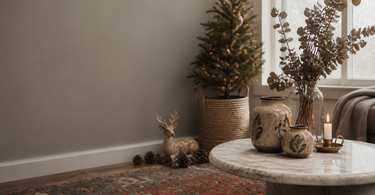
Danish Christmas decorations are typically built up gradually from the end of November: the advent wreath first, then window decorations, and the Christmas tree traditionally on 23 December. Candles and candlesticks are the most important elements for the atmosphere. Stick to one colour theme throughout the home — classic red/white, Nordic white/natural or modern burgundy/copper — and combine natural materials with a few carefully chosen decorations for a cohesive look.
Christmas is the celebration that fills Danish homes the most — not just in the calendar and kitchen, but in the room itself. From the first Sunday of Advent right through to New Year, the home changes character: the light dims, the candles are lit, and the shelves are joined by ceramics, greenery and pinecones. It's not necessarily about buying new things every year, but about putting together what you already have in a way that feels thought-through. This guide gives you a concrete approach to when, what and how.
When do you decorate for Christmas?
In Denmark, Christmas decorations typically start to appear on the last weekend of November or the first weekend of December — usually in connection with the lighting of the first candle on the advent wreath. The process is rarely one big project; most people build it up over several weeks.
A natural order is: the advent wreath and candlesticks come first, then paper stars and decorations in the windows, and finally the Christmas tree. The tree is traditionally decorated on 23 December — the day before Christmas Eve — and in many families is reserved for one shared occasion. There's no fixed rule for when you start, though. If you want four full weeks of Christmas atmosphere, it's entirely legitimate to set everything up as early as 1 December.
Build up the decorations in layers
A practical rule of thumb is to divide the home into zones: hallway, living room, dining table and windows. Start with the elements that take longest to build up — typically a tableau on a side table or a composition in the hallway — and add details along the way. This gives you the chance to adjust before everything is in place.
Tip: Unpack your Christmas decorations a week before you put them up, and lay them out on a table. This gives you an overview of what you actually have, what's missing — and what you can do without this year.
Danish Christmas traditions in interior decor
The most deeply rooted Danish Christmas traditions revolve around candles and counting. The advent wreath with four candles is almost obligatory: each candle is lit on its Sunday, marking the gradual countdown towards the 24th. Many families add a calendar candlestick holding 24 spaces for taper candles — a practical yet visually striking element that doesn't take up much space.
Nisser (Christmas gnomes), woven Christmas hearts and straw goats are motifs with deep roots in Danish culture. A woven Christmas heart in a window is a tradition dating back to Hans Christian Andersen, and paper stars in the ceiling have adorned Danish homes for over 100 years. Interestingly, these elements work surprisingly well in contemporary interiors — the handmade and slightly imperfect quality suits the aesthetic many are drawn to today.
If you want light and movement in the hallway, candlesticks of varying heights can create a simple yet effective arrangement without taking up too much space.
The Christmas tree and ornaments
The Christmas tree is the natural centrepiece of the decorations, and ornaments are the category many families actively collect over the years. Glass, wood and metal are the classic materials — glass ornaments reflect the light from thin fairy lights and candles in a way plastic simply can't.
Choose one overall colour theme for the tree and stick to it. Classic red and gold is warm and familiar. Scandinavian white and natural tones — straw, wood, unbleached textile — give a more subdued, Nordic character. Black and silver suit a bolder aesthetic. Don't mix too many themes; three colours is the maximum for a cohesive result.
In addition to the tree, ornaments can be used far more versatily than most people think: hang them on dry branches placed in a vase, put them in a bowl on the dining table, or hang a single set in the window as a minimalist installation.
Branches as an alternative or addition
Birch twigs, eucalyptus branches or dried twig arrangements in a large floor vase can make a full alternative to a Christmas tree in smaller flats — or serve as an addition in the hallway or bedroom. Hang ornaments, dried orange slices or cotton stars on the branches for effect.
Table setting for Christmas Eve
Christmas Eve dinner is the one most people remember. The table setting is a composition of several layers: table linen, tableware, cutlery, glasses, candles and table decorations. Start with white porcelain or ceramics as your base — it's neutral enough to let the other elements speak for themselves.
Add fabric napkins instead of paper; they fold better and add a tactile quality to the table. Mulled wine cups and Christmas beer glasses can have more character than everyday ones — ceramics with a matt glaze or thick, handmade shapes suit the season. Place candles at varying heights along the table: three candles at three heights create more depth than five candles at the same height.
Natural materials as table decorations
Fir branches, pine cones, nuts, dried orange slices and cinnamon sticks cost next to nothing and smell of December. These elements make excellent filler between the candlesticks and give the table an organic quality that no plastic decoration can copy. Add place cards with a small natural element — a sprig of pine cone, a cinnamon stick or a piece of hemp rope — as a personal touch.
Tip: Set the table as early as the 23rd of December. That way you can view the table calmly, adjust the placement of candles and decorations — and avoid the stress on the 24th, when the food also needs making.
If you want a cohesive look from kitchen to table, ceramic platters and bowls with natural glazes can work as both serving and decoration at once — set out with fir and pine cones, they need no further styling.
Colour themes for Christmas
The choice of colour is the single decision that has the biggest impact on whether your home looks cohesive or cluttered. Choose one overall theme and keep it consistent from hallway to dining room — not meaning everything has to match, but that the colours should speak to one another across rooms.
| Colour theme | Typical colours | Mood | Suits |
|---|---|---|---|
| Classic Danish | Red, white, gold | Warm, traditional | Homes with traditional furniture and heirlooms |
| Nordic nature | White, natural, straw, green | Calm, minimalist | Bright homes with Scandi aesthetics |
| Warm sophisticated | Burgundy, copper, green | Rich, sensuous | Homes with dark colours and texture |
| Modern statement | Black, silver, white | Sharp, clean-lined | Contemporary homes with a touch of decoration |
Candles and atmosphere
Candles are the element that changes a room's character the fastest. Three pillar candles in three sizes — e.g. 6 cm, 10 cm and 15 cm in diameter — grouped closely together give far more visual weight than three thin taper candles spread out. Use candles in uncoloured white or natural bisque colour as a base; they're neutral enough to work in all colour schemes.
Fairy lights are a complement, not a replacement. A single string of warm white LED lights wound around the inside of a bookshelf or hung in a window adds depth without seeming overloaded. Avoid mixing warm white and cool white lights in the same room — the difference in colour temperature is noticeable and breaks the illusion of cohesion.
Natural materials and free decoration
Fir, pine, moss, pinecones and dried fruit are free or very cheap and serve as the load-bearing elements in any Christmas decoration. An armful of fir branches laid along a chest of drawers, a basket of pinecones in the hallway, or dried oranges strung up in the window — these are decorations that smell wonderful, keep humidity down and are fully biodegradable once the season's over.
If you want to add more permanent character to the Christmas-styled shelf or chest of drawers, ceramic decorations in muted winter colours can carry the season without looking seasonal for the rest of the year.
For the windowsill, ceramic candle holders in earthy tones work well throughout winter — they're not specifically Christmassy, but set the light in a way that suits the darkness of the season.
Frequently asked questions
When do people start decorating for Christmas in Denmark?
Most Danish homes start decorating on the last weekend of November or the first weekend of December, when the first candle on the Advent wreath is lit. Many build up the decorations gradually through December, with the Christmas tree traditionally going up on the 23rd of December. There's no fixed rule — it's about whenever it brings joy.
What are the most important elements of Danish Christmas decorations?
The Advent wreath and candles are the foundation of Danish Christmas decorations — they mark the season and create the warm, intimate atmosphere. The Christmas tree, woven Christmas hearts, straw goats and paper stars are classic secondary elements with long traditions in Danish homes.
How do you decorate for Christmas in a modern home without it looking cluttered?
Choose one colour scheme and stick to it throughout the home. Use three materials at most — for example ceramic, natural materials and glass. Prioritise a few, quality-conscious choices over lots of elements. A minimalist look with one set of candles, a simple table composition and lights in the windows is more effective than many layers of different decorations.
When do you pack away the Christmas decorations?
Traditionally, Christmas decorations are packed away after New Year or by the 6th of January at the latest (Epiphany). The Christmas tree is typically thrown out around New Year. The rest of the decorations — candle holders, ornaments, textiles — can stay out a little longer, and many find it natural to tidy up gradually in the first weeks of January.
Can you reuse Christmas decorations from year to year?
Yes — and it's actually an advantage. Ornaments in glass and wood, candle holders in ceramic and brass, and textile elements last for years. Natural materials like fir branches and pinecones can be dried and used again. Reused decorations also have the benefit of carrying memories and giving the home a personal character rather than a showroom aesthetic.
How much does it cost to decorate for Christmas — is it possible on a small budget?
Yes. Natural materials — fir, pinecones, moss, dried fruit — are free or very cheap and form a load-bearing part of the best Christmas decorations. Supplement with candles (which are relatively cheap for the effect), and use the vases and bowls you already have to build compositions. Buy one new, quality-conscious element per year rather than lots of cheap ones.
Summary
Christmas decorations in the home aren't about filling every surface — it's about building atmosphere through light, scent, colour and material. Start with the Advent wreath and candle holders as the foundation, choose one colour scheme you keep consistent, and build up through December towards the Christmas tree on the 23rd. Natural materials like fir, pinecones and dried fruit are the most effective and cheapest way to set the season's mood. Supplement with selected ceramic and glass details that last year after year — and let the process of decorating be part of the joy of the season.
Explore our range of candles for Christmas, ceramic and glass candle holders as well as ornaments for the Christmas tree and home.