
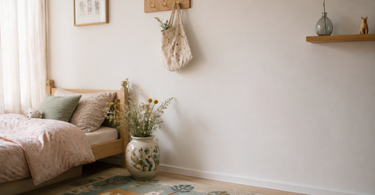
A well-functioning children's room balances play and function. Use a neutral base on the walls and add personality through textiles, hooks and decoration. Handmade animal rugs in wool and cotton are durable enough for daily use and work as floor art. Animal-shaped hooks mounted at the child's height encourage independence. Folding boxes in colours provide easy storage, and warm lighting at 2700K creates the right atmosphere at bedtime.
A children's room is one of the rooms in the home that works the hardest. It needs to function as a playground, sleeping quarters, library and creative workshop — often at the same time and within just a few square metres. The challenge isn't choosing between fun and functional, but getting the two to work together. It's about the durability of materials, the logic of storage and the psychology of colours — and about creating a room that still makes sense when the child has grown three centimetres since last time.
Animal rugs as floor art
The rug is the first thing the child hits when tumbling out of bed in the morning, and it's where building blocks, duplo and drawings end up for the rest of the day. This places demands on the material. Animal rugs handmade from wool and cotton are designed for exactly this kind of use — they're soft enough to sit on, but tight enough in construction to withstand regular vacuuming and the occasional spot treatment with a damp cloth.
The shape matters more than you'd initially think. A rug shaped like an animal — a tiger, a leopard, a bear — gives the room a natural focal point without requiring a single extra item. It's decoration and a play surface in one, and it works at any age: from crawling babies to schoolchildren doing homework on the floor.
Tiger or leopard?
Tiger rugs have a wild, energetic look with bold stripes that make them easy to identify even for the youngest children. Leopard rugs have a more subtle pattern and can more easily be integrated as the child grows older and tastes change. Both types come in variants from around 75 × 110 cm to almost 150 × 200 cm — choose size based on the room's floor area, not the child's age.
Tip: Place the rug so it covers the zone the child uses for free play — typically in the middle of the room or in front of a low bookshelf. Avoid hiding it under the bed or desk, so the motif can be seen in full.
Hooks that make a difference
A hook is rarely just about hanging a jacket. In a children's room, the hook is also a landmark: it tells the child exactly where clothes belong. Mount animal-shaped hooks within the child's actual reach — that is, around 80–100 cm from the floor for 3–6-year-olds — and the likelihood of the jacket ending up there rather than on the floor increases noticeably.
Hooks shaped like elephants, giraffes, flamingos or rhinos are hand-painted and work as standalone sculptures on the wall. This means they contribute to the room's look even on the days when nothing is hanging on them. See the full range of hooks and knobs to find the shape that suits the room's theme.
Knobs on the drawers
The same principle applies to drawer knobs. A chest of drawers with knobs shaped like animals or in clear, contrasting colours makes it easier for the child to navigate independently — and the knob becomes part of the room's visual language rather than just a handle. Choose knobs in a material that can withstand plenty of handling: hand-painted ceramic or cast resin are both durable choices.
Colours and motifs
The children's room is the one room in the home where colours can really do their work. It's about knowing when to go all-in, and when to hold back.
Wall as a base, accessories as colour
A white, light grey or soft beige wall provides the most flexible starting point. Then the rug, the textiles and the decoration can carry the colours — and be swapped out as the child grows and preferences change, without you having to repaint. Mustard yellow, coral red and petrol blue are colours that work well as accents and combine naturally with animal motifs.
Age-appropriate use of colour
| Age group | Recommended colours | Effect |
|---|---|---|
| 0–2 years | Light pink, mint green, lavender | Soothing, promotes sleep |
| 3–6 years | Coral, mustard yellow, turquoise | Stimulating, supports play |
| 7+ years | Petrol blue, olive green, terracotta | More subdued, can last longer |
Animal motifs are a theme that crosses all age groups. Combine an animal rug with animal wall vases and simple wall decor for a cohesive look that doesn't feel chaotic.
Storage that lasts
It's not storage that's lacking in a children's room — it's the right kind. Tall cabinets with doors encourage tossing everything in and closing up. Open, low-placed storage invites the child to fetch and put things back themselves, which is the real goal.
AYKASA folding crates are an obvious choice: they come in up to 20 different colours, can be stacked in a modular system and fold flat when not in use. The material is recycled plastic that withstands most things — including moisture from paintbrushes, which always ends up somewhere it shouldn't. One crate per category (cars, puzzles, craft materials) makes tidying up something a 4-year-old can actually manage.
Supplement with baskets in natural materials for books, teddies and clothes. Woven grass or rush adds texture and breaks up an otherwise hard, plastic-dominated shelf. Place the baskets the child uses most at knee height or below.
Tip: Label the crates with pictures rather than text, so the child can use the system before they can read. A small illustration of a train, a ball or a pair of scissors gives instant orientation.
Wall decoration and depth
A bare wall in a children's room is an overlooked resource. Wall decor such as woven hangings, ceramic animal wall vases or handmade masks give the room the layers that furniture alone can't create. Hang the pieces at different heights — something at eye level for a child, something a bit higher — for an arrangement that doesn't look factory-planned.
Material and safety
Avoid heavy framed glass directly above the bed. Choose lightweight materials instead: wood, fabric, papier-mâché or ceramic in a smaller size. A ceramic wall hanging typically weighs under 300 grams and sits securely on a single screw anchor, while a wall tapestry can be hung with a simple wooden rod and broom-style hangers that are easy to move if the child changes their mind.
Involve the child in the choice. A child who has pointed out the elephant-shaped hanging themselves takes better care of it — and is more likely to still want it in the room, even after five years.
Lighting from play to bedtime
A children's room needs at least three lighting scenarios: clear task lighting for drawing and homework, general room light for play and activity, and dimmed, warm light for winding down and bedtime stories. You'll rarely achieve this with a single light source.
A warm colour temperature of 2700K by the bed creates calm and signals to the body that the day is coming to an end. Cooler light at around 4000K at the desk — typically from a directional desk lamp — provides the clarity needed for focused work. Decorative lamps with fun shapes or in warm colours can be used in both places depending on your choice of bulb and dimmer.
A dimmable night light placed low down — on a bedside table or the floor — gives reassurance to children who can't sleep in the dark, without significantly disturbing sleep quality.
Frequently asked questions
When should you update the children's room decor?
A good strategy is to invest in furniture and larger dark-coloured pieces in neutral colours that last for many years, and then update accessories, bedding and decorations every couple of years. This gives you a room that grows with your child's development without a total makeover — and without costing a fortune each time.
Are animal rugs durable enough for daily use in a children's room?
Animal rugs made from wool and cotton are designed for exactly that kind of wear. They should be vacuumed gently on low suction, and stains from paint or juice are best removed with a damp cloth and a bit of mild soap. They're not machine washable, but they handle daily use well for many years.
What height should hooks be mounted at for a child?
For children aged 3 to 6, 80–100 cm from the floor is a handy rule of thumb. This roughly matches children's shoulder height at that age and lets them hang up and grab their things themselves. Mount the hooks with a proper wall screw and wall plugs if needed, so they stay secure under load.
Which colours suit a children's room?
It depends on the child's age. Pastel shades like light pink, mint green and lavender have a calming effect on younger children. For older children, bold accents like mustard yellow, coral red or petrol blue can be used on textiles and decorations, while keeping the walls neutral. Natural colours like green and brown pair well with animal motifs.
How do you create a cohesive theme without making the room too "themed"?
Choose one overarching motif — animals, for example — and let it recur in two or three elements: a rug, hooks and one wall hanging. Keep the rest of the room simple and neutral. That way the room has character without feeling like a themed nursery that's hard to grow out of.
Can AYKASA folding crates be used for anything other than toys?
Yes. AYKASA crates are water-resistant and easy to wipe down, so they work in the bathroom for bath things, on the shelf for books, in the wardrobe for clothes, or as transport for sports and activities. The modular format means they grow with your child and move along to the teen room when that time comes.
Summary
A well-thought-out children's room starts with the right foundation: neutral walls, durable materials and storage solutions placed at your child's own height. From there, you add personality in layers — a handmade animal rug on the floor, animal-shaped hooks on the wall within your child's reach, and colourful folding crates that turn tidying up into something your child can manage on their own. Lighting in two colour temperatures takes the room from bright daylight activity to a cosy evening mood. The more the room supports your child's independence, the better it works day to day — and the longer it lasts before it's time for the next upgrade.
Explore our range of handmade animal rugs, fun hooks and knobs and AYKASA folding crates for the children's room.