
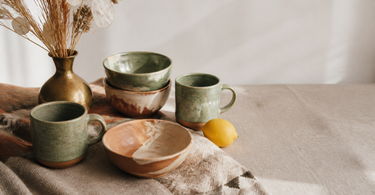
Handmade ceramics differ from mass-produced ones through small variations in shape, colour and glaze — no two cups from the same series are ever identical. Stoneware, fired at 1100-1200°C, is the most commonly used material for everyday use: durable, organic in expression and well-suited for both kitchen and living room. Ceramics can be used as tableware, vases, candlesticks and wall decoration. It just needs a little extra care, particularly when it comes to sudden temperature changes and storage.
Ceramics is one of the oldest materials in human history — and one of the most alive. In a time of uniform furniture and identical interior solutions, handmade ceramics give your home an authenticity that's hard to replicate. Every piece carries traces of the hands that shaped it, and glazes that reacted uniquely during firing. Below, we go through what actually distinguishes the material types, how ceramics work in the different rooms of your home, and how to look after them.
Ceramics, stoneware and porcelain — what's what?
Ceramics is a collective term for fired clay materials and covers everything from terracotta and faience to stoneware and porcelain. The differences are mainly about firing temperature and the composition of the clay body.
Porcelain
Porcelain is fired at over 1300°C, which gives an extremely dense and hard material. It becomes thin, almost translucent and is characteristically white. It's the material we associate with fine porcelain and the finest tableware — but this very density also makes it brittle.
Stoneware
Stoneware is typically fired at 1100-1200°C and is thicker and more rustic than porcelain. It's dense enough not to absorb liquid, but retains an organic, handmade look. For everyday use in the home, stoneware is the preferred choice: it withstands daily use, looks lively and reacts beautifully with coloured glaze.
Terracotta and faience
Terracotta is fired at lower temperatures (800-1000°C) and is porous — it absorbs liquid unless glazed. Faience is clay-glazed terracotta, giving a lighter and more even surface. Both material types are mainly used decoratively or for plant pot covers, as they're not nearly as durable as stoneware for everyday use.
Handmade vs. mass-produced ceramics
The difference is concrete and noticeable. Handmade ceramics have small variations in shape, colour and glaze — no two cups from the same series are ever quite identical, because the glaze reacts differently in the kiln, and because the hand-formed body isn't perfectly symmetrical. It's precisely this imperfection that gives each piece character.
Mass-produced ceramics are cast in identical moulds and fired on a production line, giving uniformity and low production costs. This isn't necessarily bad, but it gives a different result: predictable, but without the lively surfaces and random colour variations that occur when glaze melts during firing.
Choosing handmade ceramics is also a choice about the production chain. European ceramic producers who work with traditional techniques — the potter's wheel, hand-forming, dip glazing — produce in limited runs and with a quality control that's hard to maintain in large-scale production.
Tip: When you buy handmade ceramics, variation is a sign of quality — not a flaw. Differences in the glaze's colour variation and the thickness of the body aren't production errors, but proof that the piece was made by human hands.
Ceramics in the kitchen
The kitchen is the room where ceramics really work. Here, it's not just about aesthetics, but about the tactile experience of using things daily. A stoneware cup with a lively glaze feels different in your hand than a thin industrial cup — the thickness distributes heat differently, and the weight gives substance.
Tableware and everyday use
Cups, plates, bowls and jugs in stoneware hold up to daily use. Most glazed stoneware products are dishwasher-safe, although hand-washing extends the life of the glaze. Look for tableware with lively colour variations — lemon-coloured and pastel-coloured glazes give your kitchen table energy without feeling disruptive.
In addition to cups and plates, ceramic egg cups are an obvious place to introduce handmade ceramics into everyday life — it's a small and relatively inexpensive purchase, but it lifts breakfast significantly. The same logic applies to butter dishes, which keep the butter fresh and give your table setting a cohesive look.
Jugs and storage
A ceramic jug for coffee, tea or water is one of the most used pieces of ceramics in the kitchen. Look for a jug with a spout shaped precisely enough not to drip — that's where the craftsmanship really counts. Take a look at the range of jugs to find one that suits your kitchen.
Ceramics in the living room
In the living room, ceramics act as three-dimensional anchor points — they bring groundedness and organic form to spaces that might otherwise feel flat. A large ceramic vase on the floor or a shelf draws the eye down and gives the room weight.
Vases and flowers
A ceramic vase doesn't need flowers in it to make an impact. A beautiful, unglazed stoneware vase with a single dried flower stem gives a minimalist and timeless look. Mix different glazes and sizes for depth: a matte vase next to a glazed one and a raw, unglazed bowl creates variation. Explore ceramic vases in various sizes and glazes — from small single-stem vases to large floor vases.
Candlesticks and dishes
Ceramic candlesticks give off a warmer light than smooth glass ones, because the rough or glazed surface reflects light differently. A group of three ceramic candlesticks in different heights and colours works as a cohesive still life. Small ceramic bowls and dishes and bowls on the coffee table are a practical way to store remote controls, jewellery or candles, but also look great as purely decorative pieces.
Ceramics as wall decoration
Ceramics don't just belong on tables and shelves. Ceramic wall hangings bring a three-dimensional, sculptural quality to the wall that posters and prints simply can't match — there's depth, shadow and texture at play.
A group of three ceramic wall hangings in different sizes works best when hung as a composition rather than in a straight line. Try letting them overlap slightly in depth, so they form a cohesive picture rather than three isolated objects.
Masks and sculptural elements
Masks in ceramic or papier-mâché are popular in boho-inspired homes and add a personal, sculptural touch to the wall that's hard to achieve with two-dimensional decor. Take a look at the range of masks and wall décor for inspiration on how to incorporate them into an existing wall.
| Material | Firing temperature | Properties | Typical use |
|---|---|---|---|
| Porcelain | > 1300°C | Thin, hard, translucent, white | Fine tableware, delicate decoration |
| Stoneware | 1100–1200°C | Dense, durable, organic feel | Everyday tableware, vases, candlesticks |
| Faience | 950–1100°C | Porous, lighter glaze | Decorative tableware, tiles |
| Terracotta | 800–1000°C | Porous, reddish-brown colour, not waterproof | Pot covers, the garden |
Care and maintenance
Handmade ceramics need a little more attention than industrial porcelain, but it's not a hassle — it's mostly about knowing the material's limitations.
- Washing up: Most glazed stoneware can go in the dishwasher, but hand washing extends the life of the glaze. Avoid harsh abrasives, which wear down the glaze over time.
- Temperature changes: Avoid sudden temperature changes. Don't put a cold ceramic bowl straight into a hot oven — let it reach room temperature first. Cracks in the glaze (crazing) can occur from repeated, sharp temperature changes.
- Storage: Stack plates with felt pads or cloth napkins in between to avoid scratching the glaze.
- Unglazed ceramics: Unglazed stoneware is slightly porous and can absorb liquids and fats. For decorative purposes, this isn't a problem; for food, you should treat it with a food-safe sealant or use it for dry purposes.
- Outdoor use: Glazed stoneware can handle outdoor use in the warm season, but should be brought in before frost — water in the pores expands and can crack the piece. Terracotta is especially vulnerable to frost.
Frequently asked questions
Is handmade ceramics safe for food and drink?
Yes, as long as the glazes are food-safe — meaning tested and approved to not release lead, cadmium or other harmful substances upon contact with food and drink. Serious manufacturers document this. If you're unsure about a specific piece, the safest option is to use unglazed ceramics for decorative purposes and glazed for food.
What's the difference between stoneware and porcelain in everyday use?
Stoneware is thicker, more rustic and robust — it's for everyday use and withstands knocks better than the thinner porcelain. Porcelain is harder and more translucent, but also more fragile. For an active household, stoneware will typically last longer and look better over time.
How do you repair a cracked ceramic vase?
Kintsugi — the Japanese technique where cracks are repaired with gold-filled lacquer — is an aesthetic and meaningful way to extend a piece's life. Kintsugi kits are available for home use. Alternatively, epoxy glue is used for purely structural repairs, but the result isn't visually beautiful in the same way as kintsugi.
Can ceramics be used outdoors?
Glazed stoneware works well outdoors in the warm season — for example as pot covers on a covered terrace. Bring it inside before frost hits: water that seeps into the material expands when it freezes and can crack the ceramic. Terracotta is most vulnerable to frost and should always be kept indoors over winter.
What is kintsugi?
Kintsugi is a Japanese repair technique dating back to the 15th century. Cracks and breaks in ceramics are repaired with lacquer mixed with gold, silver or platinum powder, so the cracks are highlighted rather than hidden. The philosophy behind the technique is that breakage and repair are part of an object's history — not something to be ashamed of.
How do I style ceramics on a shelf?
Mix heights, glazes and sizes. A matte, unglazed vase next to a glazed candlestick and a small coloured bowl creates depth and variation. Stick to 3-5 items per shelf, and leave room between them — ceramics look best when not overcrowded.
Summary
Handmade ceramics aren't about nostalgia — they're about material quality, tactile experience and production. Stoneware fired at 1100-1200°C is the most versatile material for the home: durable enough for everyday tableware, organic enough to look alive as decoration. The variations in glaze and shape aren't flaws, but the result of a production process where human hands and chemical reactions aren't fully controllable — and that's exactly what gives each piece its character. Care for it sensibly, mix it freely across rooms and functions, and let it work over time.
Explore our range of ceramic vases, dishes and bowls and ceramic candlesticks — all handmade with care.