
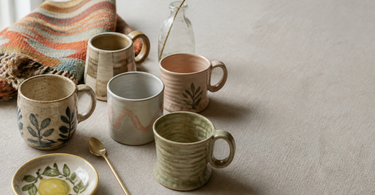
A stoneware ceramic mug is the most durable choice for everyday use — fired at high temperature, dense in structure and dishwasher-safe. Size determines the experience: 60–90 ml for espresso, 200–250 ml for filter coffee, 300–400 ml for the big morning mug. Glaze type and shape affect both aesthetics and heat conduction. Mix-and-match is the most flexible approach to putting together a mug collection with personality.
The mug you drink your morning coffee from actually sets the tone for the day — not because it's a cliché, but because tactile experience and visual stimulation have a documented influence on our wellbeing. A handmade ceramic mug with a reactive glaze and a well-shaped handle feels markedly different from a thin standard mug. In this guide, we go through the materials, sizes, glaze types and the principles behind mix-and-match — everything that gives you the basis for choosing the mug that actually suits you and your everyday life.
What makes a good ceramic mug?
The answer is about the balance between two things: aesthetics and function. A mug can look fantastic on a shelf and still be frustrating to drink from — too narrow a handle, too thin walls, too small a volume. The most important parameters are the material, shape, handle, size and glaze. They're all connected, but it helps to understand them individually.
Ceramics as an overall category covers very different products. A handmade stoneware mug from a European workshop series and a mass-produced white earthenware mug from a supermarket are both technically ceramics — but they differ in firing temperature, density, weight and lifespan. Once you know the difference, it's easier to choose correctly.
Stoneware, earthenware and porcelain — what's the difference?
Stoneware
Stoneware is fired at 1200–1300°C, which gives a dense, non-porous structure. It's the heaviest and most durable of the three materials — it withstands daily use, dishwashers and knocks without losing colour or shape. Most everyday mugs in handmade ceramics are made from stoneware. The wall thickness provides good heat insulation, and the material is neutral — it doesn't release any taste or substances into your drink.
Earthenware
Earthenware is fired at lower temperatures, typically 900–1150°C, and is more porous than stoneware. It gives a light, soft feel in the hand and takes glaze beautifully. Earthenware is more fragile and should be washed by hand, especially if the mug has hand-painted details. The material is more absorbent, so unglazed surfaces can take on moisture and stains over time.
Porcelain
Porcelain is the finest and densest material — fired at up to 1400°C. Its characteristic feature is the thin, almost translucent walls and the smooth, hard surface. Porcelain heats up quickly and cools down just as quickly, so it's best for tea and for occasions where aesthetics take priority over insulation. For everyday coffee use, stoneware is generally more practical.
Tip: If you're unsure about the material, you can listen to the mug: gently tap the rim with a fingernail. Porcelain gives a clear, bell-like tone. Stoneware gives a more muted, dull sound. Earthenware lands somewhere in between.
Size and shape: Find the right mug for your drink
The size confusion is real — mugs vary more than most people expect. Here are the most commonly used sizes:
| Mug type | Volume | Typical use |
|---|---|---|
| Espresso cup | 60–90 ml | Espresso, ristretto |
| Lungo / double espresso | 120–150 ml | Lungo, americano |
| Cappuccino cup | 150–200 ml | Cappuccino, flat white |
| Filter coffee cup | 200–250 ml | Filter coffee, latte |
| Large coffee mug | 300–400 ml | Morning coffee, hot cocoa |
| Tea cup | 200–300 ml | Tea, herbal tea |
Most ceramic cups in the mid-size segment are around 250–350 ml, which covers the needs of both coffee and tea. If you're unsure, 300 ml is a good all-round size.
The cup's shape and handle
A wide, low cup lets the coffee cool down quickly — great for those who can't wait to drink it. A tall, narrow cup keeps the heat for longer. The handle matters for ergonomic reasons: it needs to be big enough for you to hold the cup with 2–3 fingers, without your knuckles hitting the outside of the cup. A handle that's too small forces your hand into an awkward grip and makes the cup tricky to hold — especially when it's hot. Some ceramic cups are deliberately designed without a handle, inspired by Japanese tea bowls, and are meant to be held with both hands around the base.
Glaze and decoration: What does the surface tell you?
The glaze is the cup's "skin" — it determines the colour, texture, and to some extent the durability. There are three main types:
- Matte glaze: Absorbs light and gives a muted, modern look. Popular in Nordic and Japanese-inspired ceramics. Can scratch over time, but the patina adds character.
- Glossy glaze: Reflects light and gives a more classic, polished feel. Easier to clean and more resistant to stains.
- Reactive glaze: Here, two or more glaze types flow together during firing, creating unpredictable, painterly patterns. No two cups are alike — each cup is technically unique.
Beyond the glaze type, cups can feature hand-painted decorations — citrus motifs, flowers, animals, or abstract patterns. Hand-painted decorations with a lemon and fruit theme are especially popular and give your table setting a Southern European feel that works for both everyday use and special occasions. Cups with hand-painted details in gold or copper should always be washed by hand, as the metal reaction can be damaged in the dishwasher.
If you want to coordinate your cups with the rest of your tableware, you can pair them with plates and platters and bowls in the same motif or colour palette for a cohesive look.
Mix-and-match: How to put together a mug collection
It's been many years since all the cups in a home had to match perfectly. Mix-and-match is now the norm rather than the exception — and it's both more relaxed and more flexible than a traditional set. You can buy one cup at a time, swap it out, or add to it without committing to a whole set.
The key to a mix-and-match look that doesn't seem random is one common thread. This could be:
- Colour family: All cups in blue and green tones, or all in earthy shades.
- Material: All in raw, unglazed stoneware or all with a glossy surface.
- Size: All with the same volume, but varying designs.
- Motif: All with botanical motifs or all with animal figures.
Cups from anna + nina are a great example of the mix-and-match philosophy: the range includes many different motifs and glazes, but has a shared craft-led expression and a consistent size, which makes it natural to mix them. The same goes for Caja Company's citrus-motif range, where cups, jugs and bowls are designed to work together, but also on their own.
Colourful designs from makers like RICE — with stripes, dots and floral patterns in bold colours — work well if you want a kitchen with energy and contrast. They pair surprisingly well with more muted stoneware cups in neutral earthy tones.
Care and maintenance of ceramic mugs
Most stoneware cups can go in the dishwasher without any problems. The exceptions are cups with hand-painted details, metal accents (gold, copper, silver) and faience cups with especially delicate glaze. Always check the manufacturer's instructions — if in doubt, handwashing is the safe option.
Coffee and tea stains are a common issue in ceramic cups. An effective method is to mix bicarbonate of soda and water into a thick paste, apply it inside the cup and let it sit for 10–15 minutes, then rinse thoroughly. Avoid abrasive sponges, as they can scratch the glaze.
Sudden temperature changes are ceramic's biggest enemy. Don't pour boiling water directly into an ice-cold cup — this can create micro-cracks in the glaze, which over time can develop into proper hairline cracks. Let the cup come to room temperature first, or warm it up with a little lukewarm water beforehand.
Unglazed ceramic on the base of the cup can leave circular marks on furniture and white tabletops. Use a saucer, a cork pad or a piece of felt under the base if you want to protect your surfaces. Alternatively, choose cups with full glaze covering the entire underside.
Tip: Ceramic cups make the best gifts when paired with something that enhances the experience — a bag of speciality coffee, a good-quality loose tea or a small candle for cosy moments. It elevates a cup from an object to a ritual.
Frequently asked questions
Are ceramic cups healthier than plastic cups?
Generally, yes. Ceramic is a chemically inert material that doesn't release substances into your drink — not even at high temperatures. Plastic can release microparticles, especially with hot drinks. Stoneware and porcelain are the most stable choices for coffee and tea.
How do you stop a cup from leaving rings on the table?
Many ceramic cups have an unglazed base, which can leave marks on furniture. Use a saucer, a table protector or a small felt pad under the base. You can also choose cups with full glaze covering the entire underside, which eliminates the problem completely.
How long does a stoneware cup last?
With proper care, a stoneware cup can last for many years — often a lifetime. Stoneware is fired at a high temperature and has a dense structure that's resistant to everyday use. It's markedly more durable than glass and more robust than fine porcelain.
Can I put a hand-painted ceramic cup in the dishwasher?
It depends on the glaze and production method. Hand-painted decorations, metal accents and earthenware cups should be washed by hand to preserve the colours and decoration. Stoneware cups with an industrial glaze and no metal details can typically go in the dishwasher. Always check the manufacturer's recommendation.
What is reactive glaze?
Reactive glaze is a technique where two or more types of glaze are applied and then flow and react with each other during high-temperature firing. The result is unpredictable, painterly patterns with colour transitions. No two cups with reactive glaze turn out identical — that's part of the point.
What cup size is best for filter coffee?
A filter coffee cup of 200–250 ml is the standard, but many prefer a large mug of 300–400 ml for their morning coffee — it keeps the heat longer and needs fewer refills. 300 ml is a good all-round size that works for both coffee and tea.
Summary
Choosing a ceramic cup is about more than looks — the material determines durability and insulation, the shape affects the drinking experience, and the glaze sets the visual expression. Stoneware is the most robust choice for everyday use, porcelain is the finest for special occasions, and earthenware falls somewhere in between. The size depends on what you're drinking: 60–90 ml for espresso, 200–250 ml for filter coffee, 300–400 ml for the big morning mug. Mixing and matching with one common thread — colour, material or motif — is the most flexible way to build a cup collection. With the right care, a good stoneware cup lasts a lifetime.
Explore our range of ceramic cups — from hand-painted citrus motifs to reactive glaze and Scandinavian everyday designs.