
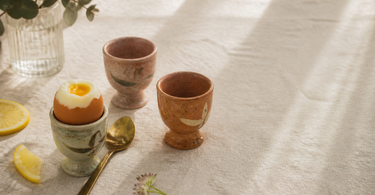
A ceramic egg cup is one of the smallest investments that can change the mood at the breakfast table. Hand-painted animal egg cups from manufacturers such as Quail Ceramics are cast in stoneware, painted by hand and designed for everyday use, they fit standard hen's eggs in size M-L and are dishwasher-safe, although hand-washing extends the life of the painted details. The range spans from lifelike dog breeds to birds, cats and quirky motifs like skulls and sunflowers.
Dims Studio's own figures: In the period from November 2025 to October 2026, more than 700 ceramic egg cups were sold, and half of them cost under 150 DKK. The products have an average of 4.8 out of 5 stars across 11 customer reviews.
A soft-boiled egg tastes the same whether it's served in a plastic cup or hand-painted stoneware. That's where logic loses out, and that's exactly the point. Ceramic egg cups are one of those categories of table decor that sit at the crossroads between everyday item and collector's piece, functional enough to survive a busy family breakfast and detailed enough to look lovely on a kitchen shelf for the rest of the day. This article covers what sets ceramic egg cups apart, which motifs are available, and what to look for if you're buying them as a gift.
What makes ceramic egg cups special?
The material matters. Ceramic egg cups, particularly those cast in stoneware, are heavier and more heat-retentive than plastic or melamine, meaning the egg stays warm a little longer. Stoneware is typically fired at 1200–1300 °C, which gives a dense, non-porous surface that resists moisture and bacteria.
The most important feature, however, is the hand-painted surface. Factory-produced ceramics use decals, printed motifs that are applied and fired on. Hand-painted pieces, on the other hand, are unique: no two cups have exactly the same brushstrokes, giving each piece its own individual character. This is visible in details like the eye colour on a figurine or the texture of a bird's plumage.
The egg cups are designed for standard hen's eggs in size M-L. Some models have a deeper bowl that can also hold an extra-large egg, this is usually noted in the product description.
Tip: Store the egg cups with the opening facing up on an open shelf, they work as decoration when not in use, and you avoid stacking them, which could damage the hand-painted edges.
Animal-shaped egg cups: Quail Ceramics
The British brand Quail Ceramics is one of the most recognised manufacturers of animal-shaped ceramic figures in Europe. Their egg cups from Quail are cast in stoneware and painted by hand with a level of detail that clearly sets them apart from mass-market products.
Each piece is shaped like an animal, not merely decorated with an animal motif, but literally sculpted so the body itself forms the cup shape. The egg bowl sits on the animal's back or head, depending on the design. The glaze gives the surface a lively, slightly varied finish that enhances the lifelike look.
The production process behind Quail ceramics
Quail works with plaster moulds into which the stoneware clay is cast. Once the piece has dried and been bisque-fired, it's painted by hand with coloured glazes, which are then fired at a high temperature. It's a multi-step process that's time-consuming compared with industrial production, and this shows in the details: the plumage on a goldfinch, the fur on a golden retriever, the precise colour transitions on a badger.
The range includes breeds and species such as labrador, French bulldog, owl, sparrow, buzzard, badger and hare. The collection is continually expanding, and certain designs are produced in limited runs.
What animal motifs are available?
Dogs are the most popular category. The range of dog egg cups covers a broad spectrum of breeds: labrador, pug, greyhound, jack russell, French bulldog and more. Many choose a design that matches their own dog, which makes the breakfast table a slightly more personal place.
Besides dogs, you'll find cat egg cups in several colours and types, a wide range of birds (great tits, parrots, goldfinches, owls), as well as rabbits, hedgehogs, foxes and more exotic motifs like flamingo and elephant. The full range of animal egg cupscontains a surprisingly large number of species, it's worth browsing through if you're looking for a specific animal.
| Category | Examples of motifs | Suits |
|---|---|---|
| Dogs | Labrador, pug, greyhound, Jack Russell, French bulldog | Dog owners, gift shopping for dog people |
| Cats | Various colours and types | Cat lovers, realistic collectors |
| Birds | Goldfinch, great tit, owl, sparrow, parrot, buzzard | Nature lovers, birdwatchers |
| Woodland animals | Badger, fox, hare, hedgehog, squirrel | Children, cosy aesthetics |
| Exotic animals | Flamingo, elephant | Colourful interiors, gift idea |
Fun and quirky designs
Not all egg cups are about realism. Quirky and fun egg cups is a category for those who'd rather have a skull or a sunflower on the table than a Labrador. These designs prioritise humour and surprise over realism, and they work as conversation starters at the breakfast table.
The material is typically glazed stoneware or ceramic of comparable quality to the realistic designs. The sturdiness is the same: they're made for everyday use, not for display cabinets. Style-wise, they're an obvious fit for families with children or kitchens with a more playful aesthetic, but they're not exclusively for young homes. A skull egg cup next to a morning coffee can easily have its place in a grown-up kitchen.
The motifs in this category include flowers (sunflowers, tulips), figures and abstract shapes. New designs pop up regularly, and the range is broader than many expect.
Gift and collector's item
As a gift
A ceramic egg cup has a number of qualities that make it a solid gift idea: it's tangible and useful, it's personal (you choose a motif that suits the recipient), and it's at a price point that suits most occasions, birthdays, Easter, Christmas, a housewarming gift or just a random pick-me-up.
The most effective strategy is to match the motif to the recipient. Do they have a particular dog breed? Find it. Are they a birdwatcher? A goldfinch or a buzzard hits the mark. Many choose to give 2-3 cups as a set, they look better in groups, and it gives the recipient a small collected look rather than a single piece.
Egg cups naturally complement other tableware items. Consider pairing them with a salt and pepper set in the same style, several manufacturers have matching series.
As a collectible
Quail egg cups are among the most collected ceramic pieces in Europe within this category. It typically starts with one, a gift or an impulse buy, and grows into a group on a kitchen shelf. The collecting logic is simple: each piece has its own character, they're relatively affordable, and new designs are added regularly, giving you an incentive to keep up.
Display-wise, they work best on open shelves or in open cupboards, where they can stand close together without hiding one another. A serving platter or a small tray arrangement gives a cohesive visual look when they're not in active use.
Frequently asked questions
Can egg cups go in the dishwasher?
Most stoneware ceramic egg cups are dishwasher-safe. Hand washing is still recommended if you want to keep the hand-painted details in the best possible condition over many years. The glaze is fired at a high temperature and is robust, but repeated dishwasher use can over time dull the surface on the most detailed areas.
Does a normal egg fit in the animal egg cups?
Yes. All egg cups in this range are designed for standard hen's eggs in size M-L. Certain models have a deeper bowl and can hold an extra-large egg (XL). The product description will usually state whether it's a standard depth or a deeper variant.
Are there egg cups for children?
The colourful animal egg cups are popular with children, and the whimsical designs with flowers and fun figures work well at the breakfast table. Stoneware is robust, but as with all ceramics, it won't survive being dropped on a hard floor. See the full range of egg cups for inspiration.
How many different animal egg cups are there?
Quail Ceramics has continuously expanded their collection in recent years. At the time of writing, there are several dozen different animals and breeds, from well-known dog breeds to more niche bird species. Certain designs are limited edition and are discontinued once stock runs out.
What's the difference between stoneware and ceramic?
Stoneware is a type of ceramic fired at 1200–1300 °C, making it denser and more durable than ordinary terracotta or earthenware. It's the preferred material for tableware that needs to withstand daily use. When people talk about "ceramic egg cups", stoneware is typically the material used in the quality segment.
Can you buy the egg cups individually, or only in sets?
They're typically sold individually, which makes it easy to put together your own combination. Buying individually is an advantage when you want to mix motifs, for example three different bird species or a blend of dogs and cats, rather than a uniform set.
Summary
Ceramic egg cups are one of those rare cases where the everyday and the decorative come together completely. A hand-painted stoneware cup costs no more than an average bunch of flowers, lasts for years, and spends its life visibly on the table or shelf, not tucked away in a drawer. The range of motifs is broad: true-to-life dog breeds and birds from makers like Quail, more playful designs with flowers and figures, and everything in between. If you're going to buy one thing for the breakfast table that actually changes the mood, a ceramic egg cup is a good argument.
Want to dive deeper into the range? Then take a look at ceramic egg cups for the full selection, or go straight to the animal egg cups if you know what you're looking for.
Read also
- Soft-boiled egg: cooking times for smiling and hard-boiled eggs
- The Easter hare: the story behind Easter's egg-laying hare
Explore our range of ceramic egg cups , animal-shaped, whimsical and ready for the breakfast table.