
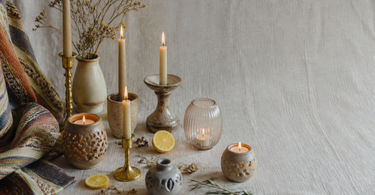
Denmark is the world's biggest consumer of candles per capita. Taper candles fit classic candlesticks and typically come in heights from 18–30 cm, whilst pillar candles stand alone or on a dish. Burn time depends on wax type, diameter and wick quality — a good 22 cm taper candle burns for 8–12 hours. Colour choice is a matter of taste: contrast works well, but a tonal match creates a calmer look.
Denmark is — by a wide margin — the world's biggest consumer of candles per capita. The figure isn't a sign of pyromania, but of a deeply rooted candle culture that stretches from Christmas candles to the everyday dinner table. Even so, surprisingly many people don't know the difference between candle types, sizes and actual burn time. This guide gives you the concrete answers you need to buy the right candles — and use them wisely.
Taper candles vs. pillar candles — what's the difference?
Taper candles and pillar candles are the two most common candle types in Danish homes, but they have very different properties and uses.
Taper candles
Taper candles are what most people picture as a classic candlestick candle: slim, cylindrical and designed to sit securely in a holder with a hole or spike. The standard diameter is 2.2 cm, and that's the size most candlesticks are made to fit. The height typically ranges from 18 cm to 30 cm, and a 22 cm taper candle burns for 8–12 hours under good conditions, depending on wax quality and wick thickness.
Taper candles are designed to be held in place by a holder — they don't stand stably on their own. It's important to check that the candle's diameter matches the holder precisely: too loose, and the candle will topple; too tight, and you risk cracking the holder.
Pillar candles
Pillar candles — also called block candles — are noticeably thicker and flat at the bottom, so they can stand on their own. Diameter typically ranges from 5 cm to 10 cm, and the burn time is correspondingly much longer: a 7 cm pillar candle with a 15 cm height often burns for 40–80 hours. They're traditionally placed on a dish, a plate or in a wide holder designed for the purpose. Pillar candles are especially handy if you want a candle burning for a long time without having to replace it.
Tip: Mix taper candles and pillar candles in the same setup for more dynamic styling — for example, a pillar candle in the centre of a dish, flanked by taper candles in two holders of different heights. The variation in levels gives depth and movement to the light.
Measurements and sizes: what fits what?
One of the most common mistakes people make is buying a candle that doesn't fit the candlestick. Here are the key measurements to know.
| Candle type | Typical diameter | Typical height | Burn time (approx.) | Requires holder? |
|---|---|---|---|---|
| Taper candle, standard | 2.2 cm | 18–30 cm | 8–12 hours | Yes |
| Taper candle, mini | 1.3–1.5 cm | 10–14 cm | 3–5 hours | Yes (small) |
| Pillar candle, small | 5–6 cm | 10–15 cm | 20–40 hours | Recommended |
| Pillar candle, large | 7–10 cm | 15–25 cm | 40–80 hours | Recommended |
| Tealight / votive candle | 3.5–5 cm | 2–4 cm | 4–9 hours | Glass/dish |
If you're a big fan of ceramic candlesticks, it's worth measuring the inner diameter of the hole before you order candles. Most candlesticks are the standard size of 2.2 cm, but there are exceptions — especially handmade candlesticks can vary by a couple of millimetres.
Burn time and quality
Burn time is closely linked to the type of wax and the quality of the wick. Cheap candles are often made from lower-quality paraffin with a thicker, poorly centred wick — the result is uneven burning, dripping and soot on the candlestick.
Types of wax and their properties
- Paraffin: The most widely used type of wax. Cheap to produce, burns clean and even if the quality is right. Made as a by-product of oil refining.
- Stearic acid (stearin): Typically made from animal fat or vegetable oils. Harder than paraffin, which means less dripping and a longer burn time. This is what's traditionally called "stearin" in Denmark — although the word technically covers a broader range.
- Beeswax: Natural, slow-burning and with a light honey scent. Beeswax is the most expensive type of wax and burns up to 50% longer than paraffin of the same size.
- Soy wax: Plant-based alternative, typically used in scented candles and containers. Its softer consistency makes it best suited for pillar candles and candles in glass.
A good rule of thumb: the harder the wax is at room temperature, the more slowly and evenly the candle tends to burn. Quality candles from European manufacturers usually state the burn time on the packaging, and it's realistic — unlike many imported candles, which are assessed under ideal laboratory conditions.
Fancy a candle that both looks great and lasts a long time? You'll find a selection of candles in various wax types and sizes, chosen specifically with burn time and finish in mind.
Tip: Trim the wick to 0.5–0.8 cm before lighting the candle. A wick that's too long produces a large, flickering flame, faster burning and more soot. A wick that's too short can result in the candle "drowning" in its own melted wax.
Colour choice and matching candlesticks
The colour of your candles isn't unimportant, but there are no rules, only choices. Two approaches work particularly well:
Tonal match
Choosing a candle in the same shade as your candlestick — for example, a terracotta-coloured candlestick with a muted orange-red taper candle — creates a calm, cohesive look. It's a design approach that works well in living rooms, where you want a sense of harmony and calm.
Contrasting colours
A white candle in a strongly coloured candlestick is the classic contrast. It draws attention to the candlestick rather than the candle, letting the shape and colour of the candlestick speak for themselves. The same goes the other way round: a strongly coloured candle in a neutral, uncoloured candlestick.
If you already have a room full of colours, white or off-white candles usually work best — they support the mood without competing with it. Coloured candlesticks, on the other hand, are designed to carry the colour, so a neutral candle lets them shine.
Crystal and glass candlesticks are a special case: they reflect light in a way that's enhanced by coloured candles. An amber candle in a crystal candlestick casts warm, golden reflections — an effect you simply can't get with white candles.
Season and mood
Candle usage among Danes is markedly seasonal. Although we light candles all year round, consumption is naturally highest from October to February, when the dark hours are longest. But colour choice can easily vary by season — and it's an easy way to change the look of your home without investing in anything new.
- Spring: Light tones — off-white, soft yellow, powder and sage. Light colours reflect the first warm days and suit fresh flowers in vases.
- Summer: Clear, warm shades — yellow, coral, light green. Summer candles don't need to burn for long evenings, but a single flame on the dinner table outside is still a classic.
- Autumn: Earthy tones — terracotta, amber, dark orange, deep green. These colours naturally match autumn's palette and add warmth in contrast to the shorter days.
- Winter and Christmas: Red, burgundy, dark green and white candles dominate. The classic Christmas red is probably the best-selling single colour in Denmark in December.
Care and safety
A good candle deserves a little attention, both to make it last longer and to use it safely.
Storage
Store candles horizontally or upright in a dark, cool room. Direct sunlight fades the colour over time, and heat can deform the candle. A candle with a slanted top — a sign of heat damage — burns unevenly and drips more.
The first time you light a new candle
Let the light burn until the entire surface of the wax has melted (typically 1–2 hours for a taper candle, 2–4 hours for a pillar candle). If you don't, a "tunnel" forms in the middle, and the candle will then always burn within itself without consuming the outer wax — meaning it burns much shorter than stated.
Placement
Always keep a minimum of 10 cm between two lit candles. The flame from a neighbouring candle will melt towards each other and create uneven burning. Also make sure the candlestick stands stably and not near curtains, paper or other flammable materials.
A well-kept set of unique candlesticks made from ceramic or glass is at its most beautiful when the candle is correctly inserted and burns evenly — it's a detail that makes a real difference to the overall look.
Frequently asked questions
What is the standard diameter of taper candles in Denmark?
The vast majority of taper candles and candlesticks in Denmark are made to a diameter of 2.2 cm. This is the dominant standard among European manufacturers. However, mini taper candles in 1.3–1.5 cm do exist, typically for advent wreaths and decorative purposes — always check the candlestick before buying candles.
How do I avoid dripping candles?
Choose candles with a high stearic acid content rather than pure paraffin — stearic acid is harder and melts more slowly. Also make sure the candle isn't burning in a draught, as moving air causes the flame to flicker and the wax to melt unevenly. A correct wick length of 0.5–0.8 cm significantly reduces dripping.
What's the difference between stearin and paraffin?
Stearin (stearic acid) is a fatty-acid-based product made from animal fat or plant oils. It's harder, burns more slowly and produces less soot than paraffin. Paraffin is an oil-based by-product that's cheaper to produce and is used in most cheap mass-produced candles. Many commercial candles blend the two to optimise price and quality.
Should I choose candles in the same colour as my candlestick?
It's a matter of style, not a rule. A tonal match — candle and candlestick in the same colour shade — creates calm and cohesion. Contrasting colours draw attention to the candlestick. White candles are the safest choice if you're unsure, as they work with almost any candlestick.
Why does my candle only burn in the middle and not at the edges?
This is due to "tunnelling" — you put the candle out too early the first time you lit it. Wax has a thermal memory: the first burn sets the pattern for all subsequent ones. Always let a new candle burn until the entire surface has melted (typically 1–4 hours depending on diameter) the first time you light it.
Can I use any candlestick for both types of candles?
No. Classic candlesticks with a hole or spike are designed for taper candles. Pillar candles require a wide, flat surface — a dish, a bowl or a specially designed pillar candle holder. If you use a pillar candle in a holder that's too narrow, the wax will melt down over the holder and can damage it.
Summary
Candles are one of the simplest ways to change the mood of a room — but there's more to know than you might think. Taper candles for classic candlesticks, pillar candles on a dish for a long burn time. The standard diameter for taper candles is 2.2 cm, and you should always check the candlestick's measurements before buying. The type of wax determines burn time and dripping: stearic acid and beeswax perform markedly better than cheap paraffin. And when it comes to colour: choose a tonal match for calm, contrast for drama — or stick to raw white if you're unsure. Remember to trim the wick and let the candle burn fully the first time.
Explore our range of candles and candlesticks — from taper candles in bright colours to pillar candles in natural wax qualities.