
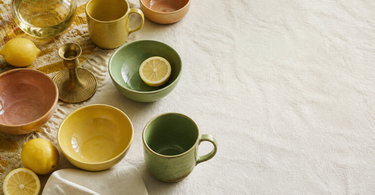
Caja Company is a Danish design brand founded by Caja Tønder, who draws inspiration from the Italian majolica tradition. The products are designed in Denmark and hand-painted in Italy, meaning that each piece is unique. The range covers everything from plates and jugs to hooks and citrus presses — all united by warm citrus colours and a loose, artistic brushstroke. No two pieces are alike, and the ceramics are recommended to be hand-washed to preserve the decoration.
There's a particular light to Southern European ceramics — the way the colours sit saturated in the glaze, and the brushstrokes that speak of a hand rather than a machine. It's exactly that feeling Caja Company has brought home to Danish kitchens and interiors. The brand is built on one strong motif — the lemon — but has since expanded into a full palette of citrus fruits, hooks and wall hangings, all carrying the same handmade aesthetic. Here's the full overview.
Who is Caja Company?
Caja Company was founded by Danish designer Caja Tønder, who drew inspiration from the Italian ceramic tradition — a tradition stretching back to the Middle Ages, and which still lives on in workshops scattered across central and southern Italy. The idea was to combine the Nordic design eye for simplicity and function with the Southern European sense of colour and craftsmanship.
The model is simple: designs are developed in Denmark, production takes place at experienced Italian ceramic workshops. This creates a process where the aesthetic expression is well thought-out, while the craftsmanship itself is handled by people with generations of experience in painting and glazing ceramics. The result is products that sit somewhere between design object and everyday item — precisely the spot that makes them hard to put aside.
The citrus motif — the lemon above all — wasn't chosen at random. The fruit has a long iconographic tradition in Southern European art and ceramics, and its bright yellow colour against a white or cream background creates contrasts that work in virtually all home styles, from rustic warmth to more minimalist Nordic.
Tip: Want to combine Caja Company's citrus motifs with other colourful kitchenware? Citrus and fruit motifs from other European manufacturers can easily be mixed with Caja Company — the key is to keep the colour palette warm and stick to handmade ceramics rather than industrial porcelain series.
The material: Italian majolica
Caja Company's products are made from majolica — also called faience — a type of ceramic with roots in the Arab-Moorish tradition, which spread to Europe via Spain and then flourished in Northern Italy from the 1400s onwards. The technique involves firing an earthenware piece at high temperature, then applying a white, tin- or zinc-based glaze as a background, and finally hand-painting the decoration and firing again.
The double firing process gives majolica its characteristic matte, slightly porous surface beneath the glaze and its clear, almost gouache-like colours. The surface isn't smooth like industrial porcelain — there's a tactile unevenness that underlines that it's human hands, not moulds, that have created the piece.
Care and maintenance
Majolica is robust in normal use, but the hand-painted decoration is vulnerable to the harsh detergents and high temperatures of a dishwasher. Over time, this can wear down the painted surface and cause the colours to fade. Hand-washing with a mild washing-up liquid is the right approach if you want to preserve the decoration for many years.
The Lemon series — the core of the range
The Lemon series is what most people associate with Caja Company, and it forms the backbone of the range. The entire series is coordinated so that individual pieces can be combined freely without clashing — an advantage when the table setting needs to be dressed up or down depending on the occasion.
Plates
Caja Company's lemon plates come in flat and deep variants. The decoration varies slightly from piece to piece, because each piece is painted individually — a lemon branch might have one leaf more to the left on one piece than on the next. This is part of the product's character rather than a flaw.
Jugs
The jugs from Caja Company are among the series' strongest pieces. Some are shaped with the lemon's organic curves as the starting point for the form itself; others are more classically jug-shaped but decorated with citrus motifs. See the full range of lemon jugs, spanning from tea-serving volume to large serving jugs.
Vases, bowls and cups
The vases in the lemon series work as decoration with or without flowers — they're sculptural enough to stand alone. Lemon vases from Caja Company are typically compact, with a wide base and narrow neck that echoes the lemon's own shape. The bowls cover everything from large serving bowls to breakfast bowls in a more everyday format, and the cups turn morning coffee into a little visual treat.
Orange and other citrus fruits
Following on from the lemon series, Caja Company has expanded the palette with orange plates and other citrus motifs. The colour scale shifts from the sharp, cool lemon yellow to a warmer, reddish orange that gives the table a different energy.
The two series are designed to work together. A table setting with mixed lemon and orange gives a dynamic that resembles a Southern European market table — generous and informal rather than tightly coordinated. For larger gatherings, it can work well to mix both plus a couple of colourful platters and bowls as a centrepiece on the table.
| Series | Primary colour | Mood | Combines well with |
|---|---|---|---|
| Lemon | Clear, cool yellow | Fresh, light, high-contrast | White tablecloth, natural linen placemats |
| Orange | Warm, reddish orange | Rich, warm, Mediterranean | Terracotta shades, dark wood |
| Mix | Both | Generous, informal, festive | Neutral tablecloths, ceramics in natural tones |
Functional pieces: citrus presses and hooks
Citrus juicers
Caja Company's citrus juicers are a great example of what happens when function and aesthetics meet on the same table. The citrus juicer is made from glazed ceramic, hand-painted with the usual citrus motifs, and it's fully functional for everyday use — not just a decorative piece. The advantage of ceramic as a material for a citrus juicer is that the surface is easy to clean, doesn't absorb flavours and withstands the acid from citrus fruits without reacting chemically.
The kind of piece that most often ends up under the wrapping paper — because its function is immediately clear, yet it's visually more interesting than the conventional alternative.
Hooks for the hallway and kitchen
Caja Company's ceramic hooks are shaped like lemons and other fruits. They mount on the wall like ordinary hooks, but bring the citrus style into rooms that otherwise rarely get any decorative attention — the entrance hall, the bathroom, the small porch. Three hooks in an irregular cluster on a light wall is a quick way to give a room character without major changes.
They belong to the broader category of ceramic hooks, which is a strong alternative to standard metal hooks, precisely because ceramic takes colour and detail in a way metal doesn't.
Ceramic wall decorations
Besides hooks, Caja Company also makes ceramic wall hangings — flat or slightly three-dimensional pieces hung directly on the wall as decoration. The motifs are typically fruits, and they can be arranged as a small composition or individually as a single splash of colour on a neutral wall.
It's a simple and reversible way to work with wall decoration — no need to repaint, and it can be moved or swapped without visible damage to the wall. For those who rent their home or are hesitant about permanent changes, it's a good alternative to bigger wall interventions.
Frequently asked questions
Is Caja Company dishwasher safe?
The dishwasher is not recommended. The high temperatures and strong detergents can, over time, break down the hand-painted decoration and cause the colours to fade or crack. Hand washing with a mild washing-up liquid is the right method if you want to preserve the piece's appearance for many years.
Where is Caja Company made?
The design is developed in Denmark, while production takes place in Italy at established ceramic workshops with long experience in the majolica technique. The Italian ceramic tradition — particularly from regions like Umbria and Emilia-Romagna — is among the oldest and most developed in Europe, dating back to the 1400s.
Can the lemon and orange series be combined?
Yes. The two series are designed to work side by side. The colour palettes are related — both warm, saturated, and sharing green leaves as a common element — so they complement each other naturally on the table. A mix of both gives a generous, informal feel rather than a strict, coordinated look.
What is majolica, and how does it differ from porcelain?
Majolica is a type of glazed earthenware fired at lower temperatures than porcelain and is more porous. The surface has a character and tactile unevenness that porcelain lacks. The colours on majolica are more opaque and matte in expression, because they're painted directly onto the white glaze before the second firing.
Are all pieces in Caja Company identical?
No — and that's the point. Because each piece is hand-painted individually, there will always be minor variations in brushstrokes, colour placement and detail. Two plates from the same series are never identical. It's part of the product's handcrafted character, not a quality issue.
Which rooms are Caja Company hooks best suited for?
The hooks work everywhere, but make the biggest difference in rooms that are normally overlooked decoratively: the entrance hall, porch, bathroom and kitchen. They can be used individually as a single colourful element or in clusters of 3–5 for a more pronounced visual expression. Choose a light, neutral wall to let the colours stand out.
Summary
Caja Company is a compact, consistent brand built on one strong aesthetic foundation: hand-painted citrus in the Italian majolica tradition. What began with a lemon motif has grown into a range that covers table settings, storage, kitchen function and wall decoration — always with the same loose, artistic brushstroke and warm, saturated colours.
The choice of material — majolica produced by Italian craftsmen — gives the products a tactile quality and a piece-to-piece variation that mass-produced porcelain can't replicate. It makes every plate, jug and hook an individual piece within a well-considered overall aesthetic. Hand washing is all it takes to keep them looking good for many years.
Explore our range of Caja Company ceramics — from lemon plates and jugs to fruit-shaped hooks and citrus juicers.