
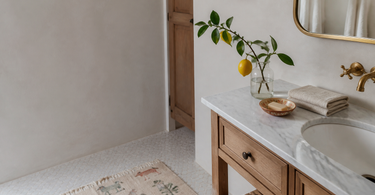
The bathroom is typically the room that gets the least design attention — yet it's also the room you use several times a day. With three relatively simple moves — a mirror with character, functional hooks in a material that lasts, and a single plant in a proper pot cover — you can create a feel that's intentional rather than accidental. This article covers what actually makes the difference, and why.
The bathroom is one of the few rooms you're guaranteed to be in at least twice a day — and yet it's typically the room that gets fresh attention last. That's probably because it feels difficult: tiles, plumbing and limited square footage give the impression there's not much you can do. But you don't need to knock anything down to change the room. Mirrors, hooks, plants and a few well-chosen details go a long way — as long as you choose them deliberately.
The mirror as an anchor point
No single element changes a bathroom's mood faster than the mirror. It's the first thing you see in the morning, and it visually doubles the depth of the room. Yet many people go for the least disruptive option — an angular standard mirror with a narrow white frame — and that's exactly the choice that makes a bathroom feel anonymous.
Shape and proportions
Round and oval mirrors break up the bathroom's many straight lines (tile grouting, cabinets, sinks) and create a contrast that feels considered rather than random. A round mirror with a diameter of 60–80 cm is a good starting point for most bathrooms; go up to 90 cm and it starts to dominate the wall in a way that needs more ceiling height.
Oval mirrors lean towards the more classic and work especially well if you have a narrow wall above the sink. An oval mirror can visually make the wall look taller and give the bathroom a more relaxed, organic character.
Frame and material
Brass is one of the materials that holds up best in a bathroom — it develops a patina over time, but doesn't oxidise on contact with moisture the way iron or cheap alloys do. A brass frame doesn't need to be thick or over the top; even a narrow 8–12 mm profile gives the mirror a defined edge that an unframed mirror lacks.
Wood is another obvious choice: warm, light, and easy to shape into a round or organic form. Pay attention to the surface treatment — unprotected wood in a room with high humidity will warp and can crack over time.
Tip: Position the mirror so the centre sits about 160–165 cm from the floor — that suits most adults' eye level and works whether you're sitting or standing. If the ceiling height is under 230 cm, avoid large, vertical mirrors that visually press the room down.
Hooks: more than just hanging space
A hook is a functional element — it holds the towel, dressing gown or clothes you dropped — but it's also visible 24 hours a day, hung right on the wall at eye level. This is one of those places where a material choice really shows.
Brass vs. other metals
Brass is popular in bathrooms not just for aesthetic reasons. It's naturally antimicrobial (copper ions inhibit bacterial growth), and the surface stays looking good with minimal upkeep. A hook in solid brass versus one with a brass-coloured coating are two very different products in terms of durability — coating can flake off within a few years in a damp environment.
Ceramic is another good choice: porous enough to give a bit of grip against fabrics, resistant to moisture, and available in far more shapes and colours than metal. A ceramic hook can have character as a small sculptural element on the wall.
Number and placement
The rule of thumb is simple: one hook per person using the bathroom, plus one extra for the guest towel. Don't place them closer than 15 cm apart — a full towel needs space to dry properly, and two towels overlapping in the middle never looks quite right.
Consider the height: towel hooks typically sit best at 140–150 cm, while a hook for a dressing gown can hang higher — 160–170 cm — so the gown doesn't drag on the floor. Brass hooks in a matching series give a more considered look than a mix of random styles.
Knobs for cabinets and drawers
If your bathroom has a cabinet with worn handles, new knobs for doors and drawers are an upgrade that takes under an hour to fit and costs markedly less than a new piece of furniture. A ceramic knob in an unexpected colour can turn a completely standard IKEA cabinet into something that looks like a deliberate choice.
Plants and pot covers
A living plant in a bathroom does something no decoration in ceramic or glass can: it moves, grows and changes over time. It's the organic contrast to a room that otherwise mainly consists of hard, smooth surfaces.
Which plants are suitable?
Bathrooms are typically characterised by high humidity and lower light levels than kitchens and living rooms. This is ideal for:
- Monstera deliciosa (Swiss cheese plant) — tolerates partial shade and enjoys high humidity
- Nephrolepis exaltata (Boston fern) — thrives in damp conditions, but requires a bit more light
- Pothos / Epipremnum aureum — extremely robust, grows in low light, can trail down from a shelf
- Sansevieria (mother-in-law's tongue) — tolerates neglect and varying humidity
Avoid plants with high light requirements such as succulents and cacti, unless the bathroom has a south-facing window with direct sunlight.
The plant pot cover as a design element
A cheap plastic pot is functional — but a plant pot cover in ceramic or woven material gives the plant a frame that matches the room's overall look. Choose a plant pot cover that's 2–3 cm wider than the pot in diameter, so you can lift the plant out for watering without hassle.
In a small bathroom, a small wall-mounted plant pot cover or a shelf in the corner with a trailing pothos can keep the floor space clear — particularly important if you have under 4 square metres to work with.
The small details that tie it all together
Mirror, hooks and plants are the three big moves. But it's the details that determine whether the room feels put-together or sporadic.
The bath mat
A bath mat typically fills a central spot in front of the basin or shower cubicle — and it's visible. A bath mat in a texture or colour that relates to the room's overall palette is a cheap way to tie elements together. Avoid generic white cotton mats if you want the room's look to feel intentional — they often look greyish after quite a short time.
Candlesticks and candles
A bathroom with candles isn't just a cliché — the movement of the flame and the warm light actually change the room's atmosphere markedly compared with a ceiling light. A single candlestick in ceramic or glass on the edge of the bathtub or a shelf is enough; it doesn't need to become a ritual.
Storage and tidiness
Nothing undermines a well-thought-out bathroom faster than a cluttered surface with mismatched products. Small baskets or bowls for cotton buds, dental floss and jewellery are functional and can look great if the material suits the rest of the room. Ceramic bowls in simple colours are easy to clean and suit most styles.
The most common bathroom decorating mistakes
| Mistake | Consequence | Alternative |
|---|---|---|
| Too small a mirror above the basin | The room appears lower and more enclosed | A mirror that's at least 60–70% of the width of the basin |
| Plastic hooks with a metallic-coloured coating | Flakes off within 2–3 years in humidity | Solid brass or ceramic |
| Plants with high light requirements | Die quickly, look neglected | Pothos, monstera, snake plant |
| Mixing too many metal colours | The room looks unplanned | Max two metal colours — e.g. brass + matte black |
| No textile warmth (only hard surfaces) | The room feels cold and clinical | Bath mat, bathrobe with quality texture |
Frequently asked questions
Which mirror suits a small bathroom best?
A round or oval mirror with a diameter of 50–70 cm is a safe choice for a small bathroom. It breaks up the many straight lines and creates a sense of more space. Avoid very large mirrors in rooms with low ceilings — proportion matters more than size on its own.
Can I use brass hooks in a humid bathroom?
Yes — solid brass is actually one of the most durable choices for the bathroom. It develops a patina over time but doesn't corrode the way iron does. Avoid hooks that are merely surface-treated with a brass colour; they'll flake off after 1–3 years in a humid environment.
Which plants survive without direct sunlight in the bathroom?
Pothos (Epipremnum aureum), monstera and snake plant do well in low to medium light and thrive in high humidity. Boston fern (Nephrolepis) is also a classic bathroom choice, but needs a bit more light and regular watering so it doesn't dry out.
How many hooks should there be in a bathroom?
One hook per regular user plus one for the guest towel is a good rule of thumb. Space them at least 15 cm apart so the towels have room to dry. Robe hooks work best at 160–170 cm, towel hooks at 140–150 cm.
What's the easiest way to upgrade an anonymous-looking bathroom?
Change the mirror if it's small and unframed. That's the single move that gives the biggest visual impact for your money. The next best move is to replace hooks and any cupboard handles — it takes less than an hour and markedly changes the overall feel of the room without needing a tradesperson.
Are candles a problem in the bathroom?
Only if you forget about them. Pay attention to placement — keep candles away from textiles and synthetic surfaces. A candle in a ceramic candlestick is stable and safe on a flat surface. Make sure there's good ventilation if the bathroom is small, as candle smoke can cause discolouration over time.
Summary
The bathroom doesn't need a renovation to feel different. A mirror with a defined frame in brass or wood, hooks in a material that ages nicely, and a single plant in a sturdy plant pot cover — these are three concrete moves that change the character of the room. Add a textured bath mat and a candlestick, and you've got a room that doesn't look thrown together. It's not about filling the bathroom up, but about choosing the visible elements with care. The rest takes care of itself.
Explore our range of bathroom mirrors, hooks and knobs and plant pot covers — or see the whole range of home décor.