
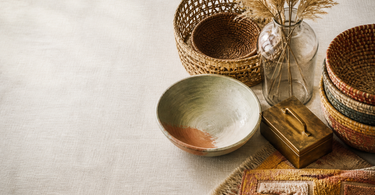
Baskets solve a concrete problem — clutter — without making the room feel tight or clinical. Whether you store towels in the bathroom, throws in the living room or laundry in the utility room, a basket in natural materials, woven paper or recycled fabrics can bring storage into the décor rather than hiding it away. Fold-up crates are a stackable alternative when you want colour and flexibility in the same solution.
Storage doesn't have to look like storage. A basket in woven seagrass, paper cord or cotton does the job — it gathers up the loose bits and keeps the invisible clutter under control — but it also looks good on a shelf or floor at the same time. That's the simple explanation for why baskets crop up in pretty much every room in the home, whether the décor is minimalist, colourful or somewhere in between.
Why baskets work as storage
A basket introduces texture and organic shape into a room while simultaneously hiding its contents. That's a rare combination, as most storage solutions go for one of the two: either pure function (plastic boxes under the bed) or pure decoration (a bowl that doesn't actually hold much). Baskets do both fairly well.
Woven material — whether it's paper cord, seagrass, bamboo or recycled fabric — has a natural give. The materials yield slightly, so the basket adapts to its contents rather than the other way round. And since the surfaces are open in structure, the basket looks visually lighter than a solid box of the same size.
Size actually matters more than most people think. A basket that's too small for the job always looks messy — the contents stick up over the edge or push the sides out. Rule of thumb: buy a basket that can hold 30–40% more than you think you need. That gives you room for the inevitable "more than planned."
Tip: Place two baskets in the same material side by side rather than one big basket — it looks more deliberate and is easier to handle, since you can lift them one at a time.
Baskets in the living room
The living room gathers up everything that doesn't really belong anywhere in particular: throws that have slipped off the sofa, too many cushions to sit neatly, magazines from the last three months and toys that have wandered in from the kids' room. A basket — or two — next to the sofa or under a side table sorts it out without requiring you to rearrange the whole room.
Throws and cushions
A tall, narrow basket by the arm of the sofa is the classic solution for throws. Choose a basket with at least 50 cm of internal depth so the throws aren't squashed and crumpled. Make sure the basket is heavy enough at the bottom not to tip over when you pull something out with one hand — dense materials like paper cord or woven leather sit better on the floor than loose bamboo versions.
Magazines and books
Flat baskets with a low edge — think tray format — work well under a coffee table. Here it's the choice of material that determines the look: a natural-coloured seagrass basket almost disappears into a neutral room, while a coloured paper cord basket becomes an active element. Both are valid choices, but they're not the same choice.
If you have rugs on the floor, a basket in a natural-coloured material is typically easier to match than a coloured version. Take a look at our range of rugs, if you're working on finding the overall visual balance in your living room.
Baskets in the bathroom
The bathroom is the room where storage is typically the least planned and the most necessary. Towels that don't fit in the cupboard, spare loo roll and the various products that don't fit in the drawer — a basket can solve all of that.
Towels
An open basket with a low edge holds 4–6 folded towels and is easier to use day to day than folding and stacking on a shelf. The basket needs to be able to handle a bit of damp — seagrass and bamboo are relatively tolerant of a humid bathroom, but direct contact with water breaks the materials down. Keep the basket away from the direct splash zone of the shower.
Loo roll and spare stock
A low, round basket next to the toilet typically holds 6–8 rolls and is far more accessible than a cupboard. It's one of those solutions that seems simple but that you're always glad of in practice. Use a basket with a solid base so the rolls don't fall through the weave.
In the bathroom, baskets naturally go well with other textured surfaces. A bath mat in cotton or wool pairs nicely with a basket in seagrass — both materials bring an organic feel into a room that's otherwise often dominated by hard surfaces.
Baskets in the utility room and hallway
The utility room and the entrance hall share a function: they're the rooms that handle the daily clutter before it spreads to the rest of the home. Here, baskets can be a bit more robust — you don't need to think about aesthetic finesse in the same way as in the living room.
Laundry
A laundry basket should have a capacity of at least 50–60 litres for a household of two adults. Baskets with lids keep the smell contained and look tidier. Many people choose baskets in paper cord or woven plastic for laundry — they're easy to wipe down and hold their shape even under heavy loads.
Shoes and outdoor gear
Low baskets by the entrance door collect shoes far better than a metal shoe rack, because they don't require the shoes to be "placed properly". You just chuck them in the basket. Keys, mittens, dog leads and everything else that gathers in the entrance hall can likewise be sorted into smaller baskets — one for each purpose.
The entrance hall is, by the way, an obvious place to consider entrance hooks as a supplement to baskets — the hooks take the vertical space, the baskets take the horizontal.
Materials and what they can handle
The choice of material isn't just an aesthetic one — it determines which rooms and loads the basket is suited to.
| Material | Strengths | Limitations | Best for |
|---|---|---|---|
| Seagrass | Natural, robust, affordable | Doesn't tolerate direct moisture over time | Living room, entrance hall |
| Paper cord | Light, colourful, good shape stability | Can wrinkle in high humidity | Living room, office |
| Bamboo | Hard surface, long lifespan | Can splinter on impact | Bathroom (dry), utility room |
| Cotton / fabric | Washable, soft, foldable | Doesn't hold its shape under heavy loads | Toys, textiles, clothes |
| Recycled materials | Sustainable production, unique texture | Variable quality depending on the manufacturer | The living room, the nursery |
European and South American manufacturers are increasingly working with certified natural materials and recycled yarn, so it's worth checking manufacturer information if sustainability is a criterion for you.
Fold-up crates as an alternative
AYKASA foldable crates are a modern alternative to traditional baskets — particularly in rooms where you want more colour and precise stacking. They're made from recycled plastic and are fully foldable, so they take up almost no space when not in use.
The key argument for foldable crates over baskets is precision. Crates have right angles, a fixed shape and stack stably. A basket in natural material is organic and flexible — it adapts, but it doesn't stack perfectly. Which solution is right for you depends on whether you prioritise expression or system.
- Foldable crates: Well suited for the wardrobe, cellar, office — places where storage needs to be systematic and easy to keep track of.
- Baskets: Well suited for the living room, bathroom, hallway — places where storage is part of the visual picture of the room.
You can of course mix the two — for example, baskets in the visible rooms and foldable crates behind wardrobe doors or in the cellar. This gives the best distribution of aesthetics and practical capacity.
In addition to baskets and crates, decoration can actually solve some of the same need: bowls, dishes and trays on shelves and tables gather loose items without it looking like storage. See our dishes and bowls for inspiration on this approach.
Frequently asked questions
What size basket should I choose for the living room?
Choose a basket that can hold 30–40% more than you initially think you'll need. For blankets and cushions, a basket with an inner diameter of 35–45 cm and a height of 45–55 cm works well. For magazines and books under the coffee table, a low, flat basket of 40–60 cm in diameter is more practical.
Can baskets be used in the bathroom?
Yes, but choose materials that can withstand moisture — bamboo and tightly woven paper cord are relatively tolerant. Avoid placing the basket directly in the shower's splash zone. Seagrass can be used in the bathroom, but requires good ventilation, as moisture breaks down the fibres over time.
What's the difference between a basket and a foldable crate for storage?
Baskets in natural materials are organic, flexible and easily integrate into the home's visual expression — particularly in visible rooms. Foldable crates have fixed edges, stack precisely and are more systematic. Both are valid choices; the difference is whether storage should be seen or hidden.
How do I maintain a seagrass basket?
Dust the basket regularly with a soft brush or a dry cloth. Stains can be wiped off with a lightly damp cloth — don't use soaking wet cloths, as the materials absorb water and can lose their shape. Place the basket in a well-ventilated room, and avoid direct sunlight over long periods, as it bleaches the fibres.
Are there baskets suitable for the nursery?
Yes — soft baskets in cotton or fabric are the safest choice for the nursery, as they have no sharp edges and can be washed. Capacity should be generous: toys take up disproportionately more space relative to their weight. A basket with handles makes it easier for children to carry it around themselves.
Can foldable crates and baskets be combined in the same room?
Yes, and it often gives the best balance. Use baskets in the visible layer — on the floor, on shelves — and foldable crates behind doors, in cupboards or in the cellar. You get the baskets' aesthetics where it counts, and the foldable crates' system where it's practical.
Summary
Baskets aren't a quick fix for clutter — they're a deliberate part of the décor. It requires you to choose the right material for the right room: seagrass and paper cord for the living room and hallway, bamboo and cotton for the bathroom, robust variants for the utility room. Size is more important than most people expect, and two medium baskets almost always beat one large one in everyday use.
Foldable boxes complement the baskets in rooms that call for organisation rather than aesthetics. Use both, and you'll get a solution that works well and looks like it's been thought through — because it has. Explore the full storage range to find the combination that suits your home.
Explore our range of baskets and storage — from foldable boxes in recycled plastic to hand-woven seagrass.