
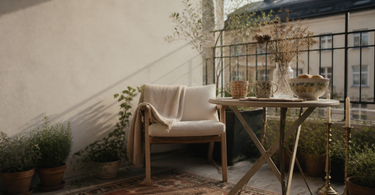
A balcony can function as a real extra room — even in Denmark. The key lies in three elements: greenery that creates life, lighting that extends the evening, and a rug that defines the space. With the right materials and a little thought about placement and scale, even 4–6 m² can feel like an outdoor lounge. This article covers what works in practice, and what you should avoid.
Most balconies are used for two things: clothes racks and the flower boxes that half-wilt in July. That's a shame, because even a balcony of 5–6 m² has the potential to become the spot in the flat where you sit the most. It doesn't take a big renovation — but it does require you to think of the balcony as a room rather than a storage space. Here's the practical approach that works.
Start with the floor: the rug sets the scene
Just like in a living room, a rug defines where the space begins and ends. On a balcony it does exactly the same thing: it tells your brain that this is a place to sit — not a walkway. A rug brings the furniture together and gives warmth under bare feet on cold morning tiles.
In terms of material, there's a difference in what holds up outdoors. Wool rugs made for indoor use can cope with brief dampness, but should be brought in when it rains. Polypropylene rugs and cotton flatweaves are more weather-resistant and can be rinsed clean with a garden hose. Many colourful rugs in cotton and recycled fibres are made for exactly this purpose and withstand both sun and rain better than genuine wool.
Size and placement
The most common mistake is choosing a rug that's too small. A rug of 60×90 cm disappears under a garden table set. As a rule of thumb, all chair legs — including the back ones — should stand on the rug when you're sitting down. On a 5 m² balcony, a rug of 160×230 cm will typically suit a table with two to four chairs. If the balcony is narrower, a 120×180 cm format can work, but don't go smaller than that.
Tip: Place an anti-slip underlay beneath the rug — not just for safety, but because it keeps the rug flat even on windy days. A rug that constantly curls up at the corners is annoying to live with.
Greenery and pot covers: create depth in a few square metres
Plants on a balcony do two things design-wise: they add a vertical element to a space that's otherwise mainly horizontal, and they soften the hard surfaces of tiles, railings and concrete walls. But it's the combination of plant and pot cover that really makes the visual difference.
Grouping rather than single specimens
A single potted plant in the middle of the floor looks abandoned. Instead, place three to five pots of varying heights and sizes close together — typically in the corner of the balcony or along the railing. Vary the height by placing a pot on a stool or a raised shelf, and let the lower plants fill in in front.
Pot covers in ceramic or terracotta give the group a sense of cohesion, even when the plants are wildly different. Use two to three pot covers in the same colour family (for example, variations of blue-green or natural tones), and avoid matching them 1:1 — that becomes too rigid. A colourful pot cover can break things up and act as an accent rather than competing with the plants.
Which plants work on a Danish balcony
Low maintenance is key, because balconies are challenging growing environments: direct sun for many hours, drying out and wind. Hosta, agapanthus, geranium and herbs like thyme and rosemary are hardy choices. Perennials are a good long-term investment, as they come back year after year.
| Plant type | Sun | Watering | Overwintering |
|---|---|---|---|
| Geranium | Full sun | Frequent (every 2 days in heat) | Indoors during frost |
| Rosemary | Full sun | Low (drought-tolerant) | Withstands light frost |
| Hosta | Shade/partial shade | Moderate | Overwinters in pots |
| Agapanthus | Full sun | Moderate | Indoors during frost |
| Thyme | Full sun | Low | Withstands light frost |
Lighting: extend the balcony into the evening
Without lighting, the balcony closes at nine. With the right lighting, you can sit there until midnight. Outdoor lighting is about creating layers — just like indoors. Overhead lighting from a single strong light source is the quickest way to kill the mood.
Three layers of lighting for the balcony
Candles and candlesticks are the most flexible layer. They need no power, are easy to move around, and cast a warm, diffuse light that doesn't disturb the dark summer sky. Candlesticks in glass are particularly well suited outdoors, as they protect the flame from wind — and a glass cover creates reflection and depth in the light. A collection of three to five candlesticks at different heights on the table gives more than one big pillar candle.
Solar lights and LED fairy lights are the practical layer. Fairy lights along the railing or wrapped around the plants give a soft ambient light without cables. Solar-powered versions are easy to install without power sockets.
Rechargeable table lamps are the newest layer — freestanding, battery-powered lamps designed for outdoor use. They can be moved, dimmed, and often withstand light rain. Take a look at, for example, rechargeable table lamps made specifically for this purpose.
Tip: Never place all light sources at the same height. A candlestick on the table, a string of lights at eye level along the fence, and a solar light down by the plants create depth and make the balcony feel bigger than it is.
Furniture and scale: what suits a small balcony
Choosing furniture for a balcony is largely about scale. A heavy, solid 220 cm L-shaped lounge sofa needs at least 10–12 m² so it doesn't feel overwhelming. On a typical flat balcony of 4–8 m², lighter furniture — both visually and physically — works better.
What works on 4–8 m²
- Two hanging chairs or folding chairs: Take up minimal floor space and can be moved out of the way when you need to pass by.
- A small bistro table (ø 60–70 cm): Seats two people and doesn't take up more space than necessary.
- A pouffe or ottoman: Doubles up as a footstool and extra seating. Ottomans in weather-resistant materials are a good choice.
- A bench along the wall: Efficient use of space — can also work as a table or spot for pots.
Avoid thinking of the balcony as an extension of the living room with full furnishing. Three well-chosen pieces of furniture on a rug work better than six pieces fighting for space.
Getting the balcony ready for four more months of use
A Danish summer lasts around three months. With a little extra investment, you can use the balcony from April to October — that's seven months instead of four.
Wind and rain
Sitting in a draught is the most common reason people don't use their balcony. A balcony screen in polyethylene or bamboo reduces the wind significantly without blocking the light. If the balcony faces west, the afternoon sun can make it too hot instead — a parasol or awning solves that.
Heat
A gas heater or electric patio heater extends the season by 4–6 weeks at both ends. Alternatively, a wool blanket over the back of the chair is enough on most May evenings.
Decorations that hold up outdoors
Not all decorations are suitable for outdoor use. Generally, ceramics, terracotta, glass and galvanised metal withstand the weather well. Unprotected wood and untreated iron rust or crack. Colours on cheap plastic products fade quickly in UV light. Invest in a couple of weather-resistant vases or ornaments rather than lots of cheap ones that need replacing every year.
Frequently asked questions
Can I use a regular indoor rug on the balcony?
It depends on the material. Wool rugs and viscose rugs aren't suited to rain and should only be used if you can bring them in quickly. Cotton flatweaves and polypropylene rugs withstand damp and can be rinsed off. As a rule of thumb: if the rug can't get wet without being damaged, it needs to come indoors in the evening.
What's the best lighting for a balcony without a power socket?
Candles in glass candle holders and solar-powered LED fairy lights are the most practical solutions. Rechargeable table lamps with USB charging are a great addition — many models last 8–12 hours on a single charge and can withstand light rain according to the IPX4 rating.
How many plants should I have on a 6 m² balcony?
Three to five pots is a good guideline for most balconies of that size. Focus on groupings rather than single specimens spread across the whole space. A concentrated plant corner in one corner looks more thought-through than seven pots scattered randomly. Vary the height by using raised stands.
What size rug should I use?
Measure your seating furniture and add 30–40 cm on all sides. A bistro table with two chairs typically needs at least 120×160 cm to look proportional. If all the chair legs are on the rug, the size is right. If only the front legs are on the rug, it's too small.
What can I use to screen the balcony from neighbours?
Bamboo mats and polyethylene railing screens are the most common solutions and are available at most DIY chain stores. Plants in tall pot covers — such as bamboo or tall grasses — are a softer, more decorative solution, but require more maintenance and watering.
Can candle holders stand outdoors?
Glass candle holders are well suited outdoors because the glass protects the flame from the wind. Open candle holders in ceramic or metal work best in a sheltered spot. On windy evenings, the storm lantern style — with almost fully enclosed glass — is the most practical solution.
Summary
A balcony becomes an extra room when you treat it as a space rather than a passageway. Start with a rug that defines the seating area and is big enough to bring the furniture together. Build a green corner with three to five pots in varying heights and let plant pot covers create visual cohesion. Layer your lighting — candlesticks on the table, fairy lights along the railing, perhaps a rechargeable lamp — and choose furniture that suits the scale of your balcony. With weather-resistant materials and a windbreak, you can easily extend the season from three to seven months.
Explore our range of plant pot covers and herb pot covers, candlesticks for outdoor use and colourful rugs for your balcony.