
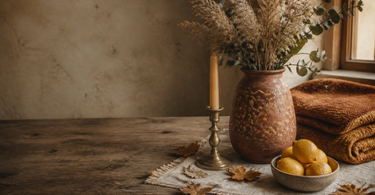
Autumn decorating is all about layering warm colours, natural materials and soft textiles. Switch to rust, burnt orange, burgundy and mustard yellow in September–October, as the light turns more golden. Candles in ceramic holders, a thick rug and dried natural materials in vases are the quickest ways to create the season's mood — without starting from scratch.
The leaves change colour from week to week in September and October, and the light outside becomes more golden and softer. That's exactly the signal that makes so many of us instinctively start bringing out the warm textiles and lighting the first candles. Autumn decorating isn't a complete makeover — it's a layer on top of what's already there. The right decorations, proper colours and a few strategically placed candles can change the entire mood of a room in under an hour.
When should you switch to autumn decorations?
There's no official start date. Most people feel the urge when the mornings noticeably cool down — typically in late August or early September. The light changes character: the angle of the sun gets lower, and daylight takes on a warmer, more amber-ish tone even in the afternoon. That's the moment when summer's white and pale blue decorations start to feel out of place.
Some switch as early as week 35, others wait until October, when darkness really sets in. Both approaches make sense. What matters most is that you respond to the season's actual signals rather than a date on the calendar.
Tip: Pack away your summer decorations in a labelled box when you take them down — that way, they'll be much easier to find again next year. Use the same box to store your autumn decorations for the rest of the year, and jot down which elements worked best while they're still fresh in your memory.
Autumn's colour palette
Autumn's natural colours aren't random — they come from the breakdown of chlorophyll in leaves, which leaves behind carotenoids and anthocyanins. The result is rust, burnt orange, mustard yellow, burgundy and deep moss green. These colours work as a cohesive palette because they share the same warm undertones and relatively saturated pigments.
How to introduce the colours
The easiest way in is through decorative objects that don't require big changes to the room: vases, candlesticks and textiles. A single ceramic vase in a warm earthy colour can serve as the visual anchor for the whole seasonal switch. Fill it with dried branches, pampas grass or the season's flowers like chrysanthemums and dahlias — both hold up well as cut flowers for 10–14 days.
Ceramic plant pot covers with glazes in ochre, terracotta or deep green are another quick trick. They turn an ordinary plastic pot from the garden centre into a decorative object, and you can swap the plant inside throughout the season without changing the cover itself.
Natural materials as free decoration
Pine cones, chestnuts, nuts and dried leaves cost nothing and work as authentic seasonal elements. Place them in flat bowls and dishes on the coffee table or dining table, or use them as place cards at dinner parties. They add texture and scent without costing a thing.
| Colour | HEX reference | Works well with |
|---|---|---|
| Rust / terracotta | ~#B7472A | Off-white, beige, brass |
| Burnt orange | ~#CC5500 | Dark green, grey-brown, black |
| Mustard yellow | ~#E3A857 | Burgundy, deep blue, natural wood |
| Burgundy | ~#722F37 | Cream, copper, dark green |
| Deep moss green | ~#4A5240 | Rust, sandy beige, natural materials |
Candles and candlesticks
No season is as closely linked to candlelight as autumn. This comes down to simple biology: as daylight hours drop from around 14 hours in August to under 10 hours in November, we respond by seeking out artificial light sources that mimic the sun's warm spectrum. Candles with a flame colour temperature of 1,400–1,800 Kelvin do exactly that.
Choose candles in autumn shades — burgundy, cognac, moss green or deep terracotta — rather than the whites that dominate summer. Group them in odd numbers (3 or 5) for a more dynamic look. Height differences of at least 5–8 cm between the candles add depth to the composition.
Choosing candlesticks
The material of the candlestick drastically changes how the light is perceived. Brass and copper reflect and enhance the flame with golden tones. Ceramic with a matte finish absorbs the light and creates a softer, more subdued mood. Cast iron adds weight and contrast.
Ceramic candlesticks with a rustic, handmade finish fit naturally with the autumn aesthetic. A matte glaze in ochre or moss green enhances the organic look and works well grouped together on the dining table or in the windowsill. Place them on a tray for easy moving and to protect the surface underneath.
Rugs and throws
Textiles are the quickest way to change a room's sensory experience. A throw in wool or coarse cotton doesn't just add visual warmth — it subtly changes the acoustics of the room and invites physical contact with the décor.
Draped over the arm of the sofa, the throw is both functional and decorative. Alternatively, you can fold it into thirds and lay it over the back of the sofa, or gather it in a woven basket beside the sofa. All three placements say "this is a good place to sit".
On the floor, a thick, woven rug makes a noticeable difference, especially on hard flooring. A rug under the coffee table visually defines the boundaries of the seating area, dampens sound from hard floor surfaces, and adds an extra layer of insulation that you can actually feel underfoot. Choose textured, woven qualities in natural fibres like wool or jute to keep the organic line.
Tip: As a rule of thumb, a rug should be big enough for the front feet of the sofa's corners to rest on it. This typically means at least 160×230 cm for a standard three-seater sofa. Too small a rug makes the room feel visually disjointed.
Table setting in autumn style
Autumn is the season for long dinners. As it gets dark by 5–6pm, social gatherings naturally move indoors, and the table becomes the focal point of the evening. It makes good sense to set the table with a bit more care than in summer.
Use ceramic plates in earthy colours as your base. Ceramics with visible texture — irregular edges, glaze with variation — suit autumn better than uniform porcelain sets. Combine with cups for warm cider, cocoa or tea, and use natural table decorations: dried leaves, nuts, small pumpkins or pine cones along the centre of the table.
Candles at varying heights along the centre replace the summer flower bouquets. Use fabric napkins in dark shades — burgundy, deep green or mustard yellow — and fold them simply. It doesn't need to be perfect; the relaxed charm is part of the autumn mood.
Dried flowers as long-lasting table decor
Dried flowers and plants last the whole season without water. Pampas grass, gypsophila, wheat stalks and dried hydrangeas all work well in vases of varying sizes. Place one large vase with pampas and a couple of smaller ones with details for a composition that ties the table and the rest of the room together.
How to put it all together
Autumn decor works through layering. Start with colour as the foundation: swap out individual decor items for autumn shades. Then add texture through blankets and throws. Finally, add light sources — candlelight creates the warmth that no LED bulb can fully reproduce in the orange-red spectrum.
Scent is the fifth element many forget. A potpourri of dried orange slices, cinnamon and star anise in a bowl costs next to nothing and instantly sets the season. Alternatively, a scented candle with notes of sandalwood, vanilla or myrrh — the dark, resinous scents naturally suit the cooler season.
Keep it simple and cohesive. Three well-placed decorations in the same colour scheme look far better than ten random items scattered around the room. Choose one anchor point in each room — for example an ornament on the bookshelf or a ceramic vase on the dining table — and let the rest of the decorations play up to it.
Frequently asked questions
When should you switch to autumn decor?
Most people switch in late August or early September, as the mornings turn cooler and the light becomes more golden. There's no fixed date — respond to the season's natural signals rather than a calendar. If you wait until October, darkness has already set in, and the effect of warm candles and textiles is immediately noticeable.
Which autumn colours work best in decor?
Rust, burnt orange, mustard yellow, burgundy and deep moss green are the classic autumn shades. They share warm undertones and work naturally together. Combine them with neutral bases like beige, cream or greyish-brown to keep the balance, so the palette doesn't feel overwhelming.
Can you use natural materials as autumn decor?
Yes — and it's one of the most effective solutions. Pinecones, chestnuts, nuts, dried leaves and branches are free and last the whole season. Place them in bowls, vases or directly on the table. Dried flowers like pampas grass and hydrangeas last without water and work well in any of the room's vases.
How do you avoid autumn decor looking too dark?
Balance is key. Combine the dark autumn tones with light elements: white or cream-coloured candles, lighter textiles as an accent, or glass vases that reflect light. Mirrors can be placed strategically to enhance the available daylight and keep the room bright.
Which type of candlestick suits autumn best?
Ceramic candlesticks with a matte finish give a rustic, organic look. Brass and copper enhance the flame with golden reflections. Cast iron adds weight and contrast. All three materials suit the autumn palette — choose based on the room's existing materials and the look you want to achieve.
How do you use candles safely as autumn decor?
Always place candles on a heat-resistant surface and at least 10 cm from flammable materials. Use a tray under groups of candles to catch wax drips and make it easy to move the arrangement. Always blow out the candles before leaving the room or going to bed.
Summary
Autumn decor doesn't require a complete makeover. It's about adding layers: switching your decor colours to rust, orange and burgundy, bringing out soft textiles and lighting the first candles. Natural materials like pinecones and dried branches are free and set the season quickly. Ceramic candlesticks, warm rugs and a vase of pampas grass are the three elements that give the biggest effect with the least effort. Start with one room — usually the living room — and let the rest follow naturally as the season settles in.
Explore our range of autumn decor and find candlesticks for the season's mood.